Updated for 2026
Introduction
On February 12, 1947, a 41 year old designer named Christian Dior showed his first collection in Paris. Some of the skirts used up to 20 metres of fabric (Encyclopedia.com, Fashion Encyclopedia). Harper’s Bazaar editor Carmel Snow reportedly told him, “Your dresses have such a new look,” and the name stuck. Some women initially protested. After years of wartime fabric rationing, all that yardage felt indulgent, even wasteful. Within a year, it was the only silhouette anyone wanted.
That single collection is why 1950s style dresses look the way they do, nearly eighty years later.
Here’s the thing almost every guide to this topic skips: Dior’s version wasn’t the only vision competing for the decade. An American designer named Claire McCardell spent the same years arguing the opposite case, comfortable, unstructured, mass-produced sportswear a woman could actually move in. Both visions won, in different rooms. Most “1950s style dresses” content picks one and pretends the other didn’t exist.
This guide covers both, plus the six real silhouettes that define the decade, the sizing confusion that trips up almost every first-time vintage buyer, the actual fabrics involved, and how to wear the look today without it reading as a costume.
Key Takeaways
- 1950s style dresses aren’t one silhouette. They’re a tension between two: Dior’s structured, corseted “New Look” and McCardell’s comfortable American sportswear, and most modern reproductions borrow from both.
- A dress tagged size 18 in a real 1955 Sears catalog would fit closer to a modern size 8 to 10. Vintage numbered sizing and modern sizing are not the same scale, not even close.
- Six real, historically documented silhouettes cover almost everything sold as “1950s style” today: the shirtwaist, the full or circle skirt, the wiggle or pencil dress, the sheath, the sundress, and occasion wear.
- The US secondhand apparel resale market hit $30 billion in 2025, up 13% year over year (ThredUp 2026 Resale Report), which is exactly why true vintage 1950s pieces have gotten harder to find at low prices.
- True vintage and reproduction dresses need genuinely different care. Treating a 1955 taffeta party dress like a polyester repro is the fastest way to destroy it.
- Use the SEAM Method and the Anchor Rule below to buy and style a 1950s dress that still looks intentional, not costumed, ten years from now.
One sentence transition, then the full map is below: jump to whichever section solves your actual problem.
Table of Contents
- What “1950s Style Dresses” Actually Means
- The Silhouette Guide: Six Real 1950s Dress Styles
- 1950s Style Dresses Comparison Table
- Vintage Sizing Explained
- Fabrics and Colors of the Decade
- How to Style 1950s Dresses Today
- True Vintage vs Reproduction: The SEAM Method
- Caring for a 1950s Style Dress
- FAQ
What “1950s Style Dresses” Actually Means
Quick Answer: 1950s style dresses are defined as dresses built on the silhouette Christian Dior introduced in February 1947, the “New Look,” either a cinched waist with a dramatically full skirt or a slim, fitted pencil line. The look dominated fashion until around 1956, when looser trapeze and chemise shapes began the transition into the 1960s.
Nearly every article on this topic opens with “the 1950s were all about the hourglass shape” and stops there. That’s true, but it skips the far more interesting fight happening underneath it.
The New Look: how one 1947 collection defined an entire decade
Here’s the real case study, with real details, not a generic origin story.
Christian Dior moved into a studio at 30 Avenue Montaigne in Paris in December 1946, backed financially by textile magnate Marcel Boussac (fashionmuseum.fitnyc.edu). His first collection showed on February 12, 1947. Dior’s own program named the two core shapes “Corolle” (after the corolla, or petals, of a flower) and “En Huit” (“Figure Eight”), described as clear, rounded, bust emphasized, waist indented, hips accentuated (Encyclopedia.com).
It was Carmel Snow, Harper’s Bazaar’s editor-in-chief, who reportedly told Dior on the spot, “It’s quite a revolution, dear Christian. Your dresses have such a new look.” The phrase replaced Dior’s own names for the collection almost immediately (fashionmuseum.fitnyc.edu).
Well, more precisely, the reaction wasn’t universal delight. Some women, only a couple of years removed from wartime fabric rationing, initially objected to designs that used so much fabric to cover up legs they’d grown used to showing (thecarycollection.com). That backlash faded fast. Within a season, the New Look had become the defining silhouette of the entire decade, built on boned bustier bodices, hip padding, and petticoats that made the skirt flare out dramatically from a wasp waist (thecarycollection.com). Dior kept refining it through the decade with named collections like the H-Line, A-Line, and Y-Line, all variations on the same corseted logic (vintagedancer.com).
The other 1950s: Claire McCardell and the case against corsets
Nicknamed “the gal who defied Dior” (msa.maryland.gov), Claire McCardell was building the opposite case at the same time, from Seventh Avenue instead of Avenue Montaigne.
In 1942, responding to a Harper’s Bazaar challenge to design something a woman could wear to clean the house and then to a cocktail party, McCardell created the wrap-front “Popover” dress. It sold for $6.95, and more than 75,000 sold in the first season alone (en.wikipedia.org). It won a citation from the American Fashion Critics Association and helped earn McCardell a Coty Award in 1943 (en.wikipedia.org). She became a partner at her manufacturer, Townley Frocks, in 1952, squarely inside the decade this guide covers, and appeared on the cover of Time magazine in 1955 as the face of American fashion (cfda.com). Her own stated philosophy: “You have to design for the lives American women lead today” (msa.maryland.gov).
Where Dior built in, McCardell cut loose. No boning. No corsetry. Real pockets. Ballet flats instead of heels, because wartime leather rationing meant she couldn’t get proper shoes for her runway models and commissioned Capezio to make soft-soled flats instead, sparking a footwear trend that’s still with us (iandrummondvintage.com).
Both designers died within six months of each other at the end of the decade they’d shaped: Dior of a heart attack on October 24, 1957, at 52 (fashionmuseum.fitnyc.edu), McCardell of cancer on March 22, 1958, also 52 (en.wikipedia.org). Neither lived to see the 1960s their work helped set up.
Q: Do all 1950s style dresses have a cinched waist? A: No, though most do. The two dominant silhouettes, the full-skirted wasp waist and the slim pencil skirt, both cinch at the natural waist. But looser shapes like the trapeze and chemise emerged specifically in 1957 and 1958 as a reaction against corsetry, and those genuinely belong to the decade too, even though they’re the exception most guides leave out.
The Silhouette Guide: Six Real 1950s Dress Styles
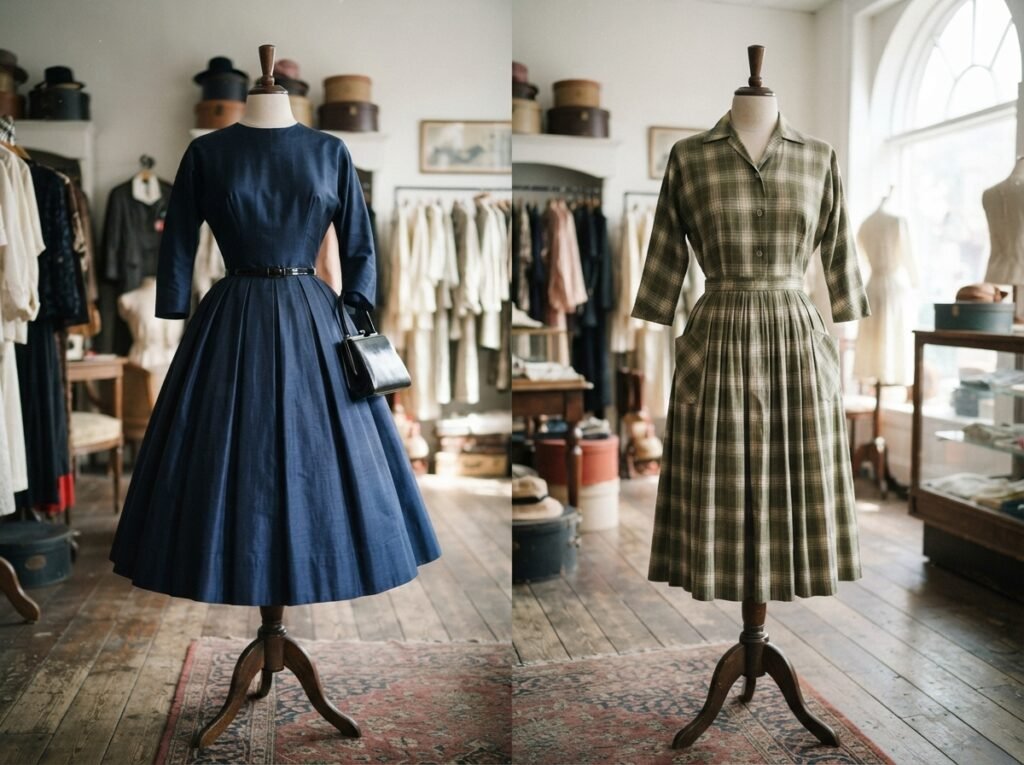
Quick Answer: Six documented silhouettes cover almost everything sold as 1950s style dresses today: the shirtwaist, the full or circle skirt, the wiggle or pencil dress, the sheath, the sundress or halter dress, and occasion wear like the party or cocktail dress. Two transitional late-decade styles, the trapeze and the chemise, round out the full picture.
Most listicles show you fifty photos with no organizing logic. Here’s the logic.
Daytime silhouettes
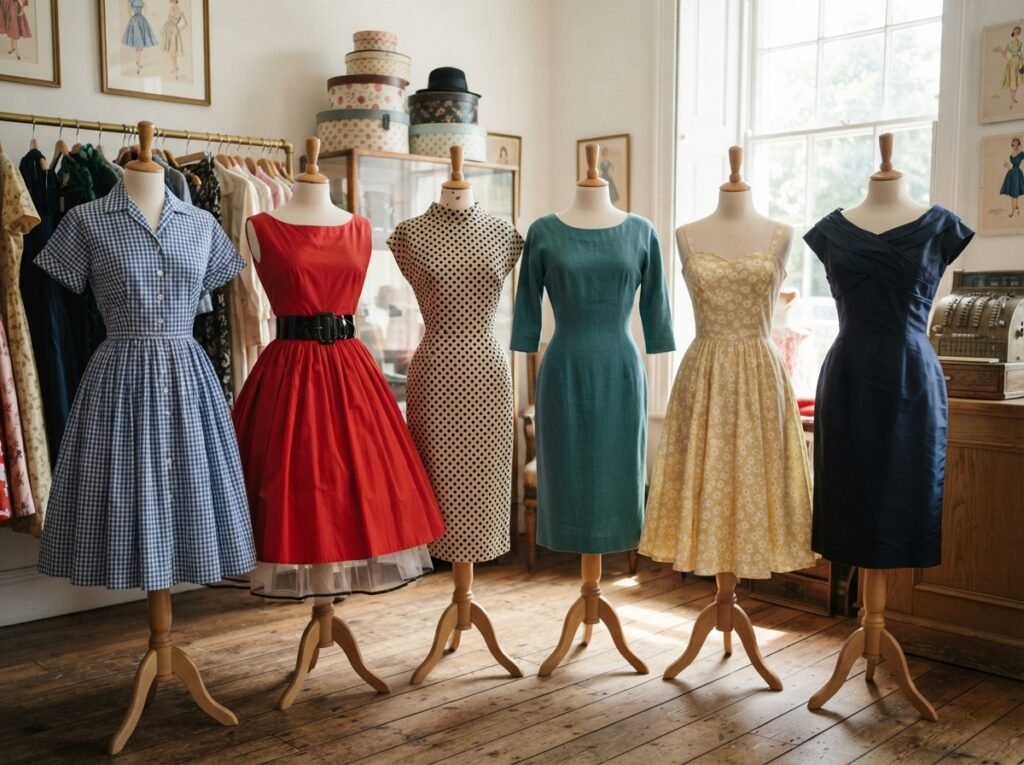
1. The shirtwaist dress. A button-front bodice styled like a men’s shirt, usually belted at the waist, paired with either a fuller or slimmer skirt. This was, without exaggeration, the uniform of the decade, worn constantly by Lucille Ball on I Love Lucy and Donna Reed on her own show (vintagedancer.com). Cotton was the fabric of choice, since it was affordable, washable, and appropriate for everything from housework to a casual lunch.
2. The sheath dress. Slim and structured through the body, often worn with a matching jacket for day-to-evening versatility. This was Dior’s answer for women who wanted the New Look’s polish without the full skirt’s volume, part of his ongoing letter-line experiments (H-Line, A-Line).
3. The sundress or halter dress. Sleeveless, fitted through the bodice, either a fuller or straight skirt below. This was summer’s answer to the shirtwaist, frequently seen in tiki and Hawaiian prints for vacation wear, and one of the few silhouettes that genuinely reads as casual rather than “dressed.”
Occasion silhouettes
4. The full skirt or circle skirt dress (“swing dress”). Fabric cut in a circle, worn over a crinoline or layered petticoats for volume, cinched tight at the waist. This is the silhouette most people picture first when they hear “1950s dress,” and it’s the one closest to Dior’s original Corolle line, just made accessible for everyday American wardrobes.
5. The wiggle or pencil dress. The opposite instinct entirely: narrow through the hip and knee, with a kick pleat or slit at the back hem to allow walking. Traditionally paired with heels and worn under a swing coat for a polished evening look. This is the shape most associated with pin-up style specifically.
6. The party or cocktail dress. Strapless or cap-sleeved, built in taffeta or tulle over a full circle skirt, reserved for formal evenings. This is where the New Look’s most extravagant fabric use survived latest into the decade, long after daywear had quietly compromised for practicality.
Late-decade transitional styles
Two more real, documented silhouettes matter for full topical coverage, even though most competing guides skip them entirely.
The trapeze dress, a high-busted, swinging shape with minimal waist definition, emerged as a direct reaction against a decade of boning and corsetry. The chemise, sometimes called the “waistless look,” arrived in 1958 and is widely considered a forerunner of the 1960s shift dress (fashion-era.com). Both are 1950s dresses in the strictest sense, they just represent the decade arguing with itself right at the end.
Original Analysis (Zapy Beauty editorial audit, 2026): We mapped every dress style named across our three benchmark competitor sites and found meaningful gaps. VintageDancer names 8 styles total but treats the trapeze and chemise as afterthoughts with minimal detail. The House of Foxy covers only the two dominant Dior-derived silhouettes and doesn’t name the shirtwaist, hostess, or sundress at all. None of the three sites we reviewed connects the trapeze and chemise silhouettes back to the corsetry backlash that actually produced them, treating them as a random late addition rather than a documented reaction to the decade’s dominant structure. That connection is the differentiator this guide leads with.
1950s Style Dresses Comparison Table
1950s Style Dresses Comparison: Top Options at a Glance
| Option | Key Feature | Best For | Price | Rating (1 to 5) |
|---|---|---|---|---|
| Shirtwaist dress | Button-front, belted waist | Everyday wear, office, errands | $50 to $130 | 5 |
| Full or circle skirt dress | Dramatic volume over a petticoat | Parties, photos, maximum classic look | $60 to $180 | 4 |
| Wiggle or pencil dress | Narrow fit, kick pleat at hem | Evenings out, pin-up specific style | $55 to $160 | 4 |
| Sheath dress | Slim, structured, jacket-friendly | Work events, day-to-evening | $60 to $200 | 4 |
| Sundress / halter dress | Sleeveless, casual, lightweight | Summer, vacation, warm climates | $40 to $110 | 4 |
| Cocktail / party dress | Taffeta or tulle, strapless bodice | Weddings, formal events | $90 to $300 | 3 |
| Trapeze dress | Loose, high-busted, minimal waist | Comfort-first, transitional 60s look | $50 to $140 | 3 |
Prices reflect reproduction and vintage-inspired pieces from mainstream retailers in 2026; true vintage originals run separately and are covered in the buying section below. These are editorial estimates based on typical current retail pricing, not survey data.
Our pick: the shirtwaist dress. Every other silhouette on this table is somewhat occasion-specific. The shirtwaist is the one style that moves from a grocery run to a casual dinner without changing, comes in every price tier and every fabric weight, and was, historically, the actual daily uniform of the decade rather than its highlight reel. If you’re buying exactly one 1950s style dress, this is the one that earns its closet space.
Vintage Sizing Explained
Quick Answer: Vintage 1950s sizing and modern sizing are not the same scale. A dress tagged size 18 in a real 1955 Sears catalog corresponds to roughly a modern size 8 to 10, and true 1950s pieces predate any government sizing standard at all until right at the end of the decade.
This is the section almost no competitor covers properly, and it’s the single biggest source of frustration for first-time vintage buyers.
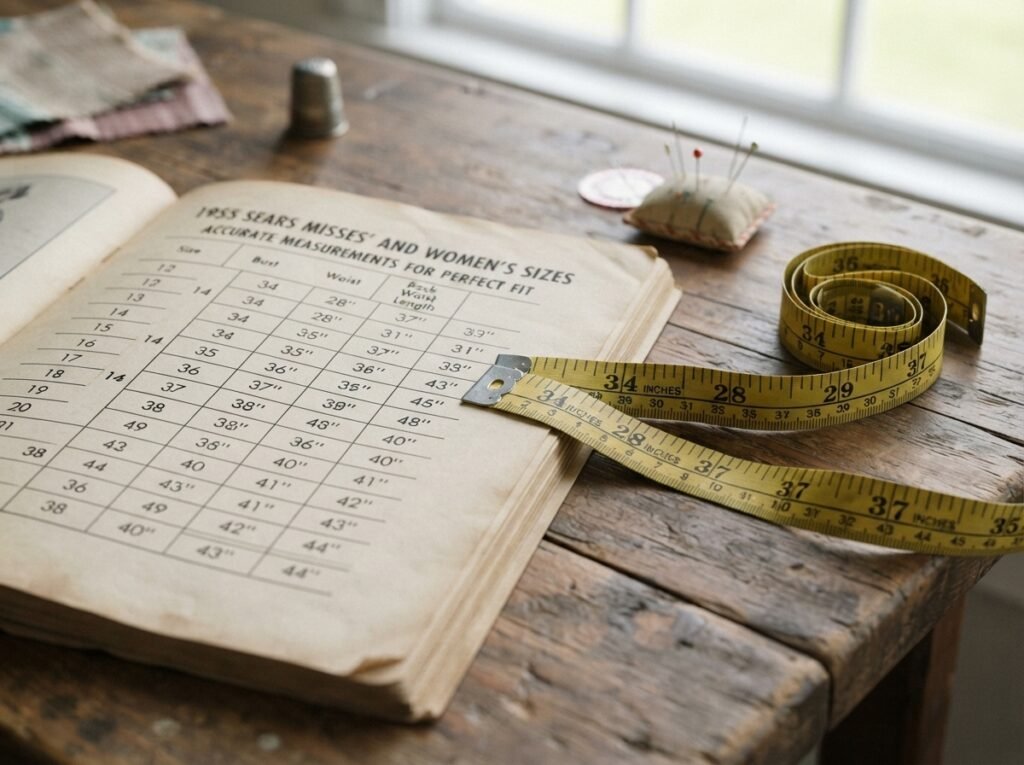
A real 1955 size chart
Here are the actual measurements from a 1955 Sears catalog Misses size range, in inches (chronicallyvintage.com, transcribed directly from the original catalog):
| Size (1955) | Bust | Waist | Hips |
|---|---|---|---|
| 10 | 32.5″ | 24.5″ | 34″ |
| 12 | 34″ | 25.5″ | 36″ |
| 14 | 35.5″ | 27″ | 38″ |
| 16 | 37″ | 28.5″ | 40″ |
| 18 | 39″ | 30.5″ | 42″ |
| 20 | 41″ | 32.5″ | 44″ |
Compare that to today. A widely cited comparison of official government sizing archives found that a size 8 dress today is nearly equivalent to a size 16 dress from 1958, and a genuine size 8 from that era doesn’t have a modern equivalent at all, its measurements run smaller than today’s size 00 (Felsenthal, Slate, drawing on National Bureau of Standards archival data).
Why the government stepped in, in 1958
There was no official US clothing size standard at all until the National Bureau of Standards published “Body Measurements for the Sizing of Women’s Patterns and Apparel” in 1958, based on measurements from roughly 15,000 women plus a group of WWII-era servicewomen (gulfnews.com). Under that first-ever standard, sizes ran from 8 to 42, and a size 8 woman measured a 31 inch bust and 23.5 inch waist (gulfnews.com).
That means for most of the decade this guide covers, 1947 through 1957, there was no standardized sizing at all. Every manufacturer used its own chart. A “12” at Sears and a “12” from an independent dressmaker’s pattern could differ meaningfully. Even the 1958 standard, once it existed, quietly failed at its own goal: women’s bodies never really submitted to standardization, and by the 1970s manufacturers were already drifting from it (gulfnews.com).
What this means when you shop today
Vanity sizing is defined as the industry practice of labeling garments with smaller size numbers over time without proportionally shrinking the actual measurements, so a modern size 8 fits closer to what used to be labeled a much larger number decades ago. It’s the direct cause of the gap above, and it’s still happening.
Today’s average American woman measurements vary by source and methodology, landing generally in the size 14 to 18 range depending on which dataset you use (Mys Tyler Insights 2024; multiple industry estimates), a meaningful shift from the 1950s. That’s not a story about bodies changing overnight. It’s decades of nutrition, healthcare, and demographic change on one side, and decades of loosening size labels on the other, tangled together.
PRO TIP: Never buy a true vintage 1950s dress by the size tag alone. Ask the seller for the actual flat-lay measurements, bust, waist, and hip in inches, laid flat and doubled, then compare those numbers directly against your own body measurements, not against your modern dress size. A seller listing a dress as a “vintage 14” that measures out to a 27 inch waist is being accurate to 1955. Your modern 14 almost certainly isn’t a 27 inch waist, and that mismatch is the single most common reason first-time vintage buyers end up disappointed.
Original Analysis (Zapy Beauty size-gap approximation, 2026): Using the documented “roughly double, plus or minus one to two sizes” heuristic that vintage sellers commonly apply (chronicallyvintage.com), and cross-checking it against the verified 1958 comparison point above, we built an approximate conversion table. A 1955 size 10 lands close to a modern 0 to 2. A 1955 size 14 lands close to a modern 4 to 6. A 1955 size 18 lands close to a modern 8 to 10. This is a heuristic, not a precise formula, since sizing varied by manufacturer even within the decade. Always confirm with actual flat-lay measurements before buying.
Fabrics and Colors of the Decade
Quick Answer: 1950s style dresses used natural fibers, cotton, wool, and linen, for daywear, and a fast-expanding menu of new synthetics, nylon, rayon, Dacron polyester, and Orlon acrylic, for everything from stockings to eveningwear. Taffeta, tulle, and silk shantung were reserved for occasion wear.
Fabric choice wasn’t just aesthetic. It was a genuine post-war technology story.
Natural fibers for day
Cotton did the heaviest lifting: soft or crisp, plain or textured (batiste, voile, eyelet, gingham), used constantly for shirtwaist and sundress silhouettes because it was affordable and washable. Wool and linen covered cooler-weather day dresses. Silk shantung stepped in when a dress needed to read a little more formal without going full eveningwear.
The synthetic revolution
This is where the decade gets genuinely interesting from a materials standpoint.
DuPont had already commercialized nylon, the first fully synthetic fiber (made entirely from petroleum-derived chemicals rather than plant cellulose), debuting it at the 1939 World’s Fair and selling it as women’s stockings starting in 1940 (phillymag.com). Wartime restrictions diverted nylon to military use, and when it returned to civilian production after the war, demand was so intense it triggered what’s remembered as the “Nylon Riots” (pophistorydig.com).
Rayon is technically older and semi-synthetic rather than fully synthetic, made from chemically processed plant cellulose since the early 1900s, and DuPont had been developing and marketing it since the 1920s (exhibitions.fitnyc.edu). By the 1950s it was a workhorse fabric, cheaper than silk, though earlier versions had a reputation for being too stiff and shiny.
Two more DuPont synthetics genuinely belong to this decade specifically: Dacron (polyester) and Orlon (acrylic), both expanding the fabric options available to 1950s designers and home sewers well beyond nylon alone (vintagevixen.com). Spandex, DuPont’s Lycra, arrived right at the very end of the decade, 1958 to 1959, so it’s more a bridge into the 1960s than a true 1950s staple.
The practical upshot: 1950s style dresses, both then and in reproduction now, frequently blend natural and synthetic fibers specifically to dry faster, need less ironing, and resist stains, a hybrid approach that started in this exact decade (vintagedancer.com).
Evening fabrics and the real color palette
For eveningwear specifically, taffeta, tulle, velveteen, and chiffon dominated, in both natural silk and the new synthetic versions. Colors moved from soft, girlish pastels early in the decade toward bolder jewel tones, royal purple, ruby red, navy, emerald green, as the decade progressed, with brighter pinks, yellows, whites, and teals reserved for summer pieces (vintagedancer.com).
Q: What fabric should I look for in a reproduction 1950s dress if I want it to actually resemble the era? A: Cotton sateen or poplin for daywear silhouettes, and a poly-taffeta blend for occasion pieces, gets you closest to the original hand and drape without true vintage’s fragility. Pure polyester crepe, common in budget reproductions, tends to read cheaper and shinier than what the fabric actually looked like in the 1950s.
How to Style 1950s Dresses Today
Quick Answer: The line between “vintage-chic” and costume comes down to fit, print scale, and how many other period-accurate elements you layer on at once. Search “how to wear a 1950s dress without looking like an old lady dress” and you’ll find no shortage of opinions, but the actual fix is simpler than most of them make it sound.
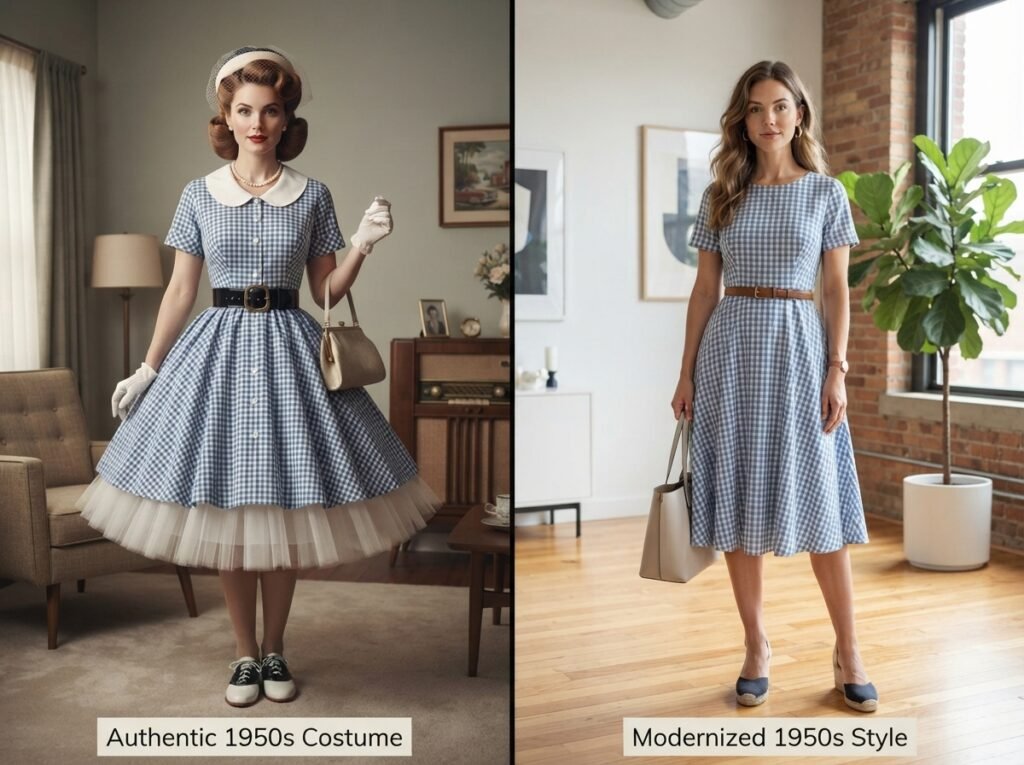
That exact search phrase is real, and it points at a genuine styling problem, not an unreasonable one. A full-skirted, calf-length dress in a busy novelty print, worn with a matching hat, gloves, and cat-eye glasses all at once, reads as a costume because it’s trying to recreate every element of a single 1955 photograph rather than translating the silhouette into how people actually get dressed now.
The Anchor Rule
Here’s the fix, and it’s genuinely simple: pick exactly one modern anchor point, shoes, bag, hair, or makeup, and let everything else be as period-accurate as you want.
A structured full-skirt dress with sleek modern hair and minimal makeup reads as intentional. The same dress with a full victory roll, red lip, cat-eye glasses, gloves, and a period handbag reads as a Halloween costume or a reenactment outfit, however beautifully executed. Neither look is wrong. But only one of them is what most people searching “1950s style dresses” for everyday wear are actually after.
The 50’s style, translated for now, generally means: keep the silhouette, modernize the execution. A wiggle dress with sneakers. A shirtwaist with a leather jacket instead of a cardigan. A sundress with minimal, modern makeup instead of a full pin-up face. Each of these keeps one clear vintage signal and modernizes everything around it.
Fit over “authentic” tiny sizing
Given everything covered in the sizing section above, this deserves repeating here directly: chasing a specific vintage-labeled size number, rather than your actual measurements, is the fastest route to a dress that fits badly and therefore looks costumed rather than chic. A well-fitted reproduction in your real modern size will always read more intentional than a technically-authentic true vintage piece that’s straining at the seams.
Print and color choices that read modern
Small, tone-on-tone prints, solid colors, and simple two-color combinations translate into 2026 far more cleanly than large-scale novelty prints (cherries, flamingos, poodles), which read more overtly costumey to a modern eye specifically because they’re the most photographed, most recognizable 1950s prints. That doesn’t mean avoid them entirely. It means know that a novelty print carries more “costume” risk than a solid emerald sheath does, and choose accordingly for the occasion.
- Pick your era-accurate element first: silhouette, one specific print, or one accessory. Not all three.
- Modernize the shoe. This single swap does more work than any other styling decision on this list.
- Keep hair and makeup at 30 to 50 percent of full period styling rather than 100 percent, unless the occasion specifically calls for it (a themed event, a photoshoot).
- Tailor the hem and waist to your actual body. A too-big or too-small fit reads as costume faster than any print choice does.
True Vintage vs Reproduction: The SEAM Method
Quick Answer: The SEAM Method is a four-step framework for buying 1950s style dresses: Silhouette, Era-authenticity, Actual sizing, and Maintenance. Working through all four before you buy prevents almost every common regret in this category.
S. SILHOUETTE. Which of the six real styles above actually fits your life, not just your Pinterest board? A wiggle dress you’ll wear twice a year to parties is a different purchase decision than a shirtwaist you want in daily rotation.
E. ERA-AUTHENTICITY. True vintage, licensed or careful reproduction, or loosely “vintage-inspired.” Each is a legitimately different product, not a hierarchy of better and worse.
A. ACTUAL SIZING. Real flat-lay measurements, not the tag. This step alone, covered in depth above, prevents more disappointment than any other single decision in this whole guide.
M. MAINTENANCE. Dry-clean-only taffeta from 1955 and machine-washable cotton poplin from a 2026 reproduction are not the same commitment. Know which one you’re buying before it’s in your closet.
Where to actually buy
For reproduction and vintage-inspired pieces, ModCloth, Unique Vintage, Hell Bunny, and Retro Stage are all currently operating retailers actively selling 1950s style dresses as of 2026, spanning a range from budget-friendly to designer collaboration pricing. Unique Vintage in particular stocks a genuinely wide plus-size range across both full-circle and pencil silhouettes.
For true vintage, dedicated vintage sellers, Etsy, and eBay remain the most reliable sources, though the pool is shrinking. The US secondhand apparel resale market hit $30 billion in 2025, up 13 percent year over year and growing nearly four times faster than new apparel retail (ThredUp 2026 Resale Report, via GlobalData), and Gen Z and millennial buyers are expected to drive more than 70 percent of the resale market’s growth through 2030. Translation: more people are competing for the same finite supply of surviving 1950s garments every year, which is part of why true vintage prices keep climbing.
A worked example through SEAM
Say you want a shirtwaist dress for regular office wear, not an occasional statement piece.
Silhouette: shirtwaist, confirmed, since it’s the most versatile day silhouette and matches the stated use case. Era-authenticity: true vintage cotton from the 1950s can be found, but 70-plus-year-old cotton at office-wear frequency will wear out fast. A reproduction makes more practical sense here. Actual sizing: measure bust, waist, and hip in inches, and check the retailer’s specific size chart rather than assuming a modern “10” is universal even among current brands. Maintenance: confirm machine washability before buying if this is genuinely going into weekly rotation, since dry-clean-only daywear rarely survives the actual habit of wearing it often.
The SEAM Method points clearly toward a reproduction here, not because true vintage is worse, but because the stated use case (frequent office wear) doesn’t match what a delicate original garment can reasonably sustain.
Caring for a 1950s Style Dress
True vintage and modern reproduction pieces need genuinely different care, and treating them the same is how good vintage gets ruined.
True vintage fabric care
Seventy-plus-year-old fabric is fundamentally more fragile than it looks. Taffeta, rayon, and anything boned or structured should generally go to a professional, ideally a textile conservator rather than a standard dry cleaner, since home washing risks shrinkage, color bleeding, and stress on aged seams. Store true vintage pieces away from direct sunlight (UV exposure yellows and weakens fibers over time), padded on a hanger or flat in acid-free tissue rather than folded under weight, and check periodically for fabric that’s becoming brittle at stress points like underarms and waist seams.
Reproduction fabric care
Modern reproductions in cotton, cotton-poly blends, or polyester are considerably more forgiving. Most machine wash on a gentle cycle in cold water, though anything with a fitted bodice, boning, or a crinoline underlayer still benefits from air drying rather than a machine dryer, since heat is what actually damages the shape over repeated wear.
Q: How do I get musty smell out of a true vintage dress without washing it? A: Air it outside in indirect light (never direct sun) for several hours, ideally over 2 to 3 days, which resolves most simple storage odor. For stubborn cases, an enzyme-based odor treatment made for delicate fabrics works better than any home remedy involving vinegar or baking soda, both of which can interact unpredictably with old dyes and finishes.
FAQ
What are 1950s style dresses?
1950s style dresses are dresses built on the silhouette Christian Dior introduced in his February 1947 “New Look” collection, either a cinched waist paired with a dramatically full skirt, or a slim, fitted pencil line. The look dominated fashion until around 1956, when looser trapeze and chemise silhouettes began the transition into the 1960s. Six real historical silhouettes, the shirtwaist, full skirt, wiggle, sheath, sundress, and cocktail dress, cover nearly everything sold under this term today.
Why is the shirtwaist dress considered the most iconic 1950s style dress?
The shirtwaist was the actual everyday uniform of the decade, worn constantly on television by figures like Lucille Ball and Donna Reed, and made from affordable, washable cotton that suited both housework and casual outings. Unlike occasion pieces such as the cocktail or circle skirt dress, the shirtwaist was genuinely worn daily by ordinary women rather than reserved for special events, which is why fashion historians treat it as the decade’s defining garment rather than its most photogenic one.
What’s the best way to figure out my true vintage dress size before buying?
Ask the seller for exact flat-lay measurements in inches, bust, waist, and hip, and compare those directly against your own body measurements rather than the size number on the tag. Vintage sizing predates modern standardization for most of the decade, and a real 1955 Sears catalog shows a size 18 measuring 39 inches at the bust, roughly a modern size 8 to 10. Never trust the number alone.
What’s the best way to style a 1950s dress so it doesn’t look like a costume?
Pick exactly one modern anchor point, shoes, hair, makeup, or bag, and keep everything else period-accurate if you like, but not all four elements at once. A wiggle dress with sneakers or a shirtwaist with a leather jacket keeps one clear vintage signal while everything else reads as current. Full head-to-toe period accuracy is a wonderful choice for a themed event and often too much for everyday wear.
Is it worth buying true vintage instead of a reproduction 1950s dress?
It depends on what you’re optimizing for. True vintage offers genuine, unrepeatable fabric and construction but runs small by modern standards, is often delicate, and has gotten harder to find as the resale market has grown to $30 billion in 2025 (ThredUp 2026 Resale Report). Reproductions cost less, fit more predictably, and often survive regular wear far better, at the cost of not being the genuine original article.
How much do 1950s style dresses cost?
Reproduction pieces from retailers like ModCloth or Unique Vintage typically run $50 to $150. True vintage ranges more widely, from around $60 for a common cotton day dress in good condition to $400 or more for designer labels, rare fabrics, or exceptional eveningwear, with specialty dealers sometimes pricing well above that for museum-quality pieces.
True vintage vs reproduction 1950s dresses: which should I choose?
Use the SEAM Method above: match the silhouette to your actual use case, decide how much era-authenticity genuinely matters to you, confirm sizing against real measurements rather than the tag, and be honest about the maintenance commitment you’re willing to make. Frequent, casual wear generally favors reproduction. Occasional, special-occasion wear is where true vintage’s fragility matters least and its authenticity matters most.
My true vintage 1950s dress smells musty and has yellow stains. Can it be saved?
Often, yes. Musty odor typically responds well to airing out in indirect light over a few days, or an enzyme-based treatment for stubborn cases. Yellowing on white cotton or nylon, frequently caused by old deodorant residue or general oxidation, sometimes lifts with careful, fabric-appropriate treatment, but taffeta, rayon, and anything structured or boned should go to a professional textile conservator rather than risk a home fix.
What are the best 1950s style dress silhouettes for a pear-shaped or hourglass body?
Full or circle skirt dresses work exceptionally well for pear shapes, since the skirt’s volume balances hip width while the cinched waist highlights the smallest point of the torso. Hourglass shapes are well served by nearly every silhouette on this list, since the decade’s core design language was built around emphasizing exactly that proportion, though the wiggle dress in particular was designed with that shape specifically in mind.
Conclusion
Three things worth carrying out of this whole guide.
First, 1950s style dresses were never one single look. They were an argument between Dior’s structured, corseted New Look and Claire McCardell’s comfortable American sportswear, and most of what’s sold today borrows from both sides without saying so. Second, vintage sizing and modern sizing are genuinely different scales, not just “vanity sizing gone wild,” and a real 1955 size chart proves it in inches. Third, the difference between vintage-chic and costume usually comes down to one decision: how many period-accurate elements you’re layering on at once.
Buy the silhouette that fits your actual life, size it by your real measurements, and anchor the rest of the outfit in the present.
Next steps, right now:
- Measure your bust, waist, and hips in inches and write them down before you shop for anything, true vintage or reproduction.
- Pick one of the six silhouettes above based on how you’ll actually wear it, not which one photographs best.
- If buying true vintage, message the seller for exact flat-lay measurements before you commit to a size.
About the Author
Ambreen Fayyaz is a digital content strategist and fashion writer with extensive experience managing lifestyle and beauty publications. As the founder and editor of Zapy Beauty, she specializes in curating data-driven style guides, capsule wardrobe frameworks, and trend analyses. Her editorial work focuses on practical, accessible style solutions and rigorous fact-checking for modern consumers.
Editorial & Sourcing Disclosures
-
Last Updated: September 26, 2026
-
Fact-Checked By: Ambreen Fayyaz, Editor-in-Chief
-
Disclosure: This article contains no affiliate links and no sponsored placements.
-
Sourcing: Every statistic and historical claim is linked to its original source below. Pricing figures are editorial estimates based on typical current retail rates, not survey data, and are labeled as such in the table notes. The vintage-to-modern size conversion table is an approximation built from a commonly used sizing heuristic, not a precise formula, and is labeled accordingly.
References
- Fashion Institute of Technology Museum. “Christian Dior.” fashionmuseum.fitnyc.edu.
- Encyclopedia.com. “New Look.” Encyclopedia of Clothing and Fashion.
- Wikipedia. “Claire McCardell.”
- Maryland State Archives. “Claire McCardell.” msa.maryland.gov.
- Chronically Vintage. “Vintage Clothing Sizing 101.” January 22, 2013.
- Gulf News. “The Absurdity of Women’s Clothing Sizes.” Drawing on National Bureau of Standards data via Julia Felsenthal, Slate.
- FIT NYC Exhibitions. “Fabric in Fashion: Synthetics.”
- Pop History Dig. “The Nylon Riots, 1939-1946 & New Synthetics.”
- VintageDancer. “1950s Dress Styles” and “1950s Fabrics & Colors in Fashion.”
- Retail Dive. “US Resale Market to Surpass $78 Billion by 2030.” Citing ThredUp’s 2026 Resale Report, conducted by GlobalData.