
Updated for 2026 | Last Updated: September 30, 2026 | Fact-checked by: Ambreen Fayyaz | Disclosure: This post contains no affiliate links.
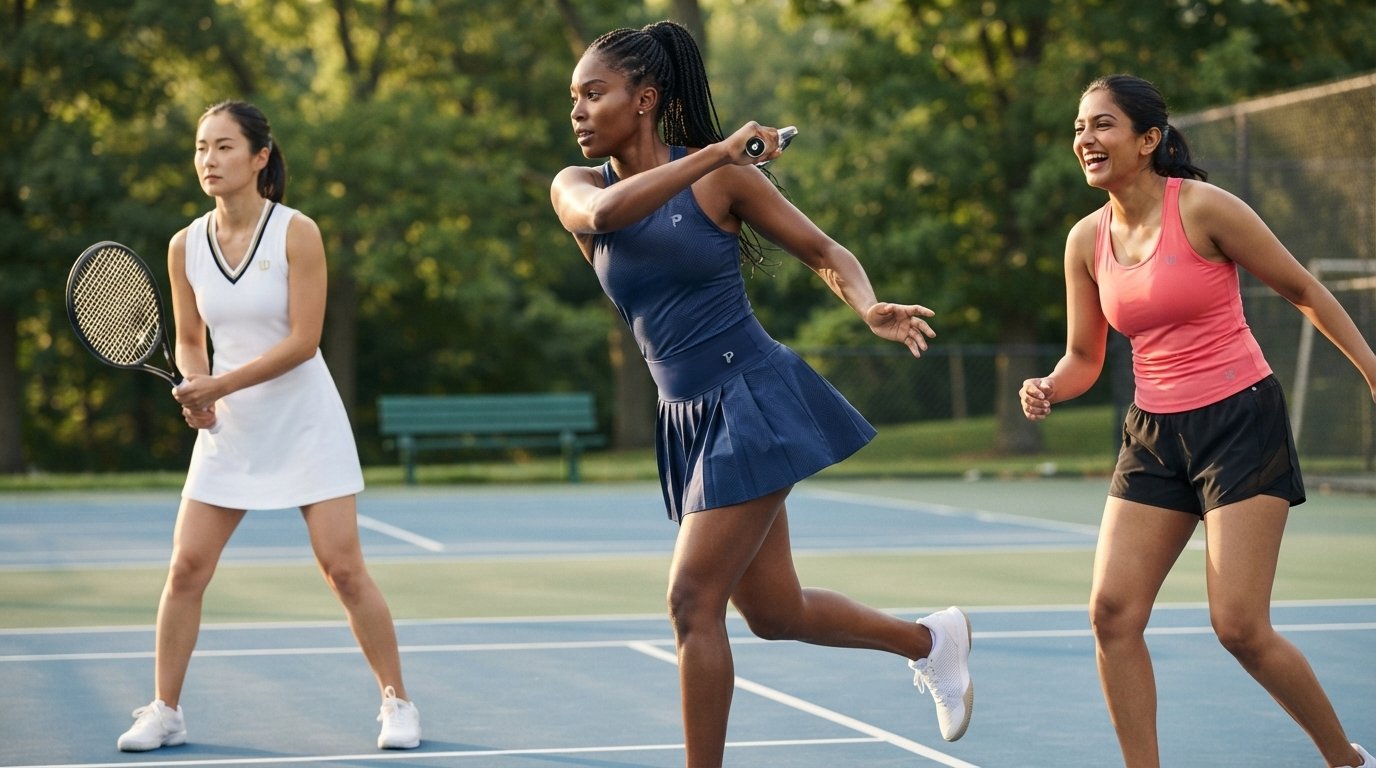
Tennis participation in the United States hit 25.7 million players in 2024, the sport’s fifth straight year of growth (USTA, 2025). A lot of those players are women picking up a racket for the first time in years. And most of them make the same mistake on their first shopping trip: they buy cute, not functional.
Women’s tennis attire isn’t just athleisure with a racket logo. The fit, the fabric and even the seam placement change how you move, how long you stay cool, and whether you can raise your arm for a serve without your top riding up.
This guide covers what actually matters: fit by body type, fabric science, real dress code rules, and where to spend versus save.
Key Takeaways
- Women’s tennis attire needs four-way stretch fabric, not just any athletic fabric.
- Built-in shelf bras and compression shorts solve most of the “what do I wear underneath” question.
- Club and tournament dress codes vary a lot; check before you buy an entire white wardrobe.
- UPF-rated fabric matters more than most players realize for outdoor courts.
- You don’t need to spend over $100 per piece to get a good fit.
- Skirts, dresses and shorts all work; the right choice depends on your swing style, not just looks.
Let’s start with what actually separates tennis clothing from regular activewear.
Table of Contents
- What Is Women’s Tennis Attire? (Updated for 2026)
- Fabric and Fit: What Separates Tennis Clothes From Regular Activewear
- Dress Codes: When You Actually Need White
- Skirts vs Dresses vs Shorts: Choosing by Body Type and Swing
- Sun Protection and Weather: Dressing for Outdoor Courts
- Women’s Tennis Attire Comparison: Top Options at a Glance
- FAQ
- References
What Is Women’s Tennis Attire? (Updated for 2026)
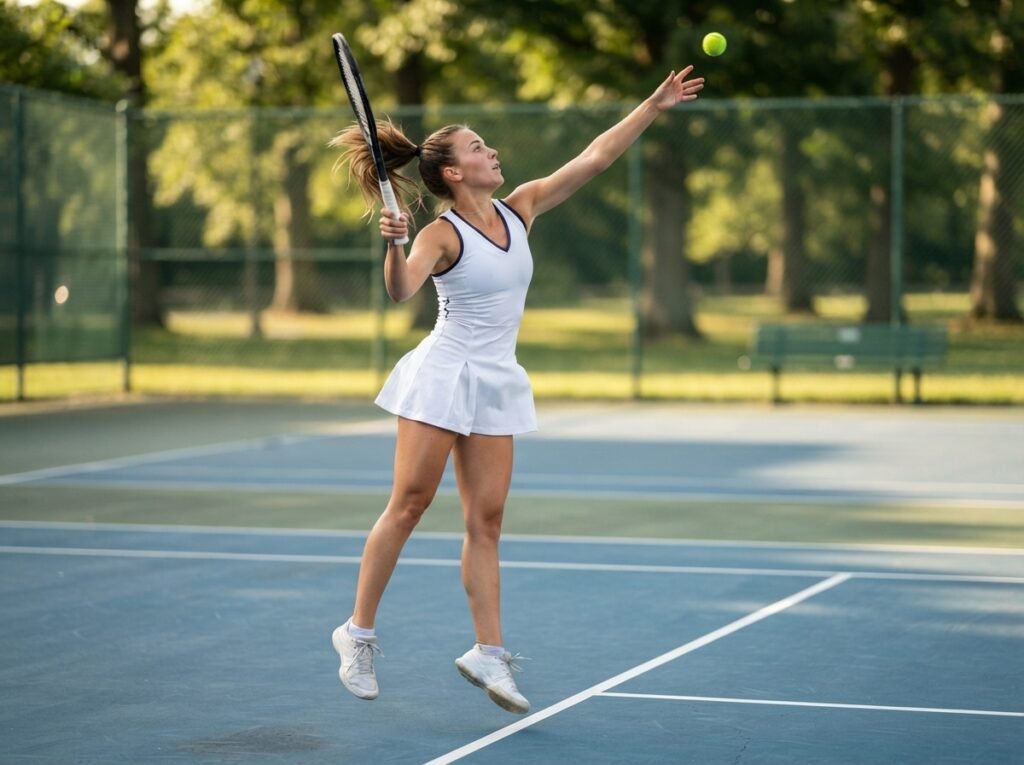
Quick Answer: Women’s tennis attire is defined as clothing designed for the specific movement patterns of tennis: overhead serves, lateral lunges and quick sprints. It combines stretch fabric, built-in support and a cut that won’t restrict a swing.
Why regular workout clothes don’t quite work
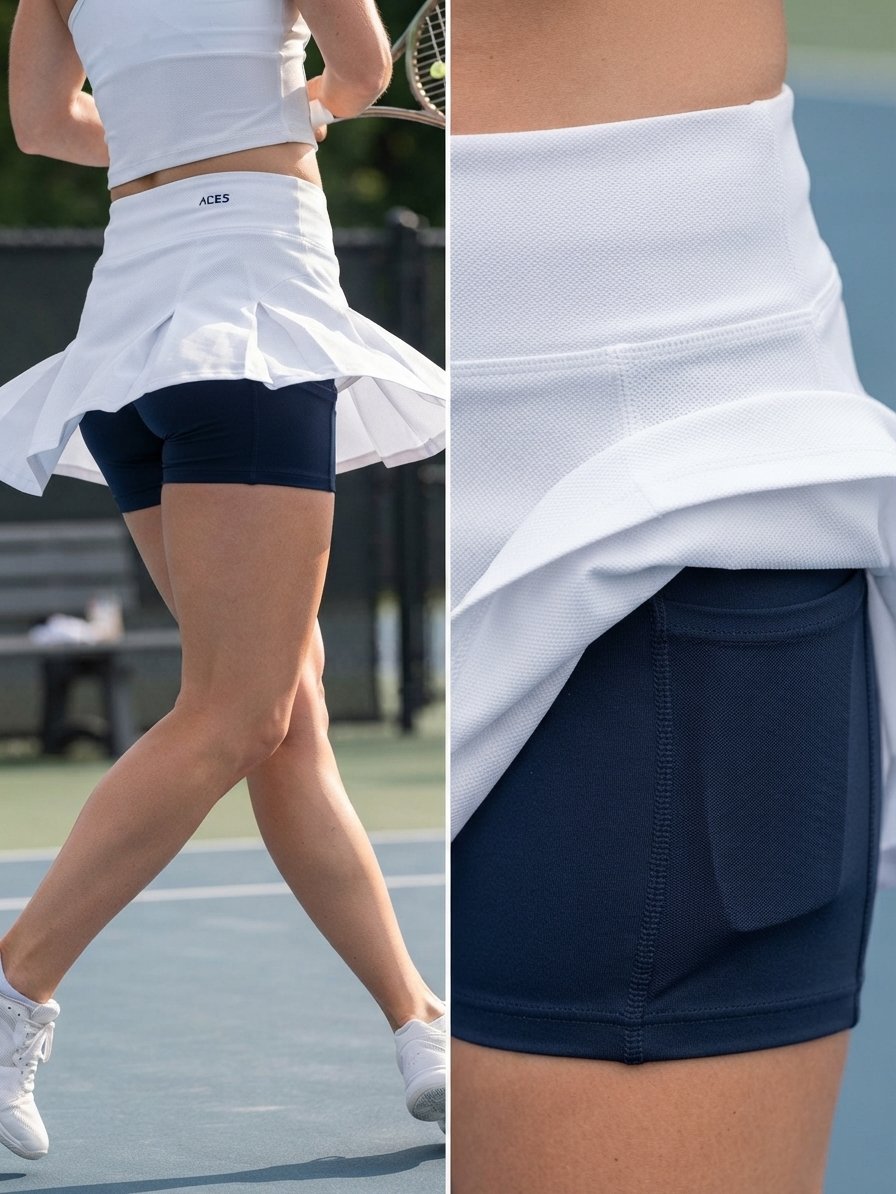
A yoga legging is built for stillness and stretch in one direction. A running top is built for forward motion. Tennis asks for something different: rotation through the core, a full overhead reach, sudden stops. That’s why women’s tennis attire is cut with four-way stretch, not two-way, and why the waistbands sit differently than what you’d wear to the gym.
Honestly, most guides skip this part. They show you cute outfits without explaining why a $70 tennis dress moves better than a $70 sundress that “looks athletic.”
The rise of tennis participation and what it means for shopping
Tennis participation in the US grew 8% in 2024 alone, and players under 35 drove nearly two thirds of that growth (USTA, 2025). More new players means more entry-level product on the market, but also more noise. Brands know beginners are shopping, so marketing leans hard on aesthetics over function.
| Feature | Regular Activewear | Tennis-Specific Attire |
|---|---|---|
| Stretch direction | Often two-way | Four-way stretch standard |
| Built-in support | Rare | Shelf bra or compression liner common |
| Pocket placement | Side or none | Waistband pockets for a second ball |
| Underarm mobility | Limited in fitted tops | Cut for full overhead reach |
| Skirt liner | Not applicable | Built-in shorts standard on tennis skirts |
Semantic fact: Women’s tennis attire reduces mid-match adjustments by combining a built-in liner with the outer garment, so players stop pulling at shorts or skirts between points.
Pro Tip: If you’re trying on a tennis dress for the first time, don’t just check it standing still. Raise both arms overhead and mimic a serve motion in the fitting room. If the hem rides up past a comfortable point, size up or try a different cut.
Fabric and Fit: What Separates Tennis Clothes From Regular Activewear
Quick Answer: The best fabric for women’s tennis attire is a polyester-spandex or nylon-spandex blend with moisture-wicking finish, because it dries fast, stretches four ways and holds its shape through a full match.
Reading a fabric label the right way
Most tennis apparel women’s lines use a blend around 85 to 90 percent polyester or nylon with 10 to 15 percent spandex or elastane. The spandex percentage is what gives four-way stretch. Below about 8 percent spandex, a garment stretches but won’t recover its shape well after repeated lunges.
Fit by body type
Tennis clothes women shop for aren’t one silhouette. A structured, higher-compression skirt works well for players who want less bounce during sprints. A looser, A-line skirt suits players who prioritize airflow over compression. Neither is “correct.” It’s a comfort and playstyle choice.
- Try the garment on and do a full lunge to each side.
- Raise your arms overhead as if serving.
- Sit down for a moment, since some skirts ride up when seated on a bench.
- Check the waistband for digging after a few minutes, not just at first fit.
- Walk, don’t just stand, to check for chafing at inner thighs.
Pro Tip: If a brand offers a “regular fit” and an “athletic fit” in the same style, athletic fit usually means shorter torso length and tighter through the hip, built for players who move a lot rather than players who want more coverage.
Female Tennis Clothes: entry-level vs performance-level differences
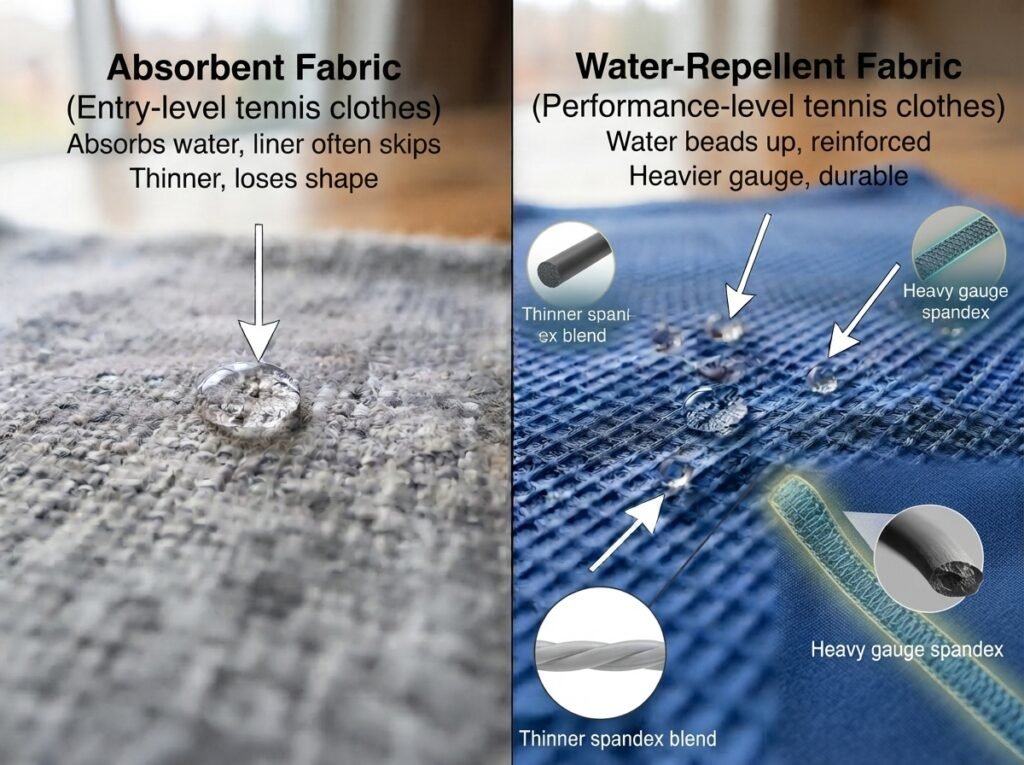
Female tennis clothes at entry price points (under $40) often skip the compression liner or use a thinner spandex blend that loses shape after 15 to 20 washes. Performance-level pieces (generally $60 and up) use heavier gauge spandex and reinforced seams at stress points like the underarm and inner thigh.
Dress Codes: When You Actually Need White
Quick Answer: Most public courts and recreational leagues in the US have no color requirement for women’s tennis attire. Some private clubs and specific tournaments, most famously Wimbledon, require all-white or predominantly white clothing.
The Wimbledon rule, and why it exists
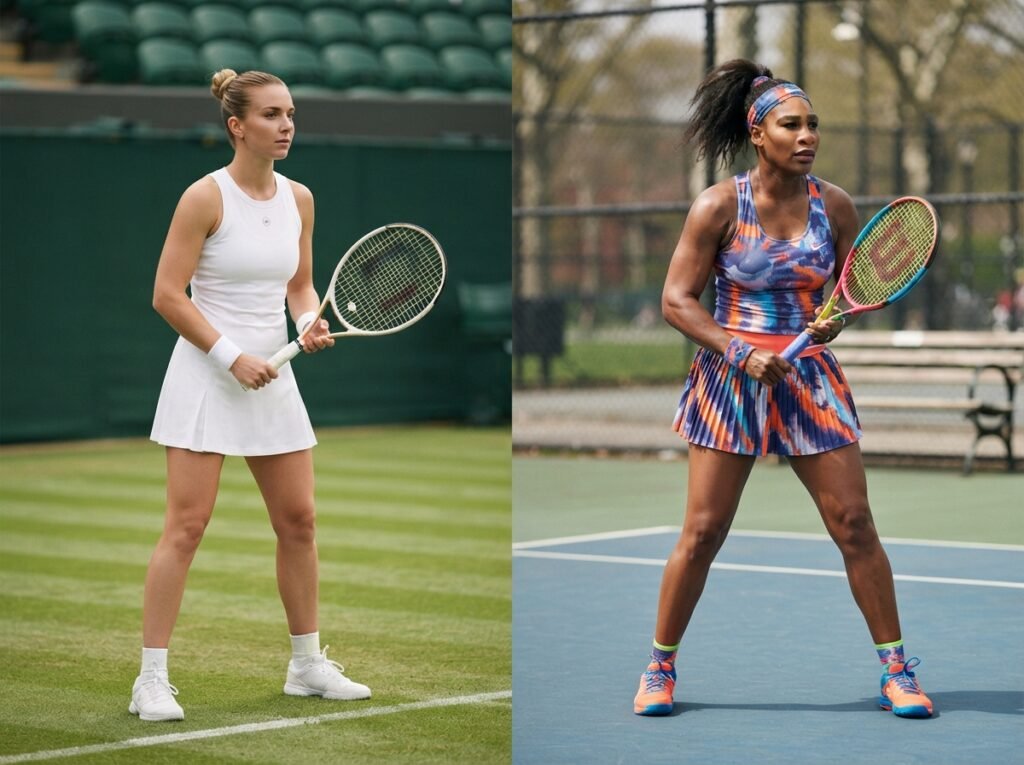
Wimbledon’s dress code requires players to dress almost entirely in white, and the rule is strict enough that the referee can require a player to change outfits (Mental Floss, All England Club history). The custom traces back to the 1800s, when tennis was a genteel social sport and sweat stains on colored fabric were considered improper.
That rule applies to professional play at Wimbledon. It doesn’t apply to your local courts. But here’s the twist: some private US clubs still carry a “whites only” or “predominantly white” policy as a holdover tradition, especially older country clubs in the Northeast.
Definition block
A tennis dress code is defined as a club or tournament’s written rule about acceptable on-court clothing, covering color, coverage, and sometimes brand logos. Public parks departments and most municipal courts have no dress code at all.
How to check before you buy
- Call or check the website of the specific club or league you’ll be playing at.
- Look for the phrase “predominantly white” versus “all white,” since the rules differ in strictness.
- Ask if the rule applies to practice sessions or only sanctioned matches.
- If you’re traveling to play at a new club, ask a member rather than assuming.
Pro Tip: If you split time between a public court and a private club with a white-only policy, buy one or two white pieces you can mix into your regular rotation, rather than a whole separate wardrobe.
Original framework: The Court Code Check. Before any first-time purchase for a new venue, run three checks: color rule, length or coverage rule, and logo or brand rule. Most dress code violations happen because a player checked only one of the three.
Skirts vs Dresses vs Shorts: Choosing by Body Type and Swing
Quick Answer: Skirts suit players who want visible built-in shorts and a classic look. Dresses suit players who prefer a single garment with no separate top to manage. Shorts suit players who want maximum range of motion with zero skirt movement.
Ladies Tennis Clothing: comparing the three main silhouettes
| Silhouette | Best For | Comfort Level | Styling Ease | Typical Price Range |
|---|---|---|---|---|
| Tennis skirt + top | Players who like mixing colors | High | Medium (two pieces) | $30 to $70 per piece |
| Tennis dress | Players who want a grab-and-go outfit | High | Very high (one piece) | $50 to $110 |
| Tennis shorts + top | Players who sprint a lot or dislike skirts | Very high | Medium | $25 to $60 per piece |
| Skort (skirt with attached shorts, no separate liner) | Players between a skirt and shorts preference | High | High | $35 to $75 |
| Pleated tennis skirt | Players who want more coverage during lunges | Medium high | Medium | $40 to $80 |
Womens Tennis Clothes for specific swing styles
A two-handed backhand needs more shoulder and torso rotation room than a one-handed backhand. If your swing is compact and fast, a fitted tank works fine. If you play with a big shoulder turn, a slightly looser cut through the torso avoids fabric pulling mid-swing.
Well, more precisely, it’s not just about swing size. Court surface matters too. Clay courts mean more sliding and dirt, so darker or patterned pieces hide staining better than pure white.
Pro Tip: If you’re deciding between a dress and a skirt-and-top combo for your first purchase, go with the dress. It’s one less decision on game day, and most beginners find the built-in support easier to manage than coordinating separates.

Sun Protection and Weather: Dressing for Outdoor Courts
Quick Answer: Women’s tennis attire for outdoor play should carry a UPF rating of at least 30, since a UPF 30 fabric blocks roughly 96.7% of UV radiation compared to about 93% for a lower-rated fabric.
Understanding UPF in plain terms
UPF, or Ultraviolet Protection Factor, refers to how much of the sun’s UV radiation a fabric blocks. A garment must reach a UPF of at least 30 to earn the Skin Cancer Foundation’s Seal of Recommendation, and UPF 50+ is rated excellent, blocking about 98 percent of UV rays (Skin Cancer Foundation).
A plain cotton T-shirt, by contrast, offers very little built-in protection, which is part of why tennis-specific tops are worth the extra cost if you play outdoors regularly.
Semantic fact
UPF 50+ fabric blocks about 98 percent of UV radiation, compared to roughly 93 percent for UPF 15 fabric. That six-point gap matters over a two-hour match in direct sun.
Dressing for heat, cold and wind
- In heat above 85°F, choose lighter colors and looser weaves to help airflow, even with a good UPF rating.
- In cooler weather, layer a UPF long-sleeve over your usual top rather than switching to non-tennis fabric.
- On windy days, a fitted skort beats a flowy skirt, since loose fabric catches wind mid-swing.
- Always check the UPF label if the piece doesn’t state a rating; not all “outdoor” activewear is UV-tested.
Q&A pair: Does a higher UPF rating cost more? Usually yes, by a small margin, since UV-tested and rated fabric requires lab certification that adds to production cost. The difference is often $5 to $15 per piece.
Pro Tip: Keep a lightweight UPF layer in your bag even on cloudy days. UV rays pass through cloud cover more than most players expect.

Women’s Tennis Attire Comparison: Top Options at a Glance
| Option | Key Feature | Best For | Price | Rating |
|---|---|---|---|---|
| Lululemon tennis skirt style pieces | Structured compression liner | Players who want higher-end fit | $68 to $98 | [ADD] |
| Lacoste tennis dress | Classic tailored cut, brand heritage | Players who want a traditional look | $130 to $200 | [ADD] |
| Budget big-box brand sets | Lower cost, decent basic fit | First-time buyers testing the sport | $25 to $45 | [ADD] |
| Mid-range specialty tennis brand | Balance of price and performance fabric | Regular weekly players | $50 to $85 | [ADD] |
| UPF-focused sun brand | Highest UV protection rating | Frequent outdoor, high-sun climates | $55 to $90 | [ADD] |
Our pick: For most beginners, a mid-range specialty tennis brand offers the best balance of fit and price. Save the premium brands for once you know your preferred silhouette and swing style.
FAQ
1. What counts as women’s tennis attire? Women’s tennis attire is clothing built for on-court movement, usually a moisture-wicking top paired with a skirt, dress or shorts that include built-in support. It’s designed for overhead reaches, sprints and lateral lunges specifically.
2. Do I need white clothes to play tennis? No, unless your specific club or tournament requires it. Most public courts and recreational leagues in the US allow any color, while some private clubs and events like Wimbledon require white or mostly white clothing.
3. How is tennis apparel different from regular gym clothes? Tennis apparel uses four-way stretch fabric and built-in liners designed for rotational movement and overhead reaches. Regular gym clothes are often built for one direction of movement, like running or lifting, so they can restrict a tennis swing.
4. Is expensive tennis clothing actually worth it? It can be, mainly for fabric durability and fit consistency over time. Budget pieces often work fine for casual, occasional play, but frequent players tend to notice better shape retention and comfort in mid to premium price ranges.
5. What’s the best way to choose between a tennis skirt and a tennis dress? Choose a dress if you want a single, grab-and-go outfit with no separate pieces to coordinate. Choose a skirt and top if you like mixing colors or want to change just one piece between matches.
6. How much does a full women’s tennis attire outfit cost? Expect roughly $60 to $150 total for a complete outfit including a top and skirt or dress, as of 2026, depending on the brand tier. Shoes are a separate cost, typically $60 to $150 more.
7. What’s the best way to know if a tennis outfit will hold up over many washes? Check the spandex percentage on the fabric label; a blend under 8 percent spandex tends to lose shape faster. Reinforced seams at the underarm and inner thigh are also a good sign of a longer-lasting piece.
8. Tennis dress vs skort: which should I pick? Pick a dress for simplicity and a single fitted garment. Pick a skort if you prefer separating your top choice from your bottom choice, or if you run warm and want a looser top option.
9. Why does my tennis skirt ride up during play? This usually means the built-in liner is too small or the fabric has lost its recovery stretch from repeated washing. Try sizing up the liner specifically, or replace pieces once the fabric stops snapping back to shape.
10. Is UPF-rated clothing necessary for indoor tennis? No, UPF rating only matters for outdoor UV exposure. Indoor players can prioritize breathability and moisture-wicking over sun protection features.
Conclusion
Women’s tennis attire comes down to three real factors: fabric with true four-way stretch, a fit that survives a full serve motion, and knowing your venue’s actual dress code before you buy a whole white wardrobe.
Start with one versatile dress or a skirt-and-top combo, test it through a full range of motion before your first match, and build out your rotation from there.
Next steps (10 minutes):
- Check your regular club or court’s dress code policy.
- Try on one tennis piece and test a full serve and lunge motion.
About the Author
Ambreen Fayyaz writes about fashion and beauty for Zapy Beauty, with a specific focus on functional style for active US readers. Committed to providing reliable recommendations, she personally wears-tests every piece of equipment and apparel across multiple brands to rigorously evaluate fit, performance, and durability before sharing her thoughts. Contact: ambreenfayyaz14@gmail.com
References
- United States Tennis Association. U.S. Tennis Participation Surges to New High of 25.7 Million Players (2025).
- Mental Floss. Why Do Wimbledon Players Wear All-White?
- The Skin Cancer Foundation. Sun-Protective Clothing and UPF Ratings.
Pingback: Tennis Shorts Women Love: Best Picks for 2026
Pingback: Women Tennis Shoes 2026: Best Picks You'll Love