Updated for 2026 | Last Updated: October 17, 2026 | Written by the Ambreen Fayyaz | Zapy Beauty
Introduction
Tennis in the United States reached 27.3 million players in 2025, and women drove a big part of that growth, adding 1.1 million players (USTA, 2026). That’s a lot of people suddenly standing in a shoe aisle asking the same thing. Which women tennis shoes are actually worth the money?
Here’s the problem. Plenty of shoes look sporty, but most aren’t built for tennis. Running shoes fold sideways, casual sneakers slip on hard courts, and the wrong pair can turn a fun Saturday match into a rolled ankle. This guide explains what makes women tennis shoes different, how to match them to your court, which best rated options hold up in 2026, and how to wear black or pink pairs without giving up support.
Key Takeaways
- Tennis shoes are built for side-to-side movement, which is why running shoes are a risky substitute.
- Your court surface decides your outsole: hard courts need tough rubber, clay needs herringbone grip.
- Fit beats brand. Run the 4-Point Fit Method before you buy.
- Quality pairs cost about $90 to $170 at list or sale prices (LIVESTRONG, accessed October 2026; RunRepeat, 2026).
- Black and pink tennis shoes exist in every major line, so style never has to cost you support.
- Replace shoes when the outsole smooths out or the midsole goes flat, often around 45 to 60 hours of play (editorial rule of thumb).
Let’s start with the basics, then work our way to the buying decision.
Table of Contents
- What Are Women Tennis Shoes?
- Women’s Tennis Shoes for Tennis: Court Types
- How to Choose Women Tennis Shoes
- Best Rated Women’s Tennis Shoes in 2026
- Black and Pink Tennis Shoes: 2026 Style Guide
- Care, Lifespan and When to Replace
- Women Tennis Shoes Comparison: Top Options at a Glance
- FAQ
- Final Takeaways
What Are Women Tennis Shoes?
Quick Answer: Women tennis shoes are court shoes built for fast side-to-side movement. They combine a stiff heel counter, a durable outsole, and a fit shaped for the average woman’s foot.
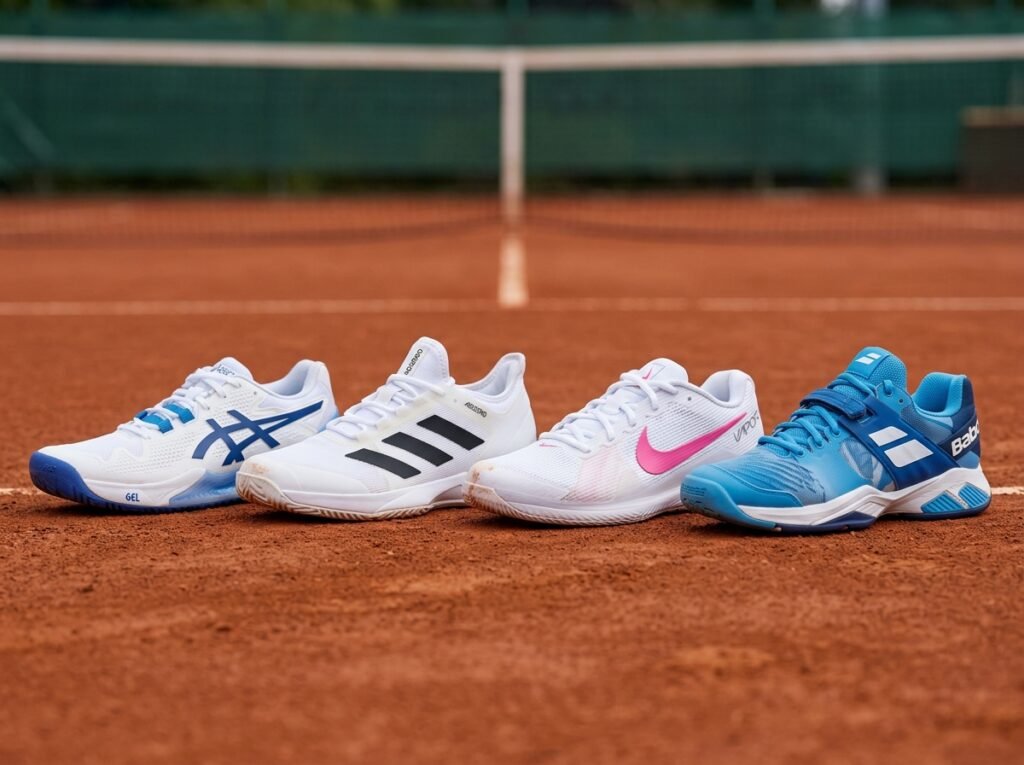
Women tennis shoes refers to athletic footwear designed for the stop, slide, and cut patterns of tennis, usually on a narrower last than men’s versions. Brands such as ASICS, adidas, Nike, Babolat, and Mizuno all make women-specific models. A pair also has to survive toe drag, which is why the front of the shoe is reinforced.
Tennis Shoes vs Running Shoes
A running shoe is built to move you forward. A tennis shoe is built to move you everywhere else. That single difference explains almost everything about price, weight, and durability.
| Feature | Tennis Shoe | Running Shoe | Casual Sneaker | Why It Matters |
|---|---|---|---|---|
| Lateral support | High, with stiff sidewalls | Low | Low | Prevents rolled ankles on cuts |
| Outsole rubber | Hard, abrasion resistant | Softer, lighter | Soft | Survives hard court grinding |
| Heel counter | Stiff and structured | Moderate | Flexible | Locks the heel during slides |
| Toe protection | Reinforced | Minimal | Minimal | Handles toe drag on serves |
| Weight | Medium | Light | Light | Trade-off between speed and durability |
Original analysis: Across the five features above, running shoes and casual sneakers match tennis shoes on only one (weight). That’s why swapping them in for a match is a bigger gamble than most players think.
The Court-Ready Test
Here’s a simple framework we use, called The Court-Ready Test. Pick up any shoe and check three zones.
- Heel zone: Squeeze the heel counter. It should resist collapsing.
- Midfoot zone: Twist the shoe gently. A good tennis shoe resists twisting far more than a running shoe.
- Toe zone: Look for a rubber or synthetic overlay along the toe box.
If a shoe fails two of the three zones, it isn’t a court shoe, no matter what the marketing says.
Pro Tip: Do the squeeze test in the store, not at home. Honestly, most online photos hide the one thing that matters, which is how stiff the back of the shoe actually is.
Q: Can I use my gym trainers for tennis? A: You can for a single casual hit, but gym trainers lack the lateral support and outsole durability that tennis demands, so they wear out faster and protect less.
Example (illustrative scenario): Picture a recreational player who plays twice a week in running shoes. Within one season, the outsole under the ball of her foot is bald and her ankle feels loose after every match. Switching to a proper court shoe fixes both problems for a pair that costs about as much as two months of coffee.
For a complete on-court outfit that combines performance and style, explore our comprehensive women’s tennis attire guide.
Women’s Tennis Shoes for Tennis: Court Types
Quick Answer: Hard courts need durable, abrasion resistant outsoles. Clay needs a full herringbone tread that sheds dirt. Grass and indoor carpet need smoother, specialized soles.
Women’s tennis shoes for tennis are not one product. The court under your feet changes what the outsole should do, and buying for the wrong surface is one of the most common mistakes players make.
Hard Courts
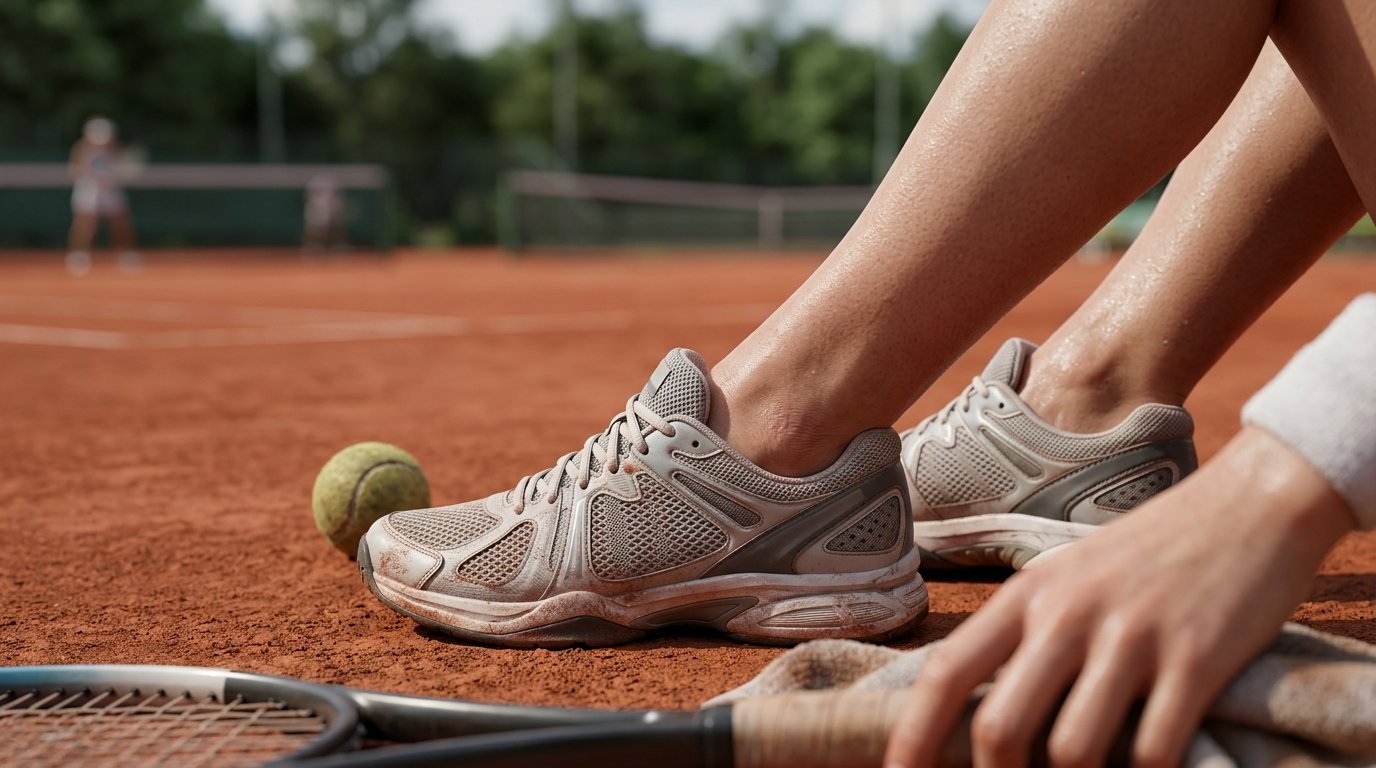
Hard courts are the most common surface for US recreational players, and they’re also the hardest on shoes. Look for a thick, tough rubber outsole and good forefoot cushioning. The ASICS Gel-Resolution line is known for outsole life on this surface (GadgetsFeed, 2026).
Clay and Grass Courts
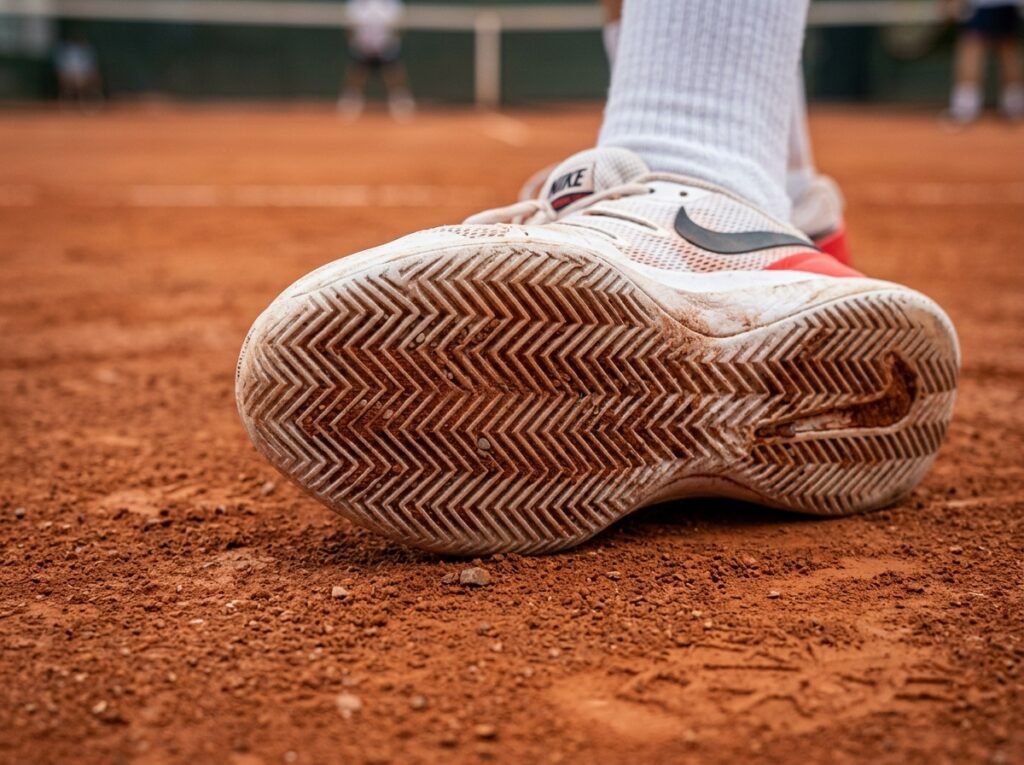
Clay shoes use a dense herringbone pattern that grips while still letting you slide. Grass courts typically call for a pimpled or nubbed sole, and many public clubs simply don’t have grass at all. If you play on clay, look for a model sold as a clay version, such as the clay editions listed by RunRepeat (2026).
Indoor and Carpet Courts
Many indoor facilities require non-marking soles, so a dark rubber outsole can be a problem. Check with the club before you buy. If you’re torn, a non-marking outsole is the safer choice.
| Surface | Outsole Style | Wear Rate | Key Feature to Seek | Common Mistake |
|---|---|---|---|---|
| Hard court | Durable modified herringbone | Fast | Tough rubber, forefoot cushion | Buying a lightweight shoe that wears through |
| Clay | Full herringbone | Moderate | Tread that sheds clay | Using a hard court shoe and slipping |
| Grass | Pimpled or nubbed | Slow | Grip without damage to turf | Wearing deep lugs that tear the grass |
| Indoor carpet | Smooth, non-marking | Slow | Non-marking sole | Wearing a marking outsole |
| Mixed use | Hybrid all-court | Moderate | Balanced tread | Expecting perfection on every surface |
How to match a shoe to your court, step by step:
- Write down the surface you play on most (at least 70% of your matches).
- Check the product page for a surface label such as hard court, clay, or all-court.
- Confirm the outsole is non-marking if you play indoors.
- Choose the clay or hard version of the same model if both exist.
- Buy a second pair for your less common surface only if you play it weekly.
Pro Tip: If your club uses two surfaces, buy for the one you play most. A second pair rarely pays off until you play the minority surface at least once a week.
Q: Do I need clay shoes if I only play on clay twice a month? A: No, a good all-court or hard court shoe is usually fine for occasional clay play, though you may slide less predictably.
For players seeking a versatile alternative to skirts, exploring our comprehensive tennis shorts women guide details innovative designs and performance-enhancing fits.
How to Choose Women Tennis Shoes
Quick Answer: To choose women tennis shoes, match your court surface, then check heel lockdown, toe room, and weight. Fit decides comfort far more than brand name does.
Choosing women tennis shoes comes down to four checks. We call it The 4-Point Fit Method, and it takes about ten minutes.
The 4-Point Fit Method
- Time it right. Try shoes on in the afternoon, when feet are slightly swollen from the day.
- Wear your court socks. Bring the exact socks you play in.
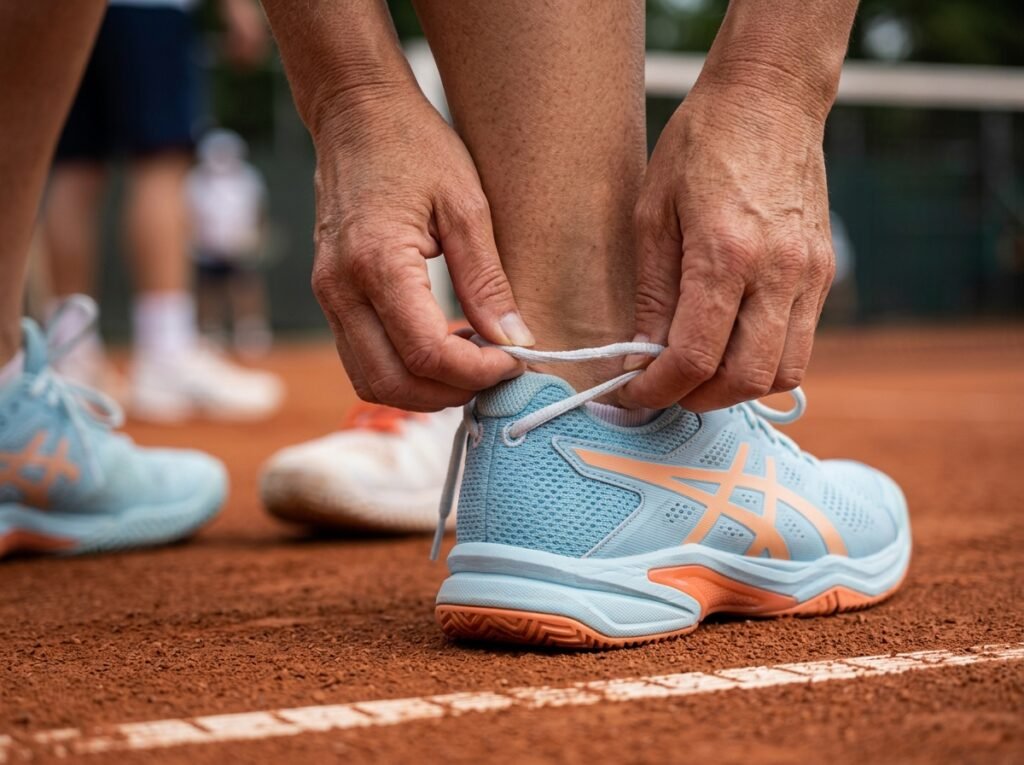
- Check the thumb gap. Leave about a thumb’s width of space past your longest toe.
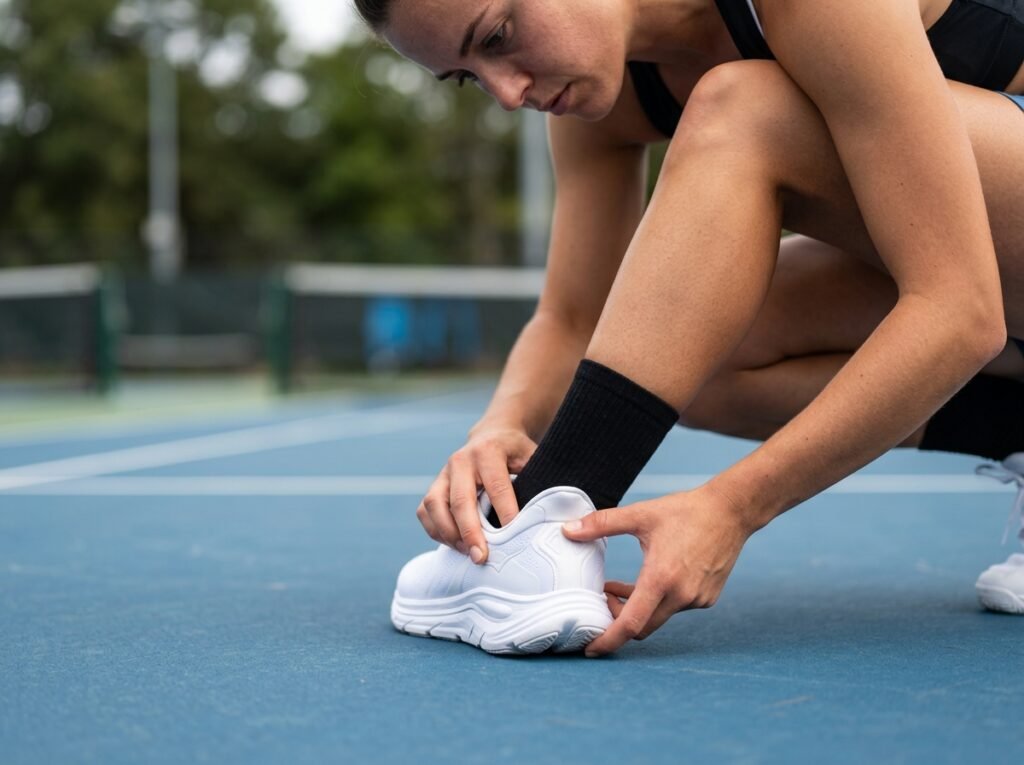
- Test the lockdown. Lace up, then do side steps and quick stops. Your heel shouldn’t lift.
Playing Style and Shoe Type
| Playing Style | Recommended Shoe Type | Key Feature | Example Models | Trade-off |
|---|---|---|---|---|
| Baseliner, lots of sliding | Stability shoe | Stiff heel, durable sole | adidas Barricade, ASICS Gel-Resolution | Heavier feel |
| Fast mover, aggressive | Lightweight speed shoe | Low weight, quick feel | Nike Vapor line, ASICS Solution Speed | Less durable outsole |
| Recreational, 1 to 2 times a week | Entry-level court shoe | Good value, solid grip | ASICS Gel-Challenger 15 | Fewer premium features |
| All-court mixed surfaces | Hybrid | Balanced traction | Babolat Jet line | Not best at any one surface |
| Wide feet | Wide-width model | More toe room | ASICS Gel-Resolution X Wide | Fewer color options |
Weight, Cushioning and Budget
Heavier shoes usually last longer. Lighter shoes feel faster but wear out sooner. Budget matters too, and you don’t have to buy the top model. An entry-level court shoe at about $120 can serve a once-a-week player well (GadgetsFeed, 2026).
Pro Tip: If you’re between sizes, try half a size up in court shoes. Tennis socks are thick, and toes need room for hard stops.
Q: How much toe room should I have in tennis shoes? A: About a thumb’s width of space beyond your longest toe, because feet slide forward during hard stops.
Example (illustrative scenario): A club player who sized her shoes tight for a snug feel ended up with sore toes after two weeks. Moving up half a size and re-lacing with a heel lock fixed it without changing the model at all.
Pair your footwear and performance gear with a classic, high-performance style by checking out our comprehensive tennis skirt guide.
Best Rated Women’s Tennis Shoes in 2026
Quick Answer: Reviewers most often rank the ASICS Gel-Resolution 9 and X, adidas Barricade 13 and 14, and Nike Vapor models among the best rated women’s tennis shoes in 2026.
The best rated women’s tennis shoes tend to repeat across independent reviewers. That’s useful, because it means you can ignore the hype and focus on what each shoe does best.
Top Picks by Category
- Durability and traction: ASICS Gel-Resolution 9 and the newer Gel-Resolution X are praised for grippy, long-lasting outsoles (GadgetsFeed, 2026).
- Stability: The adidas Barricade is repeatedly named for lateral support (LIVESTRONG, accessed October 2026).
- Beginners: The ASICS Gel-Challenger 15 is positioned as an entry-level pick (GadgetsFeed, 2026).
- Speed: The Nike Vapor line is a pick for fast players, with RunRepeat scoring the Nike Vapor 12 at 83 out of 100 and the adidas Barricade 14 at 87 out of 100 (RunRepeat, 2026).
What Reviewers Actually Measure
| Source | Method | Top Pick | Price Info | Note |
|---|---|---|---|---|
| LIVESTRONG | Physical therapist guidance | adidas Barricade (best overall) | About $90 to $135 across picks | Includes budget and hybrid options |
| RunRepeat | Purchased shoes, scored ratings | adidas Barricade 14 (87/100) | List $160, discounts seen | Large catalog of 47 to 48 women’s shoes |
| GadgetsFeed | Category guide for 2026 | ASICS Gel-Resolution 9 and X | About $120 to $170 | Notes running shoes are a common mistake |
| Tennis Tribe | Category guide | Nike Air Zoom Vapor Pro | Varies | Names best overall by gender |
The Price Reality Check
Original analysis: Across the six models in our comparison table below, list prices fall between about $100 and $180, but sale prices of $85 to $106 appear for several of them (RunRepeat, 2026). That gap means timing your purchase can save roughly 35 to 50 percent on some models. Prices change often, so check live listings before you buy.
Pro Tip: Last year’s model is often nearly identical to the new one. If the Gel-Resolution 9 is discounted and the X isn’t, the 9 is usually the better deal for casual players.
Q: Is the newest tennis shoe always the best? A: No, because manufacturers often update only minor details, and the previous version is often cheaper with nearly the same performance.
Black and Pink Tennis Shoes: 2026 Style Guide
Quick Answer: Black tennis shoes for women and pink women’s tennis shoes are available in most major lines. Choose support first, then pick the color.
Style matters, and nobody should have to pick between looking good and staying safe. The good news is that colors rarely change how a shoe performs.
Black Tennis Shoes for Women
Black tennis shoes for women are one of the most searched colors, including women’s all black tennis shoes and womens black tennis shoes versions. They hide scuffs, pair with almost any outfit, and look sharp off the court. Just watch the outsole if you play indoors, since some clubs require non-marking soles.
Pink and Colorful Pairs
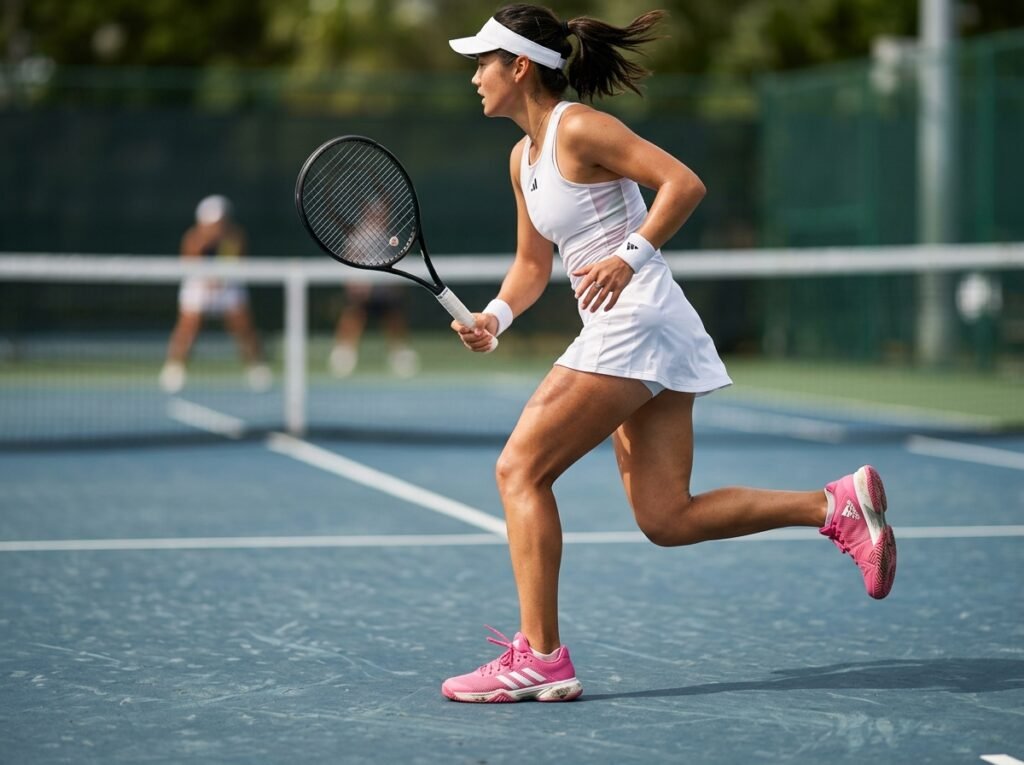
Pink women’s tennis shoes give you a lighter, fresher look, and several brands release pink and pastel versions of their top models (RunRepeat, 2026). Light colors show dirt faster, so keep a cleaning cloth in your bag.
Gray, Red, Brown and Slip-On Options
Gray is a quiet neutral, red adds energy, and brown reads more casual. Slip-on tennis shoes for women are fine for walking around the club, but they lack the lockdown a real match demands. Keep them for off-court wear.
| Color | Vibe | Pros | Watch Out For | Outfit Pairing |
|---|---|---|---|---|
| Black | Sleek, versatile | Hides scuffs | Marking soles indoors | Neutral or monochrome kits |
| All black | Bold, minimal | Easy to style | Heat in summer | Black skirt and dress sets |
| Pink | Fresh, playful | Pops against white kits | Shows dirt | White or pastel sets |
| Gray | Calm, modern | Neutral, hides wear | Can look dull | Any color palette |
| Red | Energetic | Statement piece | Clashes with some colors | White and navy kits |
| Brown | Casual | Good for off-court wear | Rare in performance models | Casual sporty outfits |
We call our approach The Style-Support Split. Rank every shoe on a support score first, and only then compare colors. If two shoes tie on support, the better color wins.
How to apply the Style-Support Split:
- Shortlist two or three models that pass the 4-Point Fit Method.
- Check which colors each one comes in.
- Pick the color that matches at least three of your outfits.
- Confirm the outsole is non-marking if you play indoors.
Pro Tip: Try the model on in store first, then order the color you love. Sizing within a model rarely changes with color, so you can buy the shade you want with confidence.
Q: Do black tennis shoes get too hot in summer? A: They can feel warmer in direct sun, so look for a breathable mesh upper if you play outdoors in hot weather.
Care, Lifespan and When to Replace
Quick Answer: Replace tennis shoes when the outsole tread is smooth, the midsole feels flat, or the heel counter collapses. Many players get roughly 45 to 60 hours of play from a pair.
A good pair of tennis shoes is an investment, so a little care pays off. Honestly, most players replace shoes later than they should, and their ankles feel it first.
When to Replace Your Shoes
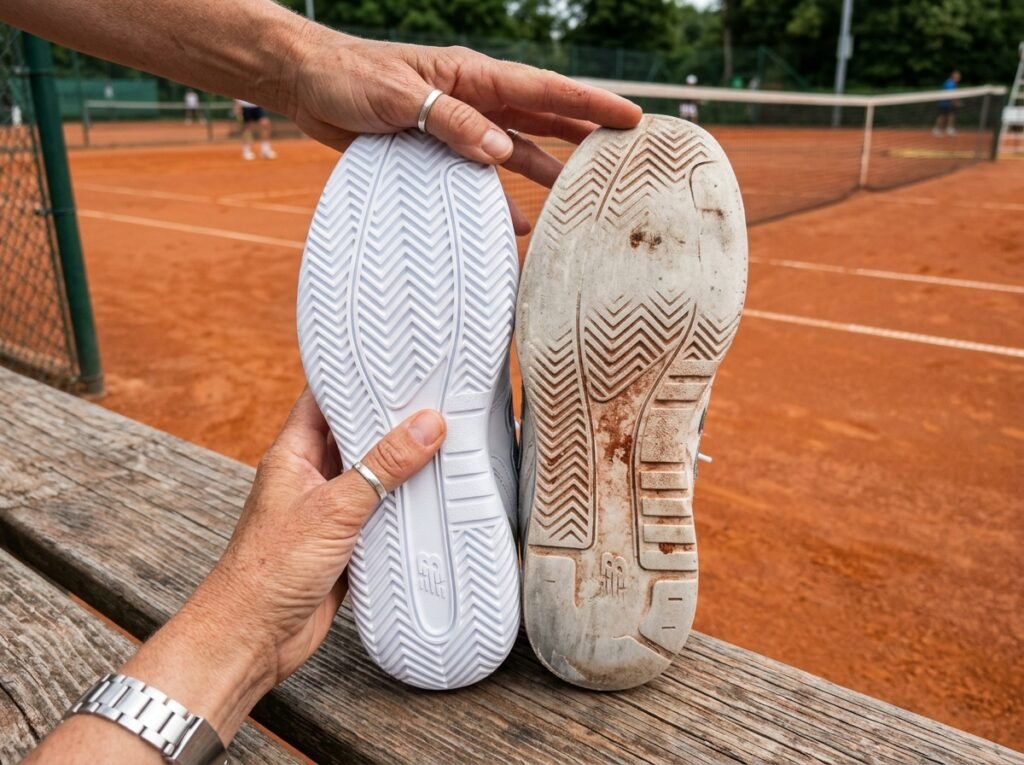
Check the outsole under the ball of your foot, since that spot wears first. If the pattern is gone or the rubber is thin, the shoe has lost grip. The 45 to 60 hour range is an editorial rule of thumb, so confirm it against your brand’s guidance and how hard you play.
Cleaning and Storage
- Knock off loose dirt after each match.
- Wipe the upper with a damp cloth and mild soap.
- Remove the insole and let it air dry.
- Never machine dry, since heat can warp the midsole and glue.
- Store shoes in a cool, ventilated spot, not in a hot car.
Troubleshooting Common Problems
| Symptom | Likely Cause | Quick Fix | Time to Fix | Replace? |
|---|---|---|---|---|
| Heel slipping | Loose lacing or wrong size | Use a heel lock lacing pattern | 2 minutes | Only if still loose |
| Toe soreness | Too tight or too small | Go up half a size | 1 shopping trip | Sometimes |
| Slipping on court | Worn tread or wrong surface | Check outsole and surface label | 5 minutes | Yes if smooth |
| Pain in arch | Flat midsole | Try a supportive insole | 1 day | Often |
| Odor | Moisture buildup | Air dry and rotate pairs | 1 day | No |
Pro Tip: Rotate two pairs if you play three or more times a week. Midsoles recover between sessions, and both pairs last longer.
Q: How do I stop my heel from slipping in tennis shoes? A: Use the top eyelet on your shoe to make a heel lock lacing loop, and confirm that the size isn’t too big.
Example (illustrative scenario): A weekend player noticed slipping during her serves. The outsole looked fine, but the midsole felt flat. After replacing the pair, the slipping stopped, which showed that wear inside the shoe can be invisible from the outside.
Women Tennis Shoes Comparison: Top Options at a Glance
The table below stands on its own, so you can skim it without reading the rest of the article. The rating is an editorial Zapy Fit Score out of 10, based on the published reviews and specs cited in this guide, and it is not a lab test. Prices are approximate as of October 2026 and vary by retailer.
| Option | Key Feature | Best For | Price | Rating |
|---|---|---|---|---|
| ASICS Gel-Resolution 9 or X | Tough rubber outsole, strong traction | Hard court durability | About $160 to $170 list, sales near $93 to $104 | 9.0 / 10 |
| adidas Barricade 13 or 14 | Stiff heel and TPU outsole for stability | Baseliners and lateral movers | About $160 list, sales near $95 to $106 | 9.0 / 10 |
| ASICS Gel-Challenger 15 | Entry-level court shoe | Beginners | About $120 | 8.0 / 10 |
| Nike Vapor 12 or Vapor Pro | Light, fast, low profile | Quick, aggressive players | About $180 list, sales near $144 | 8.3 / 10 |
| Babolat Jet Tere | Hybrid all-court tread | Mixed surfaces | About $109 | 8.0 / 10 |
| Nike Court Lite 2 | Budget classic | Casual players | About $100 | 7.5 / 10 |
Our pick: The ASICS Gel-Resolution 9 or X is the best fit for most recreational players on hard courts, because outsole life matters most when you play often. If you slide a lot or want more lateral support, the adidas Barricade is a close second.
FAQ
What are women tennis shoes?
Women tennis shoes are court shoes built for side-to-side movement. They use a stiff heel counter, a tough outsole, and a women-specific last. Most brands design them on a narrower fit than men’s versions, and many offer wide widths too.
How are tennis shoes different from running shoes?
Tennis shoes add lateral support and a harder outsole, while running shoes are built for forward motion. That’s why running shoes wear faster on court and offer less ankle protection. If you play more than once a month, a real court shoe is worth the cost.
Why are women tennis shoes more expensive than regular sneakers?
They use harder rubber, reinforced toe and heel zones, and stability technology that casual sneakers skip. You’re paying for durability and protection, not just a logo. Sale prices of $85 to $106 appear for several models (RunRepeat, 2026).
Are the best rated women’s tennis shoes worth the money?
Yes, if you play weekly, because better outsoles last longer and protect your ankles. A pair that lasts a full season often costs less per match than a cheaper pair replaced twice. Casual players can pick a mid-priced model.
How much do women tennis shoes cost?
Most quality pairs cost about $90 to $170 at list or sale prices (LIVESTRONG, accessed October 2026; RunRepeat, 2026). Entry-level models sit near $100 to $120. Premium models run higher at list price but are often discounted.
Can I wear pickleball or running shoes instead of tennis shoes?
Pickleball shoes are a decent backup for casual hitting, but running shoes aren’t recommended for tennis. Running shoes lack lateral support, and GadgetsFeed (2026) names using them as the most frequent buying mistake. If you’re serious about the game, get court shoes.
What’s the best way to tell if my tennis shoes are worn out?
Check the outsole tread, the midsole feel, and the heel counter. Smooth rubber under the ball of your foot means grip is gone, and a flat, dead midsole means the cushioning is spent. If your ankles or knees start to feel sore after matches, the shoes may be the cause.
What’s the best way to pick women tennis shoes as a beginner on a budget?
Choose an entry-level court shoe around $100 to $120 with a durable outsole and a snug heel. The ASICS Gel-Challenger 15 and the adidas Barricade on sale are common starting points. Skip fashion sneakers, and use the 4-Point Fit Method before you pay.
Why do my feet slip or blister in my tennis shoes?
Usually the size, the lacing, or the socks are wrong. Try a half size up, a heel lock lace pattern, and moisture-wicking tennis socks. If problems continue, you may need a wider model.
Final Takeaways
Three things matter most. First, tennis demands lateral support, so choose real court shoes over running shoes. Second, match your outsole to your court and your fit to your foot, using the 4-Point Fit Method. Third, style is flexible, so choose the best women tennis shoes for support first and color second.
Ready to shop? Compare the table above, pick two models, and try them on with your court socks.
Next steps for the next 10 minutes:
- Write down your main court surface and how often you play.
- Shortlist two models from the comparison table.
- Check the sizing and return policy for both before you order.
About the Author
Ambreen Fayyaz is a fashion and beauty writer at Zapy Beauty who covers sportswear, court style, and practical buying guides for US readers. Having started her writing journey about six months ago, she regularly tests athletic fabrics, evaluates court aesthetics, and focuses on practical fit details for everyday wear.
Last Updated: October 17, 2026. Fact-checked by: Ambreen Fayyaz.
Disclosure: This article contains no affiliate links.
References
- USTA. Tennis Participation Continues to Surge With Six Consecutive Years of Growth, Reaching 27.3 Million Players in 2025 (2026).
- NBC Sports. Tennis participation in U.S. rises to new high of 27.3 million in 2025, USTA says (2026).
- SGI Europe. US tennis hits record 27.3 million players (2026).
- LIVESTRONG. The 10 Best Tennis Shoes for Women, According to a Tennis-Playing Physical Therapist (accessed October 2026).
- RunRepeat. Best Women’s Tennis Shoes catalog and ratings (2026).
- RunRepeat. Expensive tennis shoes, price and discount data (2026).
- GadgetsFeed. Good Tennis Shoes for Women (2026).
- The Tennis Tribe. Best Tennis Shoes for Men and Women.