Updated for 2026 | Last Updated: October 19, 2026 | Written by Ambreen Fayyaz | Zapy Beauty
Introduction
Ninety-four percent of senior managers say how a candidate dresses matters, and 52% rate it as very important (Accountemps, 2019). That means your outfit gets graded before you say a single word. And if you’ve ever stood in front of your closet the night before, wondering whether a blazer is too much or too little, you know exactly how stressful that feels.
This guide to interview clothes for women answers the question people type into Google every single day: what should I actually wear? You’ll get a simple outfit formula, a dress code decoder, industry-by-industry advice, a budget capsule wardrobe, and fixes for the small mistakes that quietly cost candidates offers. No fluff. Just what works.
Key Takeaways
- Dress one step above the company’s everyday dress code, which is the safest rule for any interview.
- Only 37% of senior managers say a suit must always be worn, so a polished business casual outfit often works (Accountemps, 2019).
- Use the 4-Piece Formula (top, bottom or dress, layer, finish) to build an outfit in minutes.
- Fit matters more than price. A $60 outfit that fits beats a $400 outfit that doesn’t.
- Shoes, bag, grooming, and wrinkles get noticed. Check them the night before.
- Video and second interviews have their own rules, covered below.
Here’s the full roadmap, so you can jump to the part you need.
Table of Contents
- What Counts as Interview Clothes for Women?
- What to Wear to an Interview Female: The Formula
- Business Casual Clothes for Interview: Done Right
- Interview Clothes for Women by Industry
- Fabric, Fit and Color: The Details That Show
- Shoes, Bags and Accessories
- Virtual and Second Interview Outfits
- How Can I Dress for an Interview on a Budget?
- Interview Outfit Mistakes and Quick Fixes
- Interview Clothes for Women Comparison: Top Options at a Glance
- FAQ
- Final Takeaways
What Counts as Interview Clothes for Women?
Quick Answer: Interview clothes for women are professional, clean, well-fitted outfits chosen to match the employer’s dress code. The safest approach is to dress one step above what employees normally wear.
Interview clothes for women refers to the professional outfits a candidate wears to a job interview, from a full suit to a polished business casual look. The goal isn’t to look expensive. The goal is to look prepared, respectful, and right for the role.
Honestly, most guides skip the part that matters most: there is no single correct outfit. What’s right in a New York law firm is wrong at a creative startup in Austin. So before you buy anything, you need to decode the dress code.
The Dress Code Decoder
Here’s a framework we call The Dress Code Decoder. Match the employer to a row, and you’ve got your outfit direction.
| Dress Code | What It Means | Women’s Outfit | Typical Workplaces | Interview Risk |
|---|---|---|---|---|
| Business formal | Most traditional | Matching suit, blouse, closed-toe pumps | Law, banking, executive roles | Underdressing is a serious misstep |
| Business professional | Polished, structured | Blazer with trousers or skirt, blouse | Corporate offices, consulting | Slightly casual shoes can stand out |
| Business casual | Professional but relaxed | Blouse or knit top, blazer or cardigan, tailored trousers | Most offices, nonprofits | Too casual a top looks careless |
| Smart casual | Neat, modern, relaxed | Dark jeans or chinos, nice top, blazer | Tech, startups, retail corporate | Jeans with holes or sneakers hurt you |
| Creative casual | Personality allowed | Clean separates with one statement piece | Design, media, fashion | Overdoing trends distracts |
The One Step Up Rule
The second framework is simple. The One Step Up Rule says to dress one level more formal than the company’s daily standard. Accountemps (2019) put it plainly: whether the office is jeans and T-shirts or suits, your outfit should be one step above its usual formality. If employees wear jeans, you wear business casual. If they wear business casual, add a blazer.
Why the Suit Debate Is Messier Than It Looks
The data shows managers are genuinely split. According to Accountemps, 37% of senior managers say candidates should always wear a formal suit, 36% say it depends on the position or department, and 23% say looking professional is enough (Accountemps, 2019).
Original analysis (derived from the Accountemps data): Add the second and third groups together, and 59% of managers don’t require a suit at all. Include the 4% who say a suit would be inappropriate, and 63% of managers aren’t demanding one. So a suit is a safe choice, but it isn’t the only safe choice.
How to decode any company’s dress code, step by step:
- Read the job posting and the careers page for words like professional, relaxed, or creative.
- Check the company’s LinkedIn and Instagram for photos of real employees.
- Look at the interviewer’s profile photo to see how they present.
- Ask the recruiter, in one friendly line, whether there’s a dress code to plan for.
- Pick the matching row in the Dress Code Decoder and move one step up.
Pro Tip: Ask the recruiter directly. A short message such as, I want to make sure I’m dressed appropriately, is there a dress code I should plan for? is normal and shows you care. Many managers actually appreciate it, since Accountemps notes that telling candidates the recommended attire ahead of time removes a lot of interview stress.
Q: Is it better to be overdressed or underdressed for an interview? A: Slightly overdressed is safer, because it signals respect, while being underdressed can suggest you didn’t prepare. The key word is slightly, so a full ballgown or a three-piece suit at a casual startup is also a misstep.
What to Wear to an Interview Female: The Formula
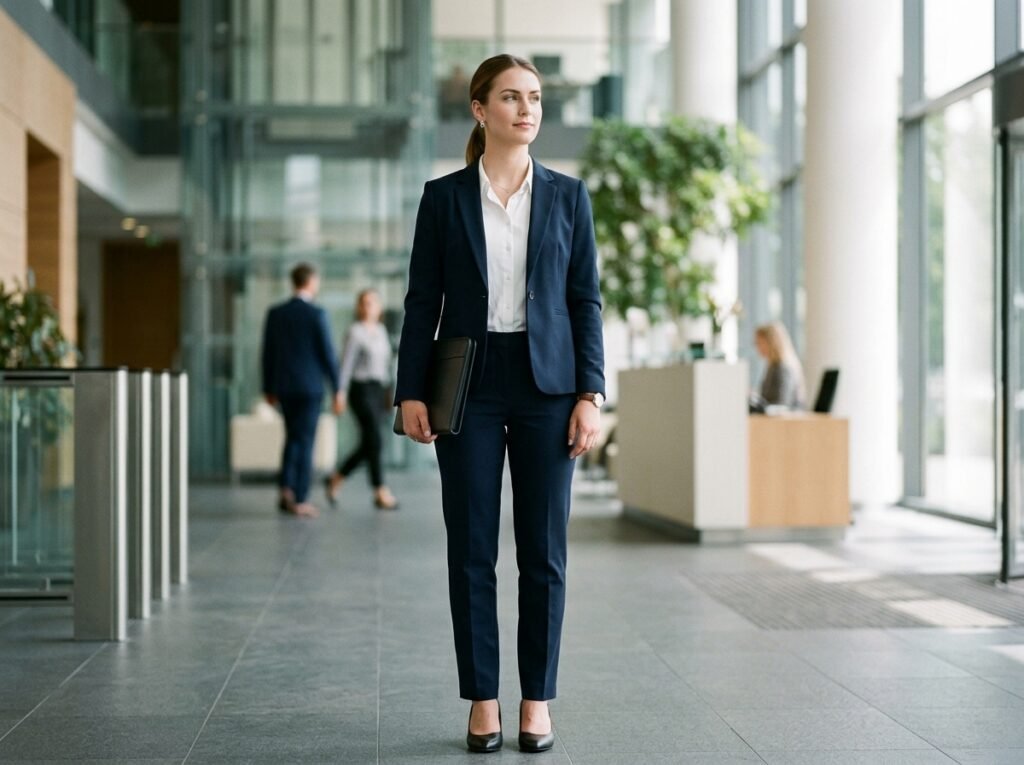
Quick Answer: Wear a tailored top or dress, a blazer or cardigan, tailored trousers or a knee-length skirt, and closed-toe shoes. Stick to neutral colors and make sure everything is clean, pressed, and comfortable.
If you’re asking what to wear to an interview female readers often start with the same panic: too many options, no clear answer. The fix is a formula. Once you have one, you can build an outfit from almost any closet.
The 4-Piece Formula
We call it The 4-Piece Formula. Every interview outfit has four parts.
- The base: a blouse, knit top, or dress.
- The bottom: tailored trousers or a knee-length skirt (skip this if you chose a dress).
- The layer: a blazer, structured cardigan, or jacket.
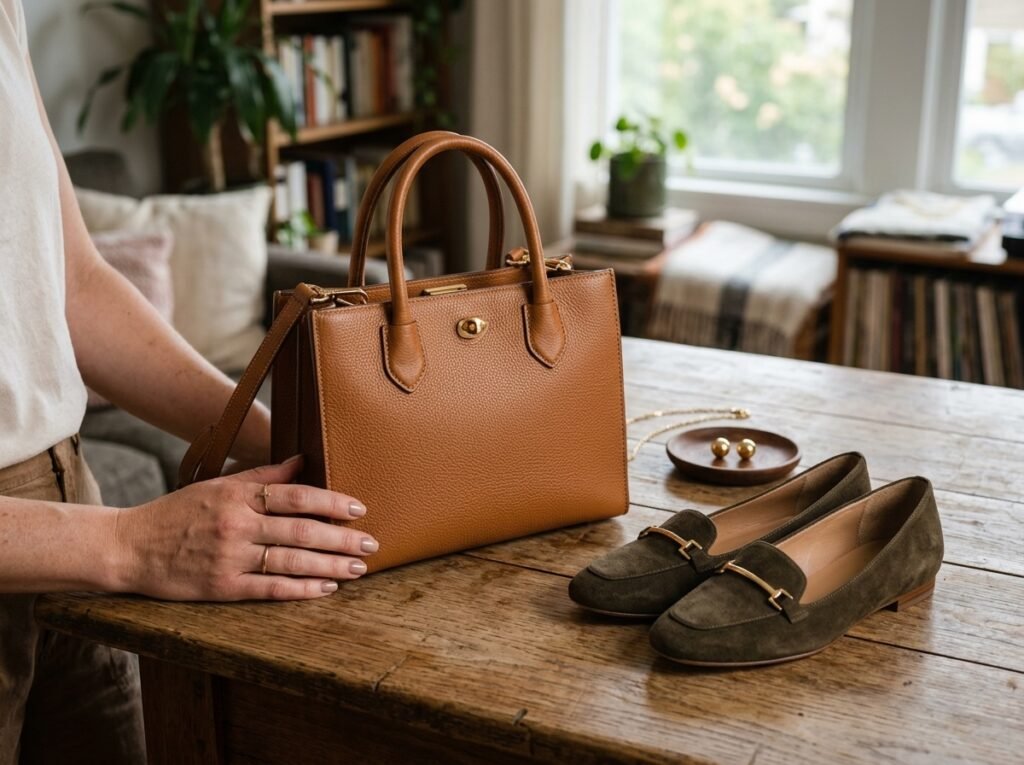
- The finish: closed-toe shoes, a simple bag, and minimal jewelry.
| Piece | Safe Choices | Avoid | Why | Pro Move |
|---|---|---|---|---|
| Base | Silk-look blouse, fine knit, button-up | Low-cut tops, sleeveless, spaghetti straps | Revealing tops draw attention away from you | Choose a neckline that stays put when you lean forward |
| Bottom | Tailored trousers, pencil or A-line skirt | Tight skirts, ripped denim, leggings | Fit and length signal professionalism | A skirt should reach the knee or just above when seated |
| Layer | Blazer, cardigan, structured jacket | Oversized hoodies, denim jackets | A layer adds polish and covers nerves-sweat | Keep the blazer on unless the interviewer offers otherwise |
| Shoes | Closed-toe flats, low heels, loafers | Flip flops, stilettos, worn sneakers | Comfort keeps you steady and confident | Break shoes in at least a week early |
| Finish | Simple watch, small studs, structured bag | Chunky stacks, loud perfume, oversized tote | Less is more in an interview | Keep jewelry to two or three small pieces |
Washington State University’s career guidance backs this up: aim for a simple, classic outfit, make sure skirts sit just above the knee when you’re seated and aren’t too tight, and avoid sleeveless tops, spaghetti straps, low-cut blouses, and bare midriffs (Washington State University, 2021).
Colors That Work
Neutral colors are the safest choice. TopInterview lists black, white, gray, navy blue, brown, and beige as acceptable interview colors (TopInterview, accessed October 2026). Navy tends to read as trustworthy and softer than black, so it’s a great default. A single accent color, such as a soft blue or deep green blouse, is fine too.
Fit and Fabric Basics
Fit beats everything. A blazer that’s too tight across the shoulders or sleeves that cover your knuckles will undo even an expensive outfit. Choose fabrics that don’t wrinkle badly, like ponte, wool blends, or good-quality crepe, and always steam or press before the interview.
How to build an interview outfit in 6 steps:
- Pick the dress code row from the Dress Code Decoder.
- Choose your base and bottom, or your dress.
- Add a layer in a matching or complementary color.
- Try everything on together and sit down, stand up, and reach forward.
- Add closed-toe shoes you’ve already worn comfortably.
- Photograph the outfit in natural light, then fix anything that looks off.
Pro Tip: Do the sit test in front of a mirror. Sit, cross your legs, and lean forward. If your skirt rides up, your neckline gaps, or your blazer pulls across your back, change it now rather than discovering it in the interview chair.
Q: Should I wear black to an interview? A: Yes, black is acceptable and professional, though navy, gray, or a softer neutral can look warmer and less severe on camera or in person.
Business Casual Clothes for Interview: Done Right
Quick Answer: Business casual clothes for interview settings mean professional pieces without a full suit: a blouse or knit top, a blazer or cardigan, tailored trousers or a knee-length skirt, and polished flats or low heels.
Most American offices run business casual these days, so it’s the dress code you’ll meet most often. The trouble is that business casual is vague. Ask five people what it means and you’ll get five answers. So let’s pin it down.
What Business Casual Actually Means
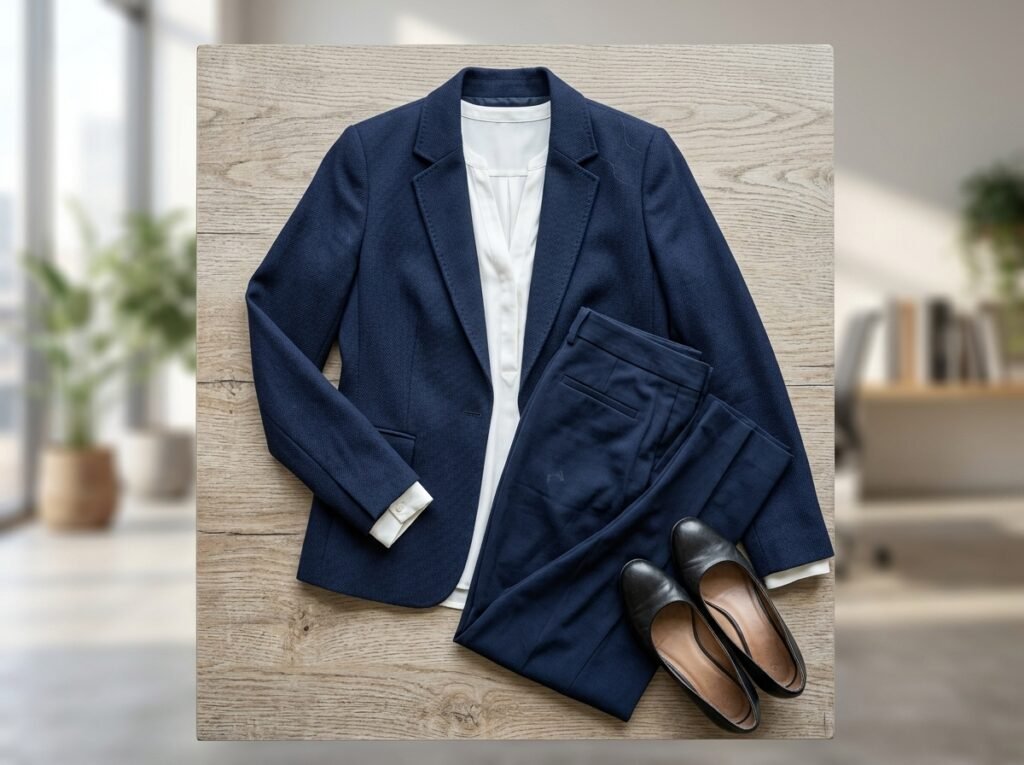
Business casual is defined as professional attire that is polished but not strictly formal, usually combining separates instead of a matching suit. For women, that typically means a nice top, a blazer or cardigan, trousers, chinos, or a knee-length skirt, and closed-toe flats or low heels. For an interview, always lean toward the polished end of the range.
Five Business Casual Outfit Combos
| Combo | Top | Bottom | Layer | Shoes |
|---|---|---|---|---|
| Classic | White button-up | Navy trousers | Gray blazer | Black loafers |
| Soft | Cream silk-look blouse | Camel A-line skirt | Navy cardigan | Nude flats |
| Modern | Fine black knit | Charcoal tailored pants | Black blazer | Low block heels |
| Warm weather | Sleeved sage blouse | White tailored trousers | Light linen blazer | Tan flats |
| Dress option | Navy sheath dress | Built in | Structured cardigan | Closed-toe pumps |
The Polish Ladder
Here’s one more framework, The Polish Ladder. It works in three rungs, and you climb one for the interview.
- Rung 1, everyday casual: jeans and a T-shirt. Not interview-ready.
- Rung 2, business casual: blouse, chinos or trousers, a layer. The usual baseline.
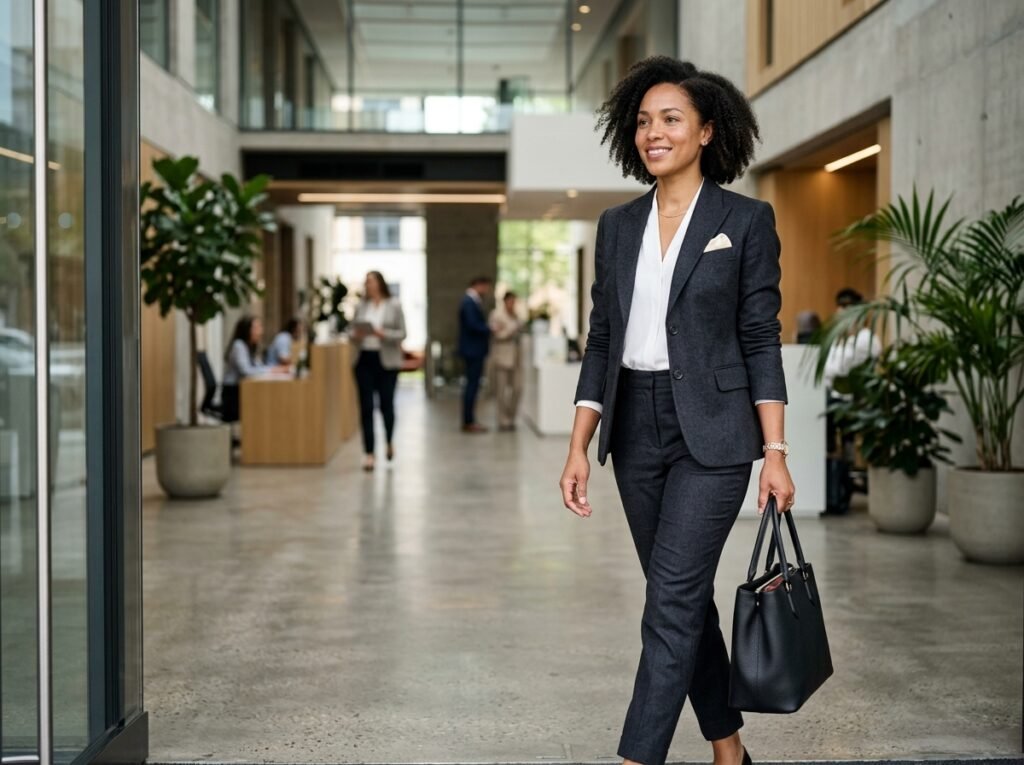
- Rung 3, business professional: a matching blazer set or a tailored dress. Your interview target if you’re unsure.
If the office lives on Rung 2, you aim for the top of Rung 2 or the bottom of Rung 3. Isn’t that easier than guessing?
How to upgrade a business casual outfit for an interview:
- Swap any casual fabric (cotton jersey, denim) for a structured one.
- Add a blazer or structured cardigan.
- Replace sneakers or sandals with closed-toe flats or low heels.
- Remove anything with visible logos or loud graphics.
- Press everything and check for lint.
Pro Tip: When in doubt between two options, pick the one that makes you stand taller. If a blazer makes you feel capable, wear it. Confidence shows in posture, and interviewers pick up on it faster than they notice a brand tag.
Q: Can I wear jeans for a business casual interview? A: Only if you know the company is very casual, and even then dark, clean, well-fitted jeans with a blazer and polished shoes are the safer approach.
Interview Clothes for Women by Industry
Quick Answer: Finance and law lean formal, while tech, creative, and retail lean smart casual. Suits are preferred by 46% of managers in finance, insurance, and real estate, but only 26% in retail (Accountemps, 2019).
Industry shapes the right choice more than almost anything else. According to Accountemps, suits are preferred more often in finance, insurance, and real estate (46%) than in construction (28%) or retail (26%) (Accountemps, 2019). That’s a 20 point gap, which is exactly why a single outfit can’t fit every interview.
Finance, Law and Corporate
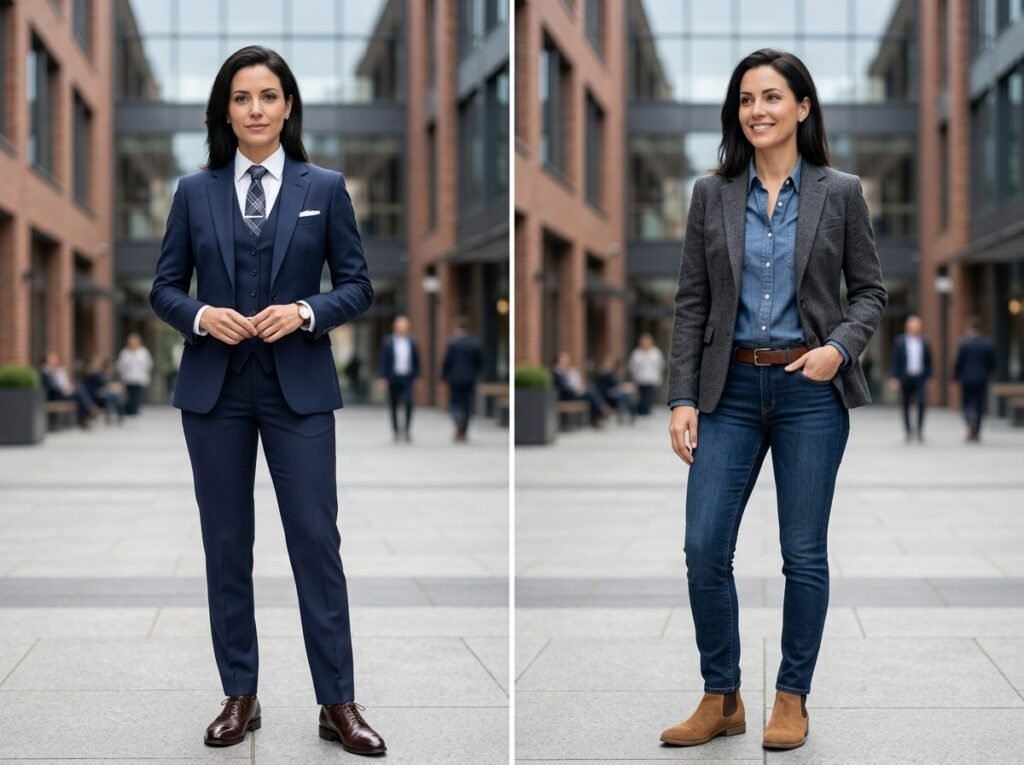
Go formal. A matching suit in navy, charcoal, or black, a crisp blouse, and polished closed-toe pumps or loafers is the standard. Keep accessories small and makeup natural.
Tech, Startups and Creative Fields
Go smart casual, but polished. Tailored trousers or dark jeans, a nice top, and a blazer works. One distinctive piece, such as a statement earring or a structured bag, shows personality without distracting from you.
Healthcare, Education and Retail
Go professional and practical. Business casual with comfortable closed-toe shoes is typical. For retail, look at the brand’s own style and mirror it, staying neat and slightly more polished.
| Industry | Recommended Outfit | Formality | Suit Preference Data | Note |
|---|---|---|---|---|
| Finance, insurance, real estate | Suit, blouse, pumps | High | 46% prefer suits (Accountemps, 2019) | Hair and nails neat, minimal jewelry |
| Law and consulting | Suit or sheath dress with blazer | High | Not measured separately | Err on the formal side |
| Tech and startups | Trousers, nice top, blazer | Medium | Not measured separately | Dark jeans can work only if you’re sure |
| Healthcare and education | Business casual, comfy flats | Medium | Not measured separately | Practical shoes matter |
| Retail | Polished business casual, brand style | Medium | 26% prefer suits (Accountemps, 2019) | Mirror the brand, then go a step up |
| Construction and trades | Neat business casual | Low to medium | 28% prefer suits (Accountemps, 2019) | Clean and pressed is the point |
Region matters too. In Miami, New York, and Washington, D.C., 54% of managers say a suit should always be worn to interviews, while in Austin and Seattle, 32% of managers say looking professional is enough (Accountemps, 2019). Size matters as well: at least 40% of managers at companies with more than 250 employees prefer a suit, compared with 31% at companies with 20 to 99 employees (Accountemps, 2019).
How to match your outfit to the industry, step by step:
- Name your industry and company size.
- Check the table above for the starting outfit.
- Adjust for your city (more formal on the East Coast and in big metros, slightly looser in tech hubs).
- Read three recent photos of employees for tone.
- Finalize the outfit and move one step up if you’re torn.
Pro Tip: If you’re interviewing in a region known for formality, such as New York, add the blazer even if the company seems relaxed online. You can always take a blazer off, but you can’t add one you left at home.
Q: Do I need a suit for a tech interview? A: Usually no, because tech teams tend to dress casually, so smart casual with a blazer is more fitting than a full suit.
Fabric, Fit and Color: The Details That Show
Quick Answer: Choose wrinkle-resistant fabrics, a fit that lets you sit and move comfortably, and neutral colors like navy, gray, black, or cream. Add neat grooming, since interviewers notice details in the first seconds.
Two outfits can use the same pieces and still look completely different. The difference is almost always fabric, fit, and finishing. Washington State University’s career guidance notes that you have less than 30 seconds to make a first impression, so the details do real work (Washington State University, 2021).
Fabric That Survives the Day
You’ll be sitting, walking, and probably nervous. Pick fabric that forgives all three.
| Fabric | Look | Wrinkle Risk | Best For | Care Tip |
|---|---|---|---|---|
| Wool blend | Structured, classic | Low | Suits, trousers, blazers | Steam, rarely wash |
| Ponte knit | Smooth, stretchy | Very low | Sheath dresses, trousers | Machine wash cold |
| Crepe | Fluid, elegant | Low | Blouses, dresses | Hang right after wearing |
| Silk-look polyester | Polished, light | Medium | Blouses | Steam on low heat |
| Pure linen | Relaxed, breathable | Very high | Warm weather only, with caution | Avoid for formal interviews |
| Cotton poplin | Crisp, clean | Medium | Button-ups | Iron while damp |
The 3-Point Fit Check
Here’s The 3-Point Fit Check, a quick routine we’d use before any interview.
- Shoulders: The seam should sit at the edge of your shoulder, not hang off it.
- Sit test: Sit down. Nothing should gap, ride up, or pinch.
- Movement test: Reach forward and raise your arms. The outfit should move with you.
If an outfit fails even one point, fix it or swap it. Tailoring a blazer or hem often costs far less than buying something new, and it’s usually the best money you’ll spend.
Grooming and Beauty Details
Because this is also a beauty site, let’s talk grooming. Keep makeup natural and fresh, keep hair neat and off your face, and keep nails clean and tidy. Hocking College’s career guidance recommends minimal makeup and hair kept out of the face for interviews (Hocking College, accessed October 2026). Go light on fragrance too, since a small room and a strong perfume rarely mix.
How to do a night-before outfit check, step by step:
- Lay out the full outfit, shoes and bag included.
- Steam or iron every piece.
- Run a lint roller over the blazer and trousers.
- Check for loose threads, missing buttons, and scuffed shoes.
- Pack a small touch-up kit (blotting paper, lip balm, mints).
- Photograph yourself in the outfit and look at the photo critically.
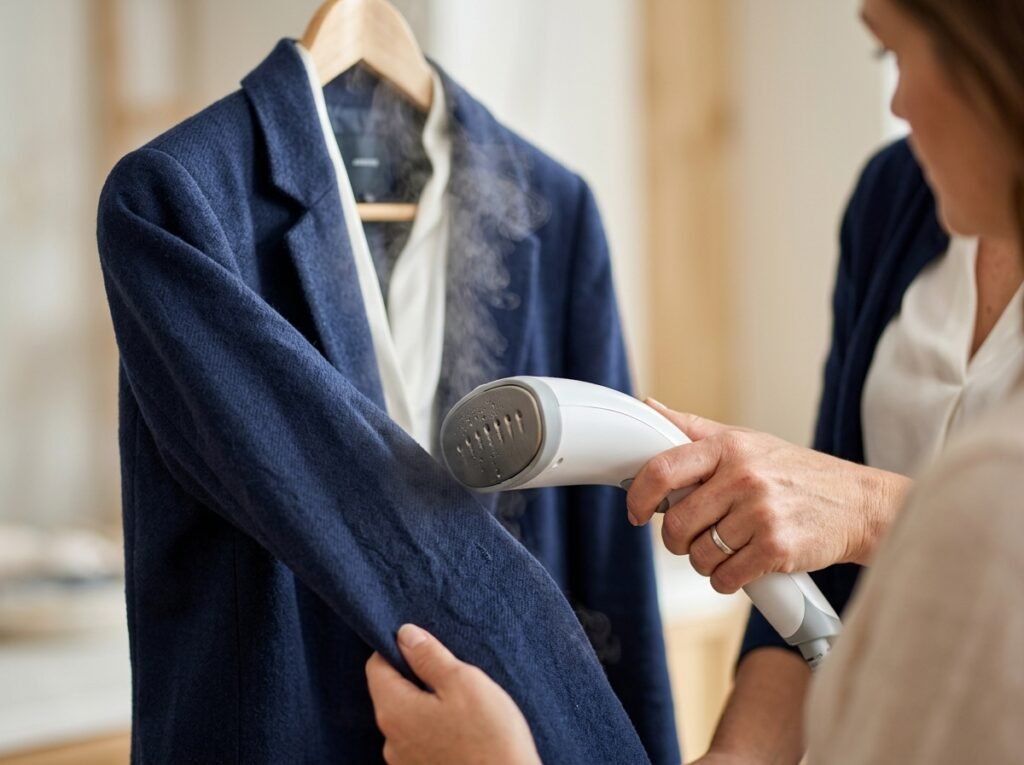
Pro Tip: Steam your outfit in the bathroom while you shower the night before, then hang it somewhere with space. Hot steam relaxes most wrinkles from wool blends and crepe without needing an iron.
Q: Does the color of my outfit really matter in an interview? A: Yes, because color shapes first impressions, and neutral tones like navy, gray, and cream look professional and keep attention on you rather than on your clothes.
Shoes, Bags and Accessories
Quick Answer: Wear closed-toe flats or low heels you’ve already broken in, carry a structured bag or portfolio, and keep jewelry minimal. These finishing pieces should support your outfit, never compete with it.
Shoes and accessories are where well-dressed candidates quietly separate themselves. A great blazer with scuffed shoes looks unfinished. And a simple outfit with polished shoes looks deliberate.
Choosing Interview Shoes
Several career guides recommend closed-toe flats, pumps, or low heels for business casual and professional interviews. Pick a pair you can walk, stand, and climb stairs in. If you’re nervous already, painful shoes won’t help.
Jewelry and Watches
Keep it small. Studs, a delicate necklace, and a simple watch work well. Wsu’s career guidance suggests minimal jewelry and avoiding over-accessorizing, and the Flanelle guide specifically warns against chunky gold chains and oversized earrings (Washington State University, 2021; Flanelle, accessed October 2026).
Bags, Portfolios and Phones
Choose one bag, not two. A structured tote or a slim portfolio holds a few printed resumes, a pen, and a notebook. Silence your phone before you enter the building, not after you sit down.
| Item | Safe Pick | Skip | Why | Estimated Budget |
|---|---|---|---|---|
| Shoes | Closed-toe flats, loafers, low block heels | Stilettos, sandals, worn sneakers | Comfort and polish | $30 to $120 |
| Jewelry | Studs, thin chain, simple watch | Chunky stacks, jingling bracelets | Avoids distraction | $0 to $50 |
| Bag | Structured tote or portfolio | Oversized slouchy bag | Looks organized | $25 to $150 |
| Hosiery | Sheer neutral, if worn | Bold patterns | Keeps focus on the outfit | $5 to $15 |
| Scarf or belt | Solid, subtle | Logo-heavy | Optional polish | $10 to $40 |
Budget figures above are editorial estimates, so check current retailer prices before you shop.
How to pack your interview bag, step by step:
- Print three copies of your resume on clean paper.
- Add a pen, a small notebook, and a list of questions to ask.
- Pack mints, blotting paper, and a lint roller sheet.
- Add a charger and your ID or parking ticket.
- Silence your phone and put it away before you walk in.
Pro Tip: Do a hallway walk test in your shoes at home. Walk for ten minutes, climb a few stairs, and stand for five. If your feet complain at home, they’ll complain louder during a nervous hour on a hard office floor.
Q: Are heels required for interview clothes for women? A: No, because polished flats and loafers look just as professional, and comfort helps you focus on your answers.
Virtual and Second Interview Outfits
Quick Answer: For video interviews, dress fully from top to bottom, choose solid mid-tone colors, and test your look on camera. For second interviews, dress slightly more formally than the first.
Interviews aren’t always in a conference room. Video calls and second rounds each have their own rules, and many candidates get them wrong.
Dressing for Video Interviews
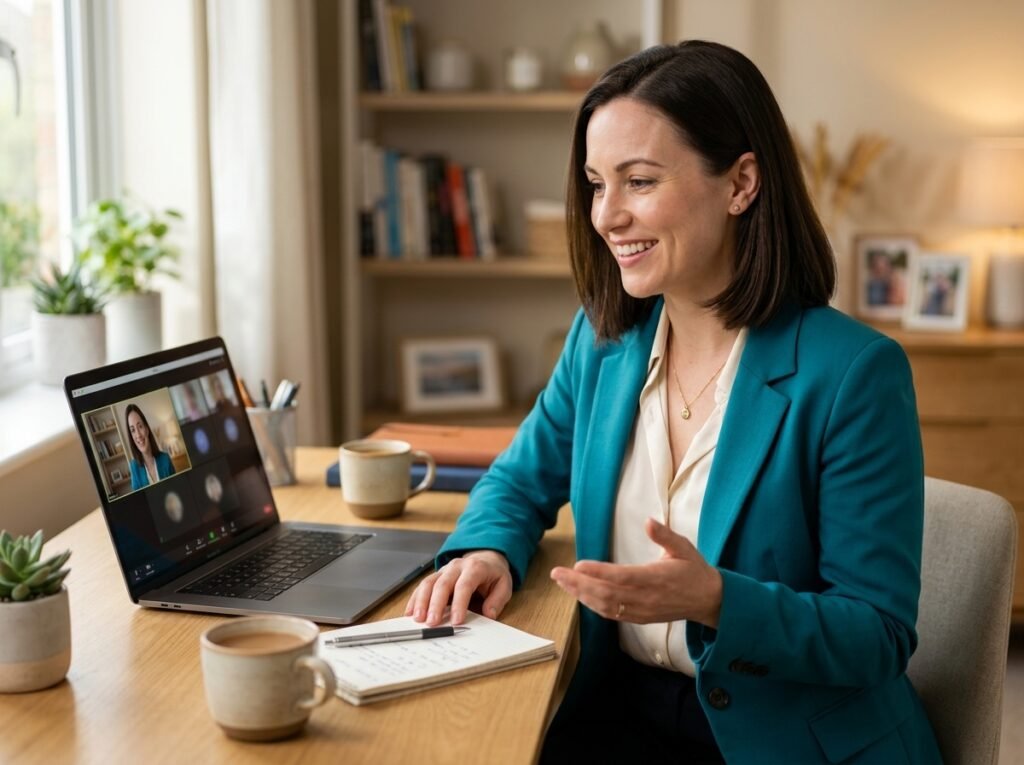
Yes, dress your whole outfit, not just the top half. It helps you feel professional and protects you if you need to stand up. Solid mid-tones like navy, teal, or dusty rose look good on most cameras. Avoid tiny stripes or busy patterns, which can shimmer on screen, and skip bright white if your camera overexposes it.
Dressing for Second Interviews
Hocking College’s career guidance suggests dressing more formally than you did at the first interview and using the attire of the people who interviewed you as your style guide (Hocking College, accessed October 2026). That makes sense. By round two, you’ve seen how the team dresses.
| Format | Outfit Focus | Best Colors | Common Mistake | Quick Tip |
|---|---|---|---|---|
| Video interview | Neckline, shoulders, blazer | Navy, teal, dusty rose | Pajama pants and a blazer | Test on camera first |
| Phone interview | Mindset more than visibility | Any comfortable choice | Staying in loungewear | Dress up to feel focused |
| First in-person | Classic and neat | Navy, gray, black | Overthinking trends | Follow the Dress Code Decoder |
| Second in-person | Slightly more formal | Navy, charcoal | Dressing exactly the same | Match your interviewer’s level |
| Panel interview | Polished and balanced | Neutrals | Loud accessories | Keep it simple |
How to test your video interview outfit, step by step:
- Open your camera at the same time of day as the interview.
- Wear the full outfit, then check how colors look on screen.
- Check the neckline when you lean forward.
- Look at your background and move anything messy.
- Record a 30 second clip and watch it back.
- Adjust lighting so your face is clearly visible.
Pro Tip: Keep a second blazer or cardigan within arm’s reach for video calls. If the lighting makes your first choice look washed out, you can swap in seconds.
Q: What’s the best way to dress for a video interview? A: Wear a complete professional outfit in a solid mid-tone color, check it on camera first, and make sure your lighting and background are clean.
How Can I Dress for an Interview on a Budget?
Quick Answer: Build an 8-piece capsule wardrobe in neutral colors, shop sales and secondhand, borrow from career closets, and tailor one key piece. A complete outfit can cost about $60 to $300.
How can I dress for an interview when money is tight? It’s one of the most common questions, and it deserves an honest answer. You don’t need a big budget. You need a small, smart set of pieces that mix and match.
The 8-Piece Interview Capsule
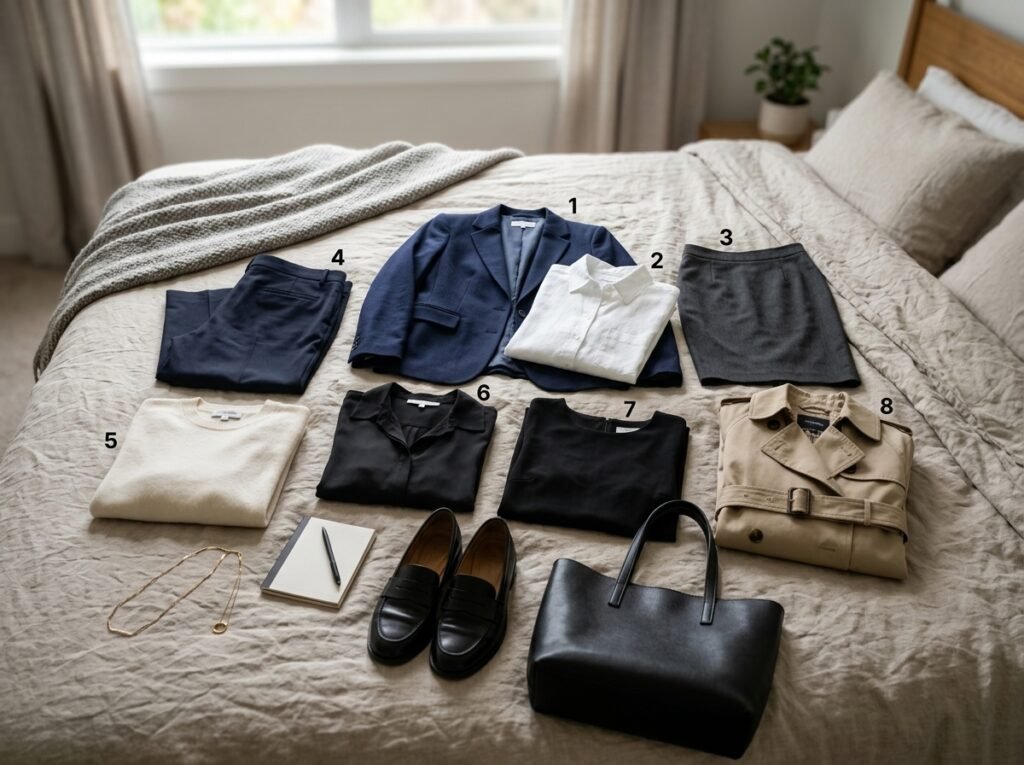
This is The 8-Piece Interview Capsule. These eight pieces can create more than a dozen outfits.
| Piece | Why It Earns Its Spot | Estimated Budget | Where to Look | Reuse Value |
|---|---|---|---|---|
| Navy blazer | Works with everything | $40 to $150 | Thrift stores, Old Navy, Banana Republic Factory | Very high |
| Black tailored trousers | Classic and flexible | $30 to $90 | Target, H&M, J.Crew Factory | Very high |
| White button-up | Crisp and clean | $20 to $60 | Uniqlo, Zara, Old Navy | High |
| Neutral knit top | Softer option | $15 to $50 | Target, Everlane | High |
| Sheath dress | One-piece solution | $35 to $120 | Ann Taylor Factory, Nordstrom Rack | High |
| Knee-length skirt | Variety | $25 to $80 | H&M, Target | Medium |
| Structured cardigan | Layer when it’s cold | $25 to $70 | Old Navy, thrift | High |
| Closed-toe flats | Comfort and polish | $30 to $90 | DSW, Nordstrom Rack | Very high |
Prices are editorial estimates and change often, so check live listings. Several stores listed run regular sales, which is where most of the savings are.
Where to Borrow and Save
Dress for Success is a nonprofit that provides professional attire and career support to women, and many colleges and community centers run free career closets too (Dress for Success, accessed October 2026). Thrift stores often carry blazers in excellent condition. And a $15 hem or sleeve tailoring job can make a $40 blazer look custom.
Tailoring and Care Basics
Spend your money on fit before fashion. Take your blazer or trousers to a tailor if the shoulders are right but the sleeves or hem are off. Press everything, and keep a stain remover pen in your bag.
How to build a budget interview outfit in 5 steps:
- Set a total budget, such as $100, and split it across blazer, bottoms, and shoes.
- Shop your closet first, then buy only the missing pieces.
- Check thrift stores and sale racks for blazers and trousers.
- Tailor one key piece if needed.
- Style it two ways (with and without the blazer) to test versatility.
Pro Tip: Buy the blazer first. A good blazer upgrades any top and bottom you already own, so it gives you the biggest visible improvement for the least money.
Q: How much should I spend on an interview outfit? A: Most candidates spend about $60 to $300 on a complete outfit, but a well-fitted $100 outfit usually looks better than an expensive one that doesn’t fit.
Interview Outfit Mistakes and Quick Fixes
Quick Answer: The most common interview outfit mistakes are poor fit, wrinkles, revealing pieces, uncomfortable shoes, and ignoring the dress code. Each one has a quick fix, usually in under ten minutes.
Most interview outfit mistakes are small and fixable. The trick is catching them before you leave the house.
Before and After: A Real Contrast
Before: A wrinkled polyester blouse, a too-tight skirt that rides up when sitting, brand-new shoes, and a loud statement necklace. She spends the interview adjusting her skirt and touching her necklace.
After: A steamed crepe blouse, tailored A-line skirt that passes the sit test, broken-in loafers, and small studs. She forgets about her clothes entirely and talks about her work. That’s the goal of interview clothes for women: to disappear into confidence.
Troubleshooting Table
| Problem | Why It Hurts | Quick Fix | Time Needed | Cost |
|---|---|---|---|---|
| Wrinkled clothes | Looks careless | Steam or iron | 10 minutes | $0 |
| Tight or short skirt | Distracting, uncomfortable | Swap to trousers or a longer skirt | 5 minutes | $0 |
| Visible stains | Suggests poor preparation | Stain pen or switch top | 5 minutes | $0 to $5 |
| Blazer too big | Looks borrowed | Tailor sleeves or choose another | 1 day | $15 to $30 |
| Scuffed shoes | Unfinished look | Wipe and polish | 5 minutes | $0 to $8 |
| Overpowering perfume | Distracts in small rooms | Skip it | 0 minutes | $0 |
The Day-Of Emergency Kit
Keep a small pouch in your bag with a stain remover pen, safety pins, a lint roller, blotting papers, mints, and a spare pair of neutral hosiery if you wear them. It takes two minutes to pack and can save the whole day.
How to fix an outfit emergency, step by step:
- Arrive 20 minutes early so you have a buffer.
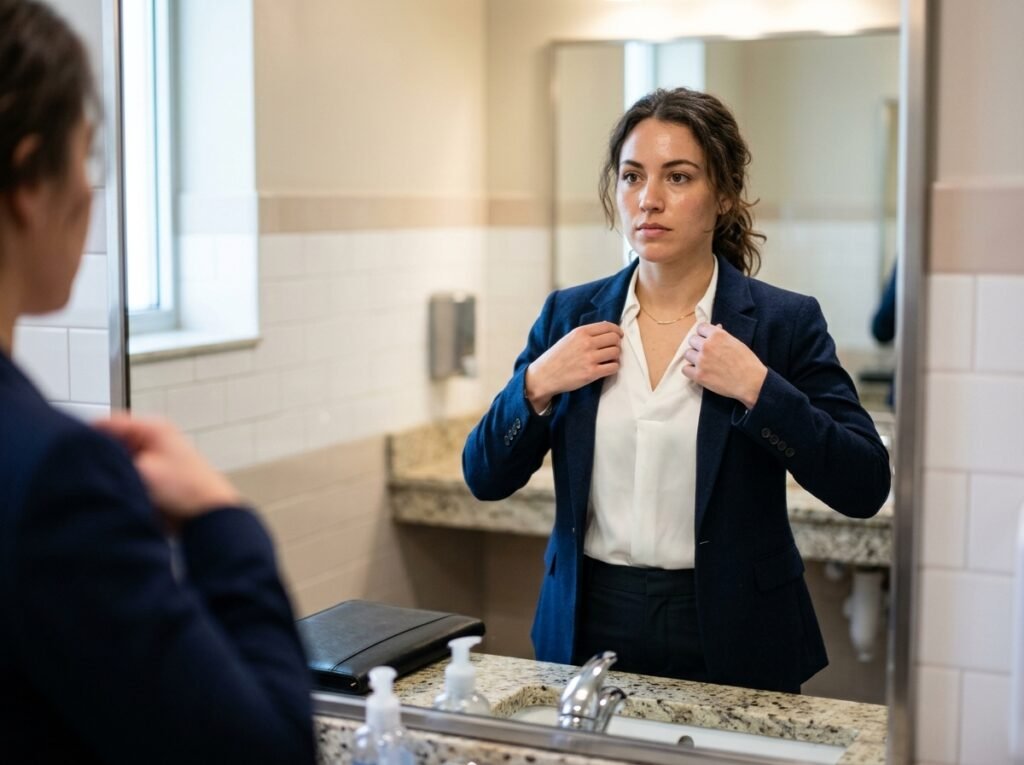
- Use the restroom to check the mirror before you check in.
- Treat stains right away with the pen and blot, don’t rub.
- Pin loose hems or gaping buttons discreetly.
- Take three slow breaths and walk in tall.
Pro Tip: Arrive early, but not too early. Aim to reach the lobby about 10 minutes before the interview, and use the 10 minutes before that for a final mirror check in a restroom or your car.
Q: What if my outfit gets stained right before the interview? A: Blot the stain with a damp cloth and a stain pen, remove your blazer if it covers the area, and carry on calmly, because interviewers care more about composure than a tiny mark.
Honest note on limits: The Accountemps survey is from 2019, and dress codes have loosened since remote work grew. The core rule (dress one step above the company’s norm) still holds, but you should confirm current expectations for your specific employer.
Interview Clothes for Women Comparison: Top Options at a Glance
This table stands on its own, so you can skim it without reading the rest of the article. The rating is an editorial Polish Score out of 10 for how safe and professional each outfit is across industries. Budgets are estimates for a complete outfit and vary by retailer.
| Option | Key Feature | Best For | Price | Rating |
|---|---|---|---|---|
| Matching pantsuit | Fully coordinated, most formal | Finance, law, corporate | About $120 to $300 | 9.5 / 10 |
| Sheath dress with blazer | One piece plus a layer, easy to wear | Most office interviews | About $80 to $220 | 9.0 / 10 |
| Blouse with tailored trousers and blazer | Flexible, mix-and-match | Business casual offices | About $70 to $200 | 9.0 / 10 |
| Midi skirt with knit top and cardigan | Softer, still professional | Education, healthcare, nonprofits | About $60 to $160 | 8.0 / 10 |
| Dark trousers with fine knit and structured jacket | Smart casual, modern | Tech, startups, creative | About $60 to $180 | 8.0 / 10 |
| Jumpsuit with blazer | Trend forward, one piece | Creative fields only | About $70 to $200 | 6.5 / 10 |
Our pick: The blouse, tailored trousers, and blazer combination is the best all-round option, because it adapts to almost any dress code and builds on pieces you may already own. If you’re interviewing in finance or law, upgrade to the matching pantsuit.
FAQ
What are the best interview clothes for women?
The best interview clothes for women are clean, well-fitted, professional pieces that sit one step above the company’s everyday dress code. Think a blazer, tailored trousers or skirt, a polished top, and closed-toe shoes. Neutral colors like navy, gray, and black are the safest starting points.
What should a woman wear to a job interview?
Wear a tailored top or dress, a blazer or cardigan, tailored trousers or a knee-length skirt, and closed-toe shoes. Add minimal jewelry and neat grooming. If you’re unsure about the dress code, ask the recruiter or look at employee photos online.
Is a suit still necessary for an interview?
Not always, because only 37% of senior managers say candidates should always wear a formal suit (Accountemps, 2019). A suit remains the safest choice for finance, law, and big city corporate roles. For most other workplaces, a polished business casual outfit with a blazer works well.
Can I wear jeans to an interview?
Only if you know the company is very casual, and even then it’s a risk. Dark, clean, well-fitted jeans paired with a blazer and polished shoes are safer than anything distressed. When you can’t confirm the dress code, choose trousers.
What colors are best for interview clothes?
Navy, black, gray, white, brown, and beige are the safest interview colors (TopInterview, accessed October 2026). Navy tends to look trustworthy and softer than black. A single accent color in a blouse or scarf is fine, but keep the overall look quiet and polished.
How much should I spend on an interview outfit?
A complete interview outfit can cost about $60 to $300 depending on where you shop, and fit matters more than price. Thrift stores, sale racks, and career closets can bring costs down. A $15 tailoring fix often does more than a $100 upgrade.
What’s the best way to dress for a video interview?
Dress fully from top to bottom, choose solid mid-tone colors such as navy or teal, and test your outfit on camera first. Avoid tiny stripes and very bright white. Check your lighting, your background, and your neckline when you lean forward.
What’s the best way to pick an outfit when I don’t know the dress code?
Research the company, ask the recruiter, and dress one step above what employees usually wear. If you can’t find anything, a navy blazer, tailored trousers, and a simple blouse is a safe default. It works for most business casual and smart casual offices.
What if my outfit gets stained or wrinkled on the day?
Carry a small emergency kit with a stain pen, a lint roller, and safety pins, and arrive early enough to fix problems. Blot stains, don’t rub. If the mark is on a blazer, you can often keep it on and stay composed, since interviewers care more about your confidence than a tiny flaw.
Final Takeaways
Three things matter most. First, decode the dress code and dress one step above it, because that rule works almost everywhere. Second, build your outfit with the 4-Piece Formula and check fit with the 3-Point Fit Check before the day. Third, spend your money on fit and finishing details, not labels. The right interview clothes for women make you feel capable, and that feeling shows.
Ready to get started? Pick your dress code row, choose your four pieces, and lay everything out tonight.
Next steps for the next 10 minutes:
- Identify the company’s dress code using LinkedIn, Instagram, or a quick note to the recruiter.
- Pick your outfit using the 4-Piece Formula and try it on.
- Run the sit test, steam anything wrinkled, and pack your emergency kit.
About the Author
Ambreen Fayyaz is a fashion and beauty writer at Zapy Beauty who covers workwear, professional style, and practical wardrobe guides for US readers. Over the past six months, she has focused on curating smart, versatile interview outfits and capsule wardrobes that help professionals step into every career milestone with confidence. Last Updated: October 19, 2026 Fact-Checked By: Ambreen Fayyaz Disclosure: This article contains no affiliate links.
References
- Robert Half (Accountemps). Are Suits Still Suitable for Job Interviews? Managers Split Between Formality and Function (2019).
- PLANSPONSOR. Should You Still Suit Up for a Job Interview? (2019).
- CPA Practice Advisor. Is a Business Suit Still Recommended for Job Interviews? (2019).
- Washington State University, Voiland College of Engineering and Architecture. What to Wear at a Job Interview (2021).
- Hocking College. Cracking the Dress Code: What to Wear for a Job Interview (accessed October 2026).
- TopInterview. What to Wear to a Job Interview as a Female (accessed October 2026).
- Flanelle. How to Dress for a Job Interview: Best Tips for Success (accessed October 2026).
- Dress for Success. Professional attire and career support for women (accessed October 2026).