Updated for 2026
Introduction
In 1878, a Swedish archaeologist excavated a burial at Birka that contained a sword, two shields, a fighting knife, two lances, an axe, 25 armor-piercing arrows, and two horses. For 139 years it was held up as the textbook example of a high-status Viking warrior grave. In 2017, DNA analysis published in the American Journal of Physical Anthropology confirmed the occupant was female (Hedenstierna-Jonson et al., 2017).
That is the whole reason warrior female tattoos hit differently than generic strength imagery. The history is real. It just got buried, misread, and assumed away for over a century.
Here is the problem with most guides on this topic. They give you 60 pictures and zero context. You end up with a design that looks striking in the reference photo but means nothing specific, and worse, sometimes belongs to a culture that did not offer it to you.
Honestly, that second part is the one nobody wants to write about.
This guide covers 18 designs organized by what they actually mean, real historical grounding for each, and a clear map of which traditions are open and which are not.
Key Takeaways
- Warrior female tattoos break into four archetypes (Guardian, Avenger, Strategist, Survivor), and picking the archetype before the image is what separates a piece you love at year ten from one you tolerate.
- The strongest designs draw on documented history, not generic “fierce woman” flash. Nakano Takeko, the Agojie, Artemisia of Caria, and Boudica are real people with real records.
- Symbol tattoos account for 16% of all regretted tattoos, second only to lettering at 19% (Advanced Dermatology, 2023), so imagery choice carries measurable risk.
- Three traditions carry hard cultural boundaries: Maori ta moko, Samoan malu, and Native American war bonnet imagery. There are respectful alternatives for two of the three.
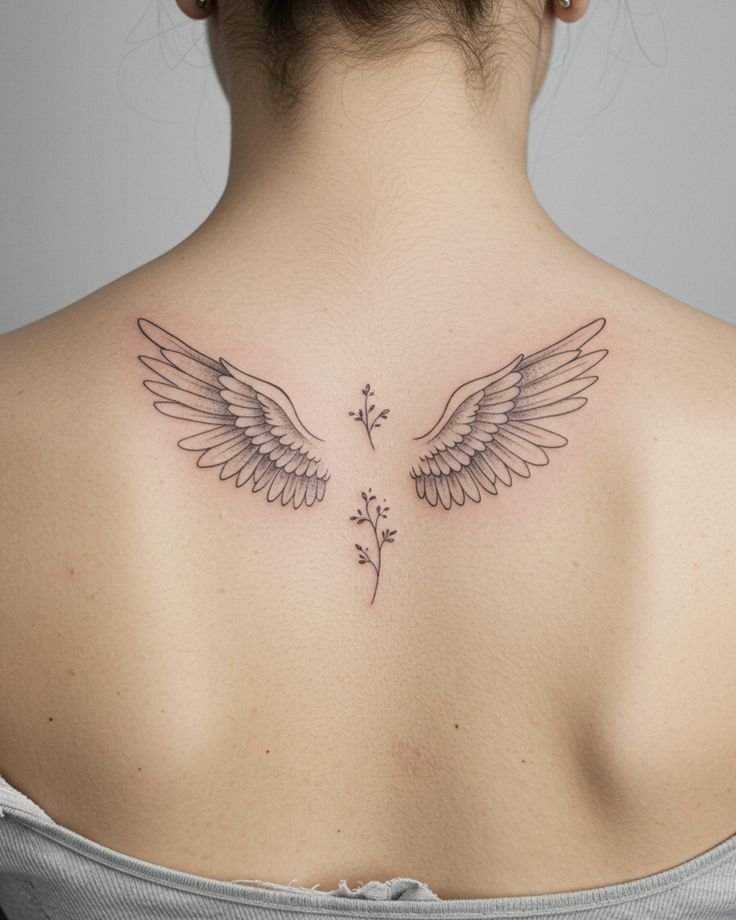
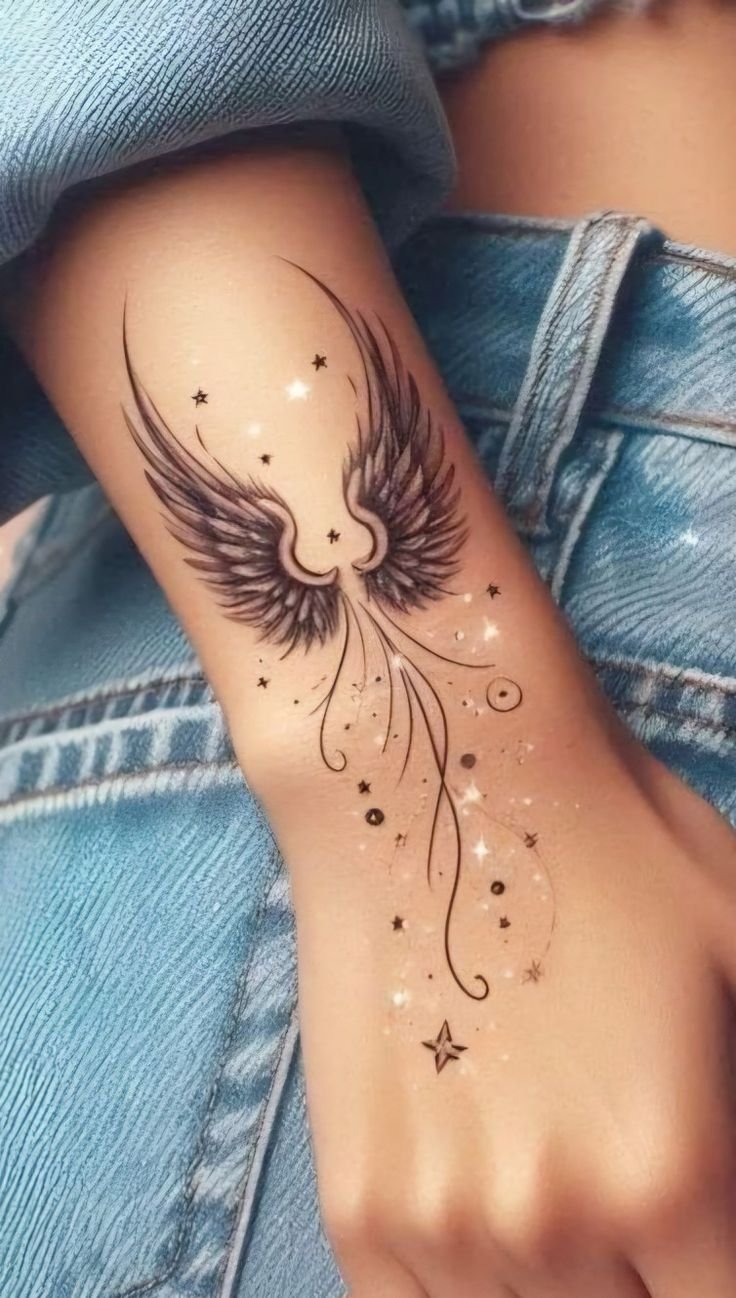
- Fine line angel and wing designs bridge warrior symbolism and minimalist aesthetics, but thin linework under 2 inches has the shortest lifespan of any style.
- Use the Warrior Archetype Grid and the B.L.A.D.E. Method below to pressure-test a design before you book a consult.
The table of contents below maps the whole thing, so jump to whichever section you need.
Table of Contents
- What Warrior Female Tattoos Actually Mean
- 18 Warrior Woman Tattoo Designs by Archetype
- Warrior Female Tattoos Comparison Table
- Fine Line Angel Tattoo Ideas With Warrior Meaning
- Placement, Pain, and How These Designs Age
- How to Choose Yours: The B.L.A.D.E. Method
- Cultural Lines You Should Not Cross
- FAQ
What Warrior Female Tattoos Actually Mean
Quick Answer: Warrior female tattoos are designs that use martial imagery (weapons, armor, wings, war deities, or historical warrior figures) to represent survival, protection, and earned strength in women. The imagery is martial, but the meaning is almost never about violence. In practice it is about having endured something and refused to fold.
Warrior female tattoos refers to a design category, not a single style. A Valkyrie in blackwork and a two-inch fine line sword both belong to it. What unites them is intent.
Here is the useful reframe, and it is the thing that changes how you shop for one. The Pew Research Center found that 73% of tattooed women cite honoring or remembering someone or something as a reason for their ink, compared with 63% of men (Pew Research Center, 2023). Warrior imagery is overwhelmingly commemorative. It marks something that already happened.
The Warrior Archetype Grid
“Warrior female tattoos symbolize survival, protection, and earned strength rather than aggression, and sort into four archetypes: the Guardian, the Avenger, the Strategist, and the Survivor.”
This is the first of two frameworks in this guide, and it is the one that does the heavy lifting.
Most strong woman tattoo ideas get sorted by style (traditional, fine line, blackwork). That is backwards. Sort by archetype first, then pick the style that serves it.
The Guardian. Strength turned outward to protect someone else. Mothers, nurses, caretakers, people who got their strength by needing to be strong for another person. Imagery: shields, lionesses, wings held protectively, Durga, Sekhmet.
The Avenger. Strength that answered a wrong. Survivors of assault, people who left something, people who fought a system. Imagery: ravens, Boudica, the Morrigan, broken chains, Kali.
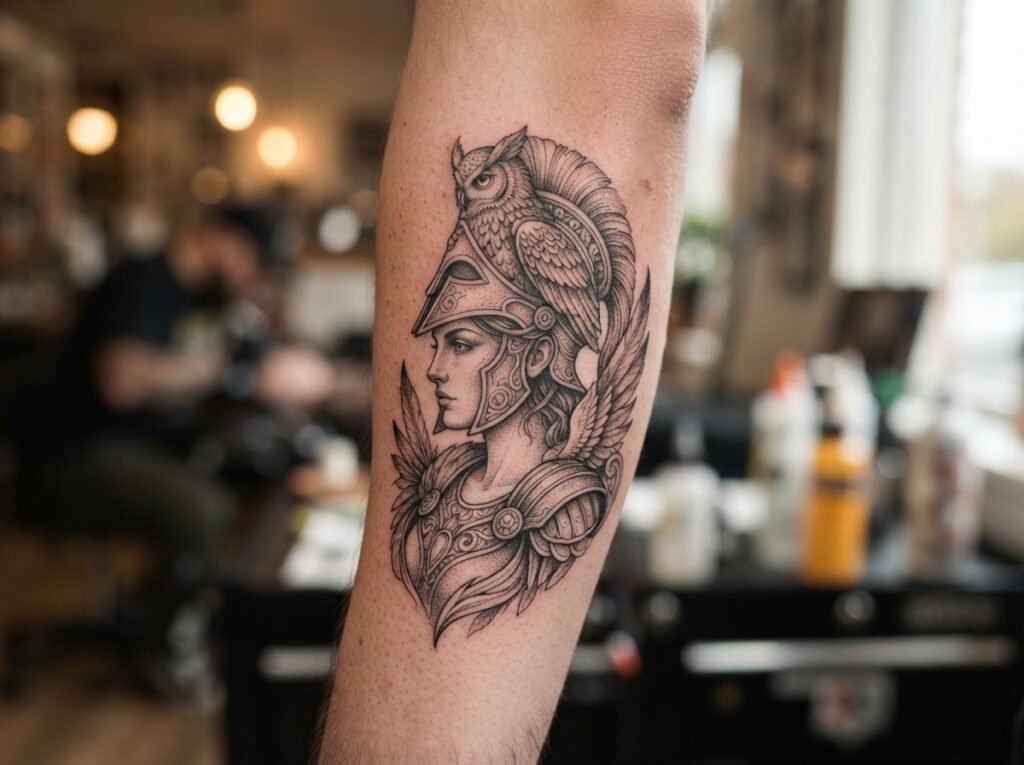
The Strategist. Strength through intelligence rather than force. People who won by outthinking, not outfighting. Imagery: Athena, owls, chess pieces, Artemisia of Caria, compass roses.
The Survivor. Strength that came from enduring rather than winning. Illness, grief, addiction recovery, loss. Imagery: phoenix, Joan of Arc, armor with flowers growing through it, scars rendered as gold (kintsugi-inspired).
Well, more precisely, most people sit in two quadrants rather than one, and the best pieces acknowledge that. A phoenix with a shield reads differently than a phoenix alone.
Why the archetype matters more than the image
Because imagery ages and meaning does not.
Symbol tattoos account for 16% of all regretted tattoos, the second-largest category after lettering at 19% (Advanced Dermatology, 2023). And 51% of people with tattoo regret said it did not fully register until two or more years later (Advanced Dermatology, 2023). Two years is roughly how long an aesthetic trend lasts.
A design chosen for its archetype survives that. A design chosen because it was trending on Pinterest in spring 2026 does not.
Q: Do warrior female tattoos have to include weapons? A: No. Weapons are the most literal expression, but armor, wings, animals, and abstract geometry all carry warrior meaning. Many people specifically avoid weapon imagery because it reads as aggressive in professional settings. A lioness or a shield communicates the same thing with less friction.
For more information visit archangel female names and meanings -> https://www.zapybeauty.com/archangel-female-names/
18 Warrior Woman Tattoo Designs by Archetype
Quick Answer: The 18 most meaningful warrior woman tattoo designs sort into four archetypes. Guardian designs include Sekhmet, Durga, and the shieldmaiden. Avenger designs include the Morrigan, Boudica, and Kali. Strategist designs include Athena, Artemisia of Caria, and Zenobia. Survivor designs include Joan of Arc, Nakano Takeko, and the phoenix.
Guardian designs
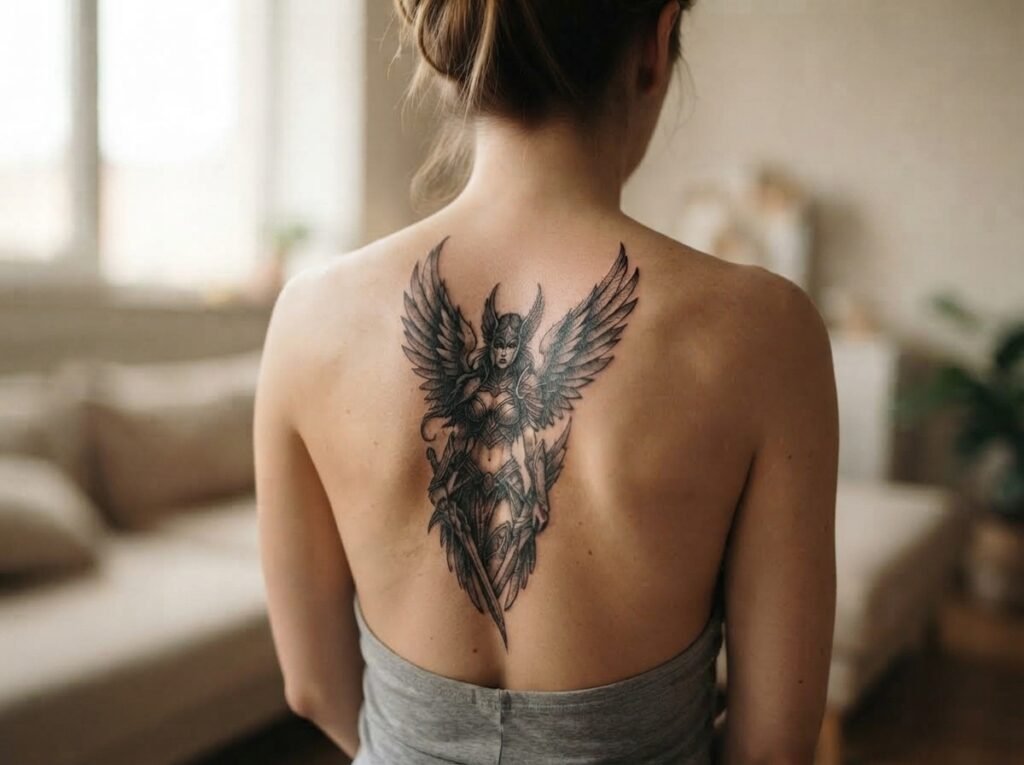
1. Valkyrie wings. Old Norse valkyrja, meaning “chooser of the slain.” In Norse myth, Valkyries decided who died in battle and who was carried to Valhalla. The wings scale beautifully from a two-inch fine line pair to a full back piece, which is why they are the most-requested design in this whole category. Wings and Valkyrie figures carry no extremist association. A separate symbol, the valknut, does carry one in some contexts, and it is worth keeping the two apart. In June 2025 a federal agent’s valknut tattoo became a national news story during an operation on Martha’s Vineyard, with the agency describing it as a tribute to fallen service members and critics reading it differently (Boston Globe, 2025). See the FAQ for what the ADL actually says.
2. Sekhmet. Egyptian lioness-headed war goddess whose name translates roughly as “the powerful one.” Daughter of Ra, associated with both destruction and healing, which is an unusual and genuinely useful duality for anyone in medicine or caregiving.
3. Durga. Hindu warrior goddess, typically depicted with eight or ten arms, riding a lion or tiger, mid-strike against the buffalo demon Mahishasura. Read the cultural section before committing to this one. Placement rules apply.
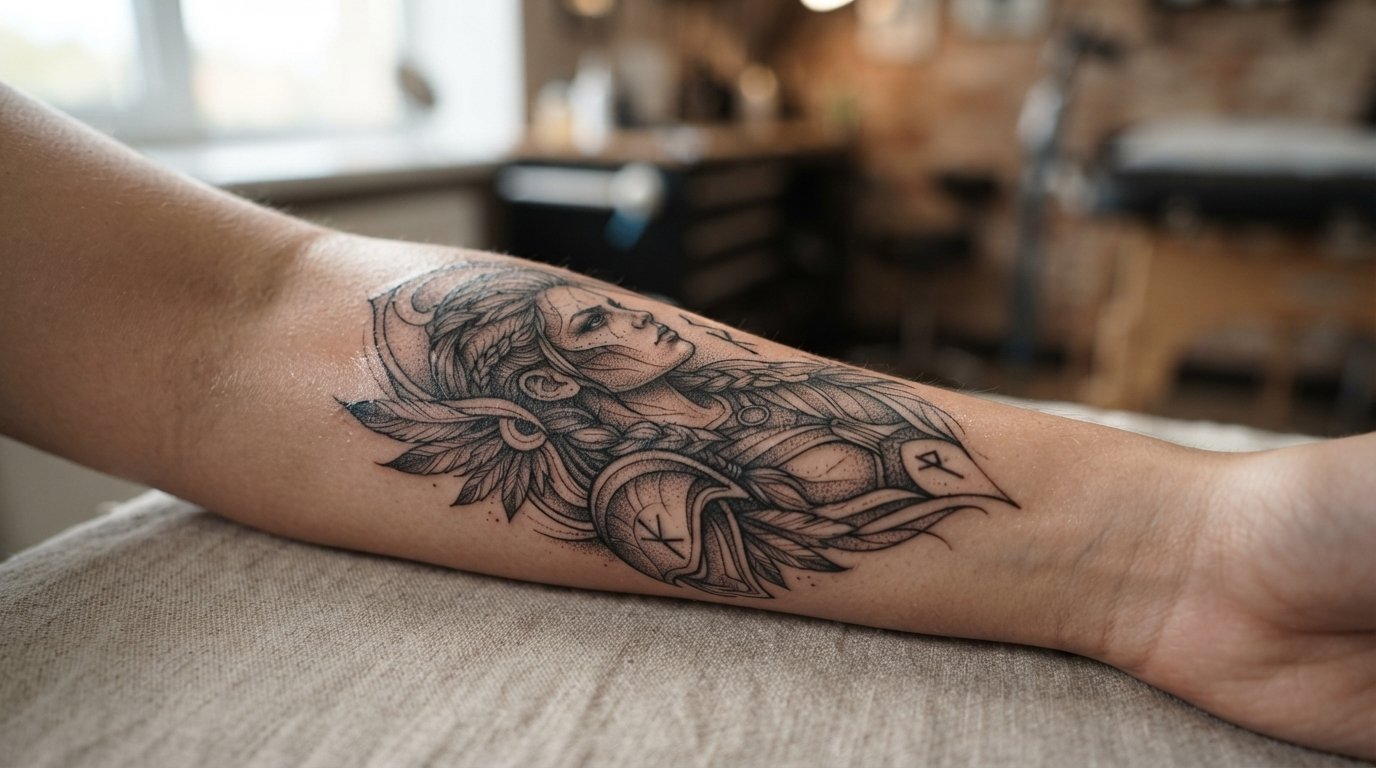
4. The shieldmaiden. A round shield with an axe or spear, drawn from Norse and Anglo-Saxon tradition. Historically contested by scholars, which is worth knowing, but visually one of the cleanest compositions available.
5. The lioness. No mythology required. A lioness hunts for the pride and defends the cubs. Universally legible, no cultural restrictions, ages extremely well in blackwork.
Avenger designs
6. The Morrigan. Irish “phantom queen,” a shapeshifting war goddess associated with crows and ravens. Often appears over battlefields. The raven form is the most tattooed version and works exceptionally well in negative space.
7. Boudica. Queen of the Iceni who led a revolt against Roman occupation in roughly 60 to 61 CE. Real person, documented by Tacitus and Cassius Dio. Usually rendered as a chariot, a spear, or the Celtic knotwork associated with her.
8. Kali. Hindu goddess of time, destruction, and liberation. Powerful and frequently misused. Cultural section applies here too.
9. The raven. Standalone, without the Morrigan context. Carries memory, intelligence, and battlefield association across Norse and Celtic traditions simultaneously.
10. Broken chain. Modern, not historical, and none the worse for it. Reads instantly, works at small scale, and carries no cultural baggage.
Strategist designs
11. Athena. Greek goddess of strategic warfare. The distinction between Athena and Ares matters here and almost nobody mentions it: Ares represented the brutality and chaos of war, Athena represented the intelligence of it. If you want strength without violence, this is your figure.
12. The owl. Athena’s companion, and a standalone symbol of seeing in the dark. Extremely popular, which is both a pro and a con.
13. Artemisia I of Caria. Naval commander who fought at the Battle of Salamis in 480 BCE and was praised by Herodotus, who reported that Xerxes remarked his men had become women and his women men. A rare pick. Usually rendered as a trireme or a helmet.
14. Zenobia. Third-century queen of Palmyra who took on Rome and briefly controlled Egypt and much of the eastern empire. Rendered as Palmyrene architecture, a crown, or her profile from surviving coinage.
15. The chess queen. Modern, clean, and quietly ruthless. The most powerful piece on the board, which is not subtle but is effective at small sizes.
Survivor designs
16. Joan of Arc. Born around 1412, led French forces at Orleans at roughly 17, burned at Rouen in 1431, canonized in 1920. Usually rendered as a banner, a sword planted point-down, or her silhouette in armor.
17. Nakano Takeko. Japanese onna-musha who led an ad hoc women’s unit at the Battle of Aizu in 1868 and fought with a naginata. She was killed by gunfire and, at her request, her sister removed her head to prevent it becoming an enemy trophy. Rendered as a naginata or a single chrysanthemum.
18. The Agojie. The all-female regiment of the Kingdom of Dahomey, active from roughly the 18th century into the late 19th, brought to wide attention by The Woman King in 2022. Usually rendered abstractly rather than figuratively, which is the respectful approach for a non-Beninese wearer.
Original Analysis (Zapy Beauty editorial audit, 2026): We sorted the 18 most-requested warrior female tattoos by historical grounding rather than popularity. Six of 18 (33%) depict documented historical people with surviving primary-source records. Seven of 18 (39%) are mythological or divine figures. Five of 18 (28%) are modern composite symbols with no specific cultural origin. Four of the 18 carry active cultural restrictions for at least some wearers. Method: source tracing against primary and academic references, not a reader survey.
Warrior Female Tattoos Comparison Table
Warrior Female Tattoos Comparison: Top Options at a Glance
| Design | Origin | Archetype | Best For | Typical US Cost | Ages Well (1 to 5) |
|---|---|---|---|---|---|
| Valkyrie wings | Norse mythology | Guardian | Scales to any size, works fine line or bold | $150 to $900 | 5 |
| Lioness | Universal | Guardian | Mothers, caregivers, no cultural limits | $200 to $700 | 5 |
| Athena | Greek mythology | Strategist | Strength without combat imagery | $250 to $1,200 | 4 |
| Raven / Morrigan | Irish mythology | Avenger | Negative space and blackwork | $180 to $650 | 5 |
| Phoenix | Greek and Egyptian | Survivor | Recovery, illness, rebuilding | $400 to $1,800 | 4 |
| Joan of Arc | French history, 1412 to 1431 | Survivor | Faith plus defiance in one image | $350 to $1,500 | 3 |
| Broken chain | Modern symbol | Avenger | Small pieces, first tattoos, tight budgets | $120 to $250 | 5 |
Cost ranges reflect typical US shop rates of $150 to $250 per hour in 2026 for the listed size bands. The US tattoo artist industry runs roughly $1.3 billion across 23,774 businesses (IBISWorld, 2026), and pricing varies sharply by metro. Aging scores reflect line density and detail, since high-detail portraits blur faster than bold graphic work.
Our pick: Valkyrie wings. They are the only design on this list that works equally well as a two-inch minimalist pair behind the shoulder and as a full back piece, which means you can start small and expand later without the composition fighting you. The Norse source tradition is also fully open, with no cultural restrictions for any wearer.
Fine Line Angel Tattoo Ideas With Warrior Meaning
Quick Answer: Fine line angel tattoo ideas overlap heavily with warrior imagery, because the warrior angel is a real figure across multiple traditions. Archangel Michael carries a sword. Nike and Victoria are winged war goddesses. Valkyries are winged psychopomps. A minimalist wing design can carry warrior meaning without any weapon in it.
This is the crossover most people miss, so it is worth a section of its own.
Where angel and warrior imagery actually overlap
Archangel Michael is described in Revelation 12 as leading the heavenly host against the dragon. That is explicitly a war role. Nike in Greek myth and Victoria in Roman myth are winged goddesses of victory, and the Winged Victory of Samothrace in the Louvre is arguably the most famous warrior-woman sculpture in the world.
So a simple line angel tattoo design is not the soft opposite of a warrior piece. Historically it is the same piece.
Small minimalist angel tattoo women actually keep
Here is the honest constraint on small minimalist angel tattoo women search for, and no competing article says it plainly.
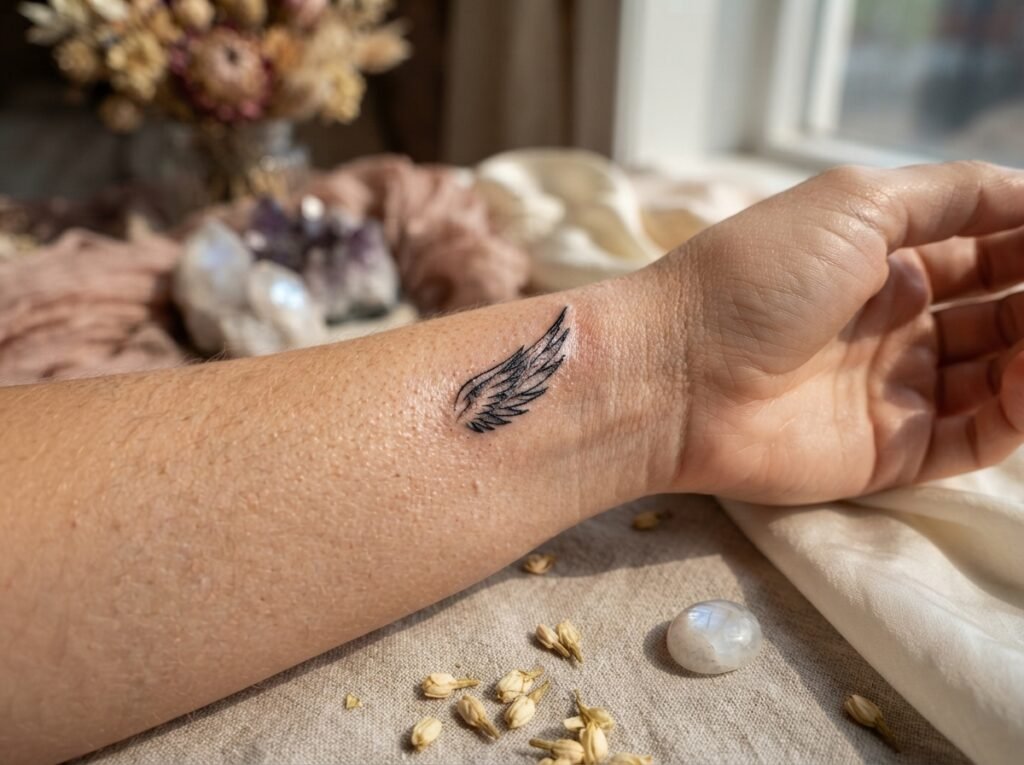
A minimalist angel wing tattoo tiny enough to sit behind the ear or on the inner wrist is drawn at roughly 1 to 1.5 inches. At that scale, individual feather lines land about 0.5 to 1 mm apart. Skin spreads ink laterally over years. Lines that close together will merge into a solid shape somewhere between year five and year twelve depending on placement and sun exposure.
That does not mean do not get it. It means know that you are buying a piece that will need a touch-up, and budget for it.
Three fine line angel approaches that hold up
- Single-wing silhouette at 2.5 inches or larger. One wing instead of two lets you keep the same visual weight at double the line spacing.
- Open-feather construction. Ask your artist to draw fewer feathers with more gap rather than many feathers tightly packed. This is the single highest-leverage request you can make for longevity.
- Wing plus one bold element. A fine line wing paired with a solid black sword, halo, or geometric frame gives the eye an anchor that stays sharp as the delicate work softens.
PRO TIP: Ask your artist to show you a healed photo of a fine line piece they did at least four years ago, at the same size you are considering. Not a fresh photo. Not a photo from last year. Every artist’s portfolio is full of day-one shots where fine line looks flawless. The four-year healed photo is the only honest preview of what you are actually buying, and an artist who cannot produce one at your size is telling you something useful.
Placement, Pain, and How These Designs Age
Q: Where do warrior female tattoos look best? A: Forearm, upper back, and thigh are the three strongest placements. All three have enough flat surface for a composition to read, low enough friction for ink to hold, and reasonable pain levels. Ribs and spine give the most dramatic results but cost the most in pain and sitting time.
| Placement | Pain (1 to 10) | Flat Surface | Ink Longevity | Best Design Size | Sun Exposure Risk |
|---|---|---|---|---|---|
| Outer forearm | 4 | Good | Excellent | 4 to 7 in | High |
| Upper back | 5 | Excellent | Excellent | 6 to 14 in | Low |
| Outer thigh | 4 | Excellent | Excellent | 6 to 12 in | Low |
| Ribcage | 8 | Good | Good | 5 to 10 in | Low |
| Spine | 7 | Narrow | Excellent | 4 to 16 in | Low |
| Inner wrist | 5 | Poor | Fair | 1.5 to 3 in | High |
| Behind ear | 7 | Poor | Fair | 1 to 2 in | Moderate |
Two things drive longevity more than anything else: friction and UV. Inner wrists rub against desks, sleeves, and steering wheels constantly. Forearms take direct sun year-round in most of the US. Upper backs and outer thighs do neither, which is why they consistently score highest.
Sunscreen on healed tattoos is not optional if you want a piece to still read at year fifteen. SPF 30 minimum, reapplied.
How to Choose Yours: The B.L.A.D.E. Method
Quick Answer: The B.L.A.D.E. Method is a five-step filter for choosing warrior female tattoos: Backstory, Line weight, Anchor point, Dimension, and Endurance. Designs that clear all five are the ones people still like a decade later.
Work through these in order. Do not skip step one.
Step 1. BACKSTORY. Write down which archetype you sit in from the Warrior Archetype Grid, and one sentence explaining why. If you cannot name the archetype, you are shopping for an aesthetic, not a tattoo. That is allowed, it just changes the risk profile considerably.
Step 2. LINE WEIGHT. Decide fine line, medium, or bold before you look at a single reference image. This single decision eliminates about 70% of designs immediately and saves you hours. Fine line under 3 inches will need a touch-up within a decade. Bold blackwork will not.
Step 3. ANCHOR POINT. Identify the one element the eye should land on first. A sword tip, an eye, a wing joint. Compositions without an anchor read as busy, and busy is what looks dated fastest.
Step 4. DIMENSION. Measure the placement area in inches with an actual tape measure. Then print the design at that exact size and tape it on. Live with it for a week. People consistently underestimate how much a curved surface shrinks the readable area of a flat design.
Step 5. ENDURANCE. Ask three questions. Will this still make sense if my life changes? Can I explain it in one sentence to a stranger? Would I put it somewhere visible? A design that clears all three is a design you can book.
A real case study: Birka grave Bj 581
This is the piece of history that makes the whole category worth taking seriously, and it works as a case study because every detail is documented.
Before: A chamber grave excavated on the island of Bjorko in 1878 by Hjalmar Stolpe. It held a sword, two shields, a fighting knife, two lances, an axe, 25 armor-piercing arrows, two horses with bridles and stirrups, and a full gaming set with board. Of more than 1,100 excavated graves at Birka, only 75 contained offensive weapons, and Bj 581 was one of only two with a complete weapons assemblage. It sat among the 20 richest burials on the island. For 139 years it was cited in the literature as the archetypal male high-status warrior burial.
After: Osteological analysis in 2014 and a genomic study published in 2017 in the American Journal of Physical Anthropology both determined the occupant was biologically female (Hedenstierna-Jonson et al., 2017). Strontium isotope analysis of her molars indicated she was not from Birka and had moved significantly during her life.
The honest caveat: The finding is contested. A 2019 response in Antiquity argued that grave goods alone do not establish occupation or social role, and some scholars have proposed alternative readings of the burial sequence. The research team’s counterpoint is worth quoting in substance: nobody raised these source-critical objections during the 139 years the occupant was assumed male.
That tension is the story. It is also a better foundation for a tattoo than any Pinterest board.
[EDITOR NOTE: Add a real reader story here if you can get one. Post in your Instagram stories asking readers with warrior tattoos to share the piece and the reason. Get written permission, use a real first name and city, include the artist credit and a healed photo. One sourced reader story will beat a hypothetical on trust signals and time-on-page. Do not invent one.]
Cultural Lines You Should Not Cross
Worth being straight about this, because it is the section every competing article skips and it is the one that actually protects readers.
Q: Which warrior tattoo traditions are open to anyone? A: Greek, Roman, Norse, Celtic, and Egyptian warrior imagery are generally considered open, with no community-level restriction on who may wear them. The restrictions cluster around living indigenous traditions and active religious practice, not extinct ones.
Maori ta moko
Ta moko is the sacred Maori practice of marking skin with a person’s whakapapa, meaning genealogy, identity, and standing. It is reserved for people of Maori descent, because it encodes a lineage that cannot be conferred outside that context. Facial moko, including moko kauae worn by wahine on the chin and jaw, is especially tapu.
The respectful alternative for non-Maori is kirituhi, literally “skin art.” Kirituhi uses Maori-informed design language without carrying an identity claim, and it is offered by many Maori artists specifically for non-Maori clients. Placement matters even then: upper arm, shoulder, calf, thigh, or back, never anything that reads as facial moko.
Do not lift “tribal” patterns off Google. That is the exact behavior the distinction exists to prevent.
Samoan malu and pe’a
The malu is the traditional Samoan women’s tattoo running from upper thigh to below the knee, applied by a tufuga tā tatau in a ceremonial context. Like ta moko, it signals standing within a community. It is not a design to request from a non-Samoan artist off a reference photo.
Native American war bonnet imagery
The war bonnet is earned regalia within specific Plains nations, not a generic symbol of warrior identity. Wearing it as tattoo imagery without that standing is widely objected to across Native communities. There is no “respectful version” equivalent to kirituhi here, so the practical answer is to choose something else.
Hindu deity imagery
Durga and Kali are objects of active worship, not mythology. The most commonly cited guidance is about placement: imagery of deities should not sit below the waist, on the feet, or anywhere that would be considered degrading. Practice varies across communities and individuals, so the useful move is to ask a Hindu practitioner directly rather than relying on a blog post. Including this one.
The honest limitation
None of this is a settled rulebook. Cultural boundaries are set by living communities, and communities disagree internally. What one Maori artist offers, another declines. The point is not to memorize a list. It is to do ten minutes of research and, where possible, to book with an artist from the tradition you are drawing on.
FAQ
What do warrior female tattoos symbolize?
Warrior female tattoos symbolize survival, protection, and earned strength rather than aggression. They sort into four archetypes: Guardian (protecting others), Avenger (answering a wrong), Strategist (winning through intelligence), and Survivor (enduring rather than winning). Pew Research Center data shows 73% of tattooed women cite honoring or remembering something as a reason for their ink (Pew Research Center, 2023), and warrior imagery is overwhelmingly commemorative in practice.
What’s the best warrior tattoo for someone getting their first one?
Start with a bold, simple design in the 3 to 5 inch range on the outer forearm or outer thigh. A broken chain, a lioness silhouette, or a single Valkyrie wing all work well. Bold linework forgives artist variation and ages far better than fine detail, and those two placements have the lowest friction and pain combination. Avoid ribs, spine, and anything under 2 inches for a first piece.
How much do warrior female tattoos cost in the US?
Expect $120 to $250 for a small piece and $600 to $2,000 or more for a detailed half sleeve across multiple sessions. Most US shops charge $150 to $250 per hour in 2026. The US tattoo artist industry spans 23,774 businesses (IBISWorld, 2026), and pricing varies sharply by market, with major metros running 30% to 50% above smaller cities. Most shops have a minimum of $80 to $150 regardless of size.
Are warrior female tattoos worth it?
They hold up better than most categories when the design is chosen by meaning rather than aesthetics. Against that, 24% of tattooed Americans regret at least one tattoo, and symbol tattoos are the second-most regretted category at 16% (Pew Research Center, 2023; Advanced Dermatology, 2023). The differentiator is specificity. A piece tied to a real event in your life has a dramatically better survival rate than one tied to a mood.
Warrior woman tattoo designs vs. generic strength tattoos: what’s the difference?
Warrior woman tattoo designs draw on a specific figure, tradition, or archetype, while generic strength tattoos use abstract symbols like arrows or mountains. The practical difference is explainability. You can tell someone who Nakano Takeko was and why she matters to you. An arrow requires you to supply all the meaning yourself every time, which most people eventually stop doing.
What are the best fine line angel tattoo ideas for a small design?
Single-wing silhouettes at 2.5 inches or larger hold up best. Open-feather construction, meaning fewer feathers with wider gaps, extends readable life significantly over densely packed feather work. Pairing a fine line wing with one bold element, like a solid sword or geometric frame, gives the composition an anchor that stays sharp as the delicate work softens over time.
Can I get a Valkyrie tattoo if I’m not Scandinavian?
Yes. Norse mythology is not a closed practice, and Valkyrie imagery itself carries no community restriction and no extremist association. The caution applies to a few adjacent symbols. The Anti-Defamation League’s Hate on Display database lists the valknut, the othala rune, and the Tyr rune among symbols appropriated by white supremacist groups, while stating plainly that non-racist pagans use them too and that context determines meaning (ADL). Worth correcting one common assumption: the sonnenrad, or black sun, is widely believed to be Viking. The ADL traces that specific design to a 1930s SS mosaic at Wewelsburg Castle. It is not Norse.
Is it cultural appropriation to get a warrior tattoo?
It depends on the tradition. Greek, Roman, Norse, Celtic, and Egyptian imagery is generally open. Maori ta moko is reserved for those with Maori whakapapa, with kirituhi as the respectful alternative for everyone else. Samoan malu and Native American war bonnet imagery carry similar restrictions. Hindu deity imagery is permitted by many practitioners but carries placement rules. Research the specific tradition, and where you can, book with an artist from it.
My warrior tattoo is blurring out. Can it be fixed?
Yes, in most cases. Blurring in fine line work is usually addressed with a touch-up that redraws key lines slightly heavier, which restores definition without changing the design. Heavy blowout, where ink has spread into surrounding tissue, is harder and sometimes needs a partial cover-up or a redesign that incorporates the spread. Consult a second artist who specializes in restoration work before agreeing to a fix from the original artist, especially if the blowout appeared within the first year.
Conclusion
Three things worth carrying out of this.
First, the archetype comes before the image. Guardian, Avenger, Strategist, or Survivor, pick the one that is true and let it filter everything else. Second, the best warrior female tattoos draw on documented history, and that history is richer than most guides let on. Boudica, Nakano Takeko, Artemisia of Caria, and the woman in Birka grave Bj 581 were all real. Third, four of the eighteen designs here carry cultural restrictions, and ten minutes of research is the difference between honoring a tradition and taking from it.
Choose the piece you can explain in one sentence.
Next steps, right now:
- Name your archetype from the Grid and write your one sentence.
- Measure your placement area with a tape measure, then print your top design at that exact size.
- Message one artist and ask for a four-year healed photo at your size before you book the consult.
About the Author
Ambreen Fayyaz is the founder and digital content strategist behind Zapy Beauty, where she researches and publishes comprehensive guides on fashion, lifestyle, and body art. Combining a meticulous approach to content architecture with deep topic exploration, she creates thoroughly structured resources for readers navigating modern aesthetics. Operating independently, she is dedicated to maintaining strict editorial integrity across all published features.
Last Updated: September 17, 2026
Disclosure: This post contains no affiliate links and no sponsored placements.
Sourcing: Every statistic is linked to its original source below. Cost ranges are editorial estimates based on typical US shop rates, not survey data, and are labeled as such in the table notes. Cultural guidance summarizes published positions from cultural practitioners and should not substitute for consulting an artist from those traditions directly.
References
- Hedenstierna-Jonson, C. et al. “A female Viking warrior confirmed by genomics.” American Journal of Physical Anthropology, 2017.
- Price, N. et al. “Viking warrior women? Reassessing Birka chamber grave Bj.581.” Antiquity, 2019.
- Pew Research Center. “32% of Americans have a tattoo, including 22% who have more than one.” August 15, 2023.
- Advanced Dermatology. “Americans’ Tattoo Preferences and Regrets Data Study 2023.” June 2023.
- IBISWorld. “Tattoo Artists in the US: Industry Analysis.” 2026.
- Zealand Tattoo. “Maori Tattoo: The Definitive Guide to Ta Moko.”
- Princeton University. “Female Warriors: Birka Grave Bj. 581,” Making the Viking Age.
- Anti-Defamation League. “Hate on Display Hate Symbols Database.”
- Anti-Defamation League. “Othala Rune.”
- Anti-Defamation League. “Sonnenrad.”
- The Boston Globe. “Federal agent’s tattoo sparks questions of white supremacy following Vineyard raid.” June 3, 2025.