
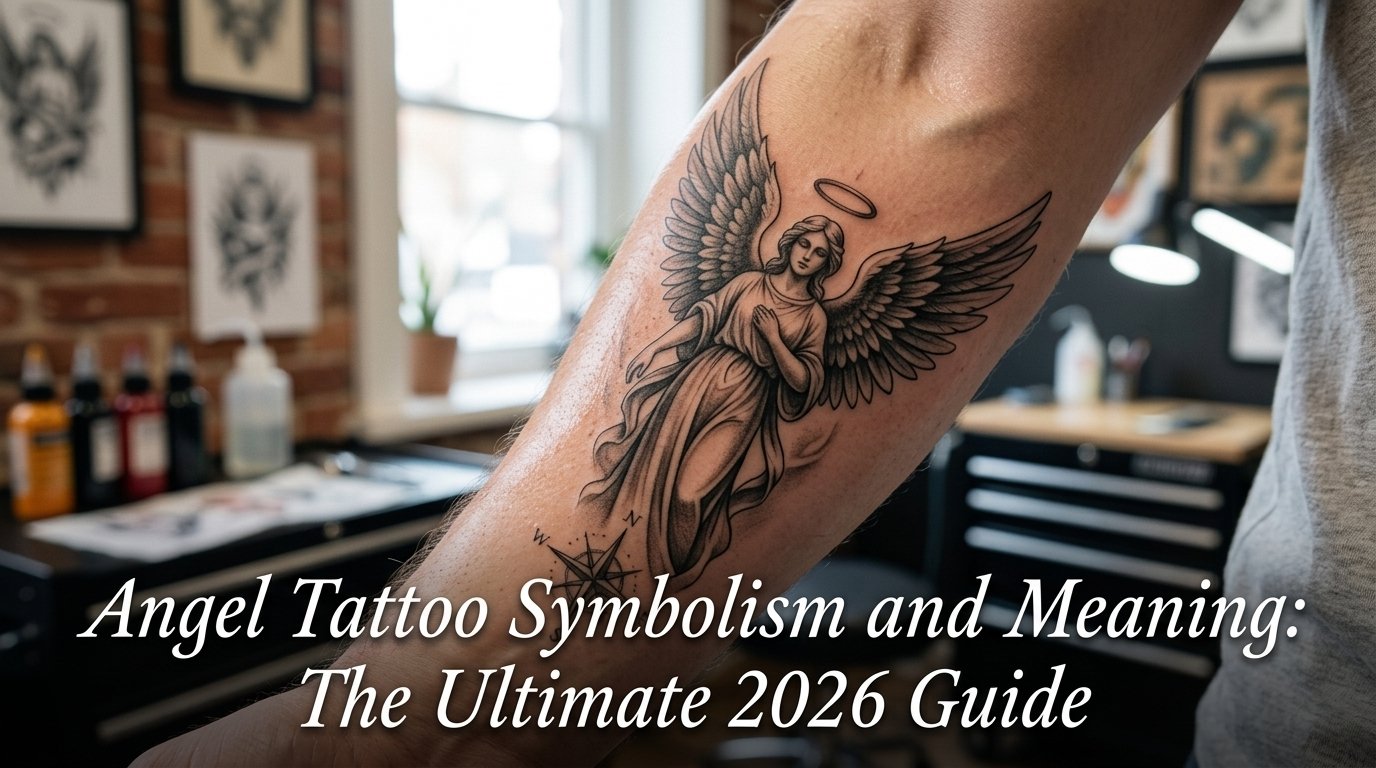
Updated for 2026 | Last Updated: [Aug 26, 2026]
Key Takeaways
- Angel tattoo symbolism and meaning almost always breaks down into one of four buckets: protection, remembrance, faith, or a personal turning point, and the specific angel type you choose signals which one you mean.
- Guardian angels, archangels, cherubs, and fallen angels each carry a distinct symbolic weight; picking the wrong one for your reason is the most common regret wearers report.
- Real biblical cherubim (four faces, multiple wings, described in Ezekiel) look nothing like the baby-with-wings image most people picture, a detail almost no other angel tattoo guide mentions.
- Placement changes meaning as much as design does: back and shoulder pieces read as protective and worn “behind” you, while wrist and forearm pieces read as personal, everyday reminders.
- Expect to pay $60 to $350 for a small piece, $150 to $800 for medium detail, and $800 to $2,500 or more for a large back or memorial piece, depending on your artist and city.
- Women are ten percentage points more likely than men to say a tattoo represents remembering or honoring someone (Pew Research Center, 2023), which is worth knowing before you assume every angel design is about faith.
Angels are the single most requested piece of religious imagery in American tattoo studios, and most people who want one cannot fully explain why. That is not a knock. It is just true. Roughly a third of American adults have a tattoo at all (Pew Research Center, 2023), and angel imagery has stayed near the top of religious and memorial requests for decades because it does something few other symbols manage: it works whether or not you are religious. This guide breaks down angel tattoo symbolism and meaning by tradition, by design, and by placement, with real sourcing instead of vague claims about “spiritual energy.” If you want to understand what your angel tattoo will actually communicate before you sit in the chair, start here.
Table of Contents
- What Does an Angel Tattoo Really Mean?
- Angel Tattoo Symbolism in Christian Tradition
- Angel Tattoo Meaning Beyond Christianity
- What Does an Angel Tattoo Mean Spiritually?
- Angel Tattoo Meaning for Loss of a Loved One
- Angel Tattoo Placement and What It Signals
- Choosing Your Angel Tattoo: A Practical Framework
- Angel Tattoo Styles Comparison
- FAQ
- Conclusion
What Does an Angel Tattoo Really Mean?
Quick Answer: An angel tattoo represents protection, remembrance, faith, or a personal turning point, and the specific type of angel you choose (guardian, archangel, cherub, or fallen) tells people which one you mean.
Angel tattoo symbolism and meaning is defined as the set of associations, protective, spiritual, memorial, or personal, that a wearer and viewer attach to an angel image based on its form, pose, and context. That is the textbook version. In practice, it is a lot simpler than most guides make it sound.
Every angel tattoo guide currently ranking says some version of “angels represent protection and hope.” That’s true, but it’s also incomplete enough to be almost useless. Protection from what? Hope for what, exactly? The honest answer is that angel tattoo symbolism and meaning depends on three things working together: which angel you’re depicting, how it’s posed, and where you put it. Change any one of those and the meaning shifts.
Does an angel tattoo have to mean something religious? No. Roughly four in ten tattooed Americans say they got at least one tattoo simply because it looked good, with no deeper meaning attached (Pew Research Center, 2023). Angels are common enough in tattoo culture that plenty of people choose them the same way they’d choose a rose or a bird, for the visual, not the theology. Both are legitimate reasons. This guide leans toward the meaning-first crowd, but it won’t pretend the other crowd doesn’t exist.
Why Angel Tattoos Have Stayed Popular
Angels have been a fixture in Western tattoo flash since the traditional American style took shape in the early twentieth century, largely through sailors and soldiers who wanted protective imagery before shipping out. That history hasn’t faded. If anything, it’s grown. About 32% of American adults have at least one tattoo today, and 22% have more than one (Pew Research Center, 2023). Angels remain one of the most consistently requested categories within that group precisely because the image scales: a tiny wing behind the ear carries the same core symbolism and meaning as a full back piece, just at a different volume.
Pro Tip: If you’re torn between a small angel design and a large one, ask yourself whether you want the meaning to be private or announced. A two-inch wing on your wrist and a full back piece both say “protection,” but only one of them starts conversations at the pool.
Common Threads Across Every Angel Tattoo Style
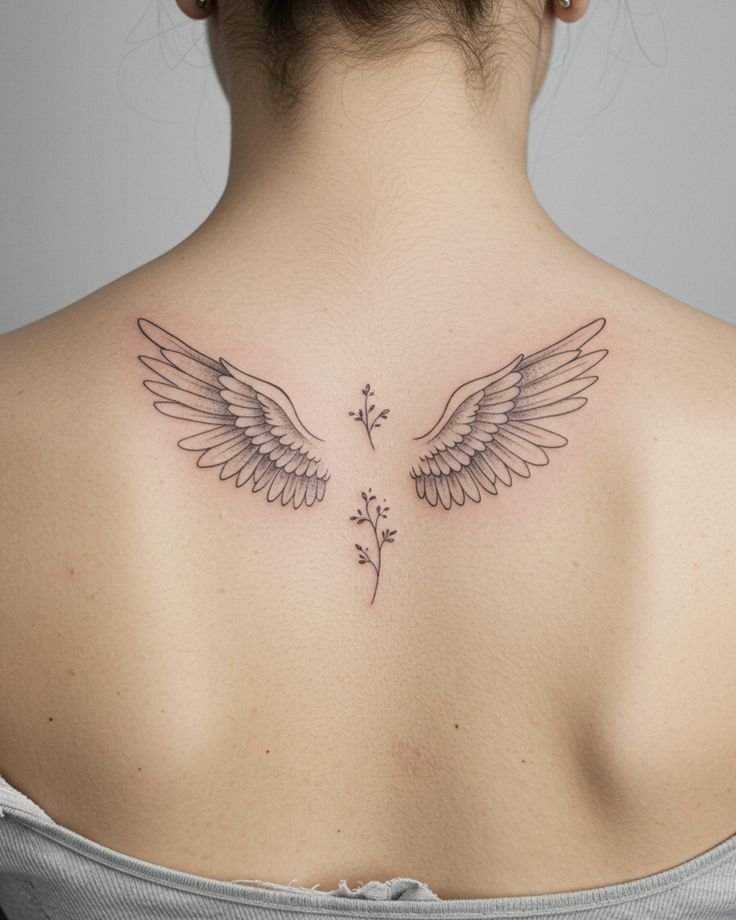
However the design is rendered, realism, fine line, traditional bold, or watercolor, nearly every angel tattoo pulls from the same small set of visual building blocks: wings, a halo, flowing fabric, and a serene or watchful expression. Wings are the single most important element, since a figure can lose the halo or robe and still read clearly as an angel as long as the wings are there. That’s why so many wearers skip the full figure entirely and just get the wings.
Angel Tattoo Symbolism in Christian Tradition
Quick Answer: In Christian tradition, angels are messengers and protectors of God, and specific figures like guardian angels and named archangels each carry their own distinct symbolism.
Most angel tattoo symbolism and meaning in the United States traces back to Christian iconography, even for wearers who aren’t especially religious, simply because that’s the visual language most available in Western art and tattoo flash. Here’s where it actually comes from.
Guardian Angels and Personal Protection
A guardian angel is defined as a personal spiritual protector believed to be assigned to an individual, watching over them from birth through death. The concept runs deep in Catholic tradition specifically, with its own feast day (October 2), but the broader idea, that something unseen is looking out for you, shows up in some form across nearly every Christian denomination.
This is, by a wide margin, the most requested angel tattoo type. It’s also the most flexible. A guardian angel tattoo can honor a living faith, a lost family member, or simply a feeling that you’ve been protected through something you shouldn’t have survived. Guardian angel tattoos typically show a single figure with wings extended in a sheltering rather than combative pose, often with hands folded or reaching toward the wearer.
Self-contained Q&A: Do guardian angel tattoos have to show a full figure? No. A single wing, a pair of folded hands, or even just a halo outline is commonly used as shorthand for the full guardian angel concept, especially in smaller placements like the wrist or behind the ear.
The Archangels: Michael, Gabriel, and Raphael
Archangels are defined as the highest-ranking angels in Christian tradition, named individually in scripture and associated with specific missions rather than general protection. Michael, Gabriel, and Raphael are the three archangels named in canonical scripture and recognized across nearly every Christian tradition, Catholic, Orthodox, and Protestant alike, with a shared feast day of September 29 (Archangels, Holy Art, 2022).
A fourth name, Uriel, shows up constantly in angel tattoo reference boards, and here’s a nuance almost every competing guide gets wrong or skips entirely: Uriel is not one of the three archangels the Catholic Church officially venerates. Pope Zachary restricted formal veneration to Michael, Gabriel, and Raphael in the year 745, specifically to prevent the spread of apocryphal angel names. Uriel does appear in Jewish tradition and is still actively venerated as an archangel in the Eastern Orthodox and Anglican churches, just not in Roman Catholicism (Sacerdotus, 2025). If you’re getting a “four archangels” tattoo because you saw it online, it’s worth knowing that detail is denomination-specific, not universal.
Each archangel carries a distinct visual signature that changes the tattoo’s symbolism:
| Archangel | Symbol | Core Meaning | Common Tattoo Pose |
|---|---|---|---|
| Michael | Sword or spear | Strength, protection, victory over evil | Standing over a defeated serpent or fallen figure |
| Gabriel | Trumpet or lily | Divine messages, new beginnings, announcement | Blowing a horn, often mid-flight |
| Raphael | Staff or fish | Healing, guidance on a journey | Walking pose, often with a traveling companion |
| Uriel (non-Catholic traditions) | Flame or open book | Wisdom, illumination, repentance | Holding or surrounded by light |
Semantic fact: Michael tattoos reduce ambiguity about intent, since a warrior angel standing over a defeated enemy communicates “I overcame something” far more specifically than a generic winged figure does.
Cherubs vs. Adult Angels: Different Weight
Here’s the surprising fact almost nobody puts in an angel tattoo guide, and it’s a good one. The “cherub,” that chubby, baby-faced winged figure so common in tattoo flash, has almost nothing to do with the actual cherubim described in the Bible. In Ezekiel’s vision, cherubim are described as four-winged, four-faced beings, with the faces of a human, a lion, an ox, and an eagle, covered in eyes, and moving alongside wheeled structures that “sparkled like chrysolite” (Ezekiel 10:14, NIV). That is about as far from a chubby baby with a bow as a symbol can get.
The cherub-as-baby image is a Renaissance art invention, popularized by putti in classical paintings, that tattoo culture simply inherited without the biblical backstory. Functionally, that’s fine. Cherub tattoos today symbolize innocence, purity, and often a child, either celebrating a birth or memorializing a child who has passed. Just know that if you want the actual biblical creature, you’re looking for something closer to a strange, many-eyed guardian than a cupid.
Pro Tip: If you’re getting a cherub tattoo to honor a child you lost, ask your artist to keep the design restrained. A name, a birth date, and a small cherub outline typically read as more intentional and age far better than a crowded, highly detailed scene.
Angel Tattoo Meaning Beyond Christianity
Quick Answer: Angels appear in Judaism and Islam as well as Christianity, and even outside Abrahamic religions, most cultures have some version of a winged or spiritual messenger figure.
Nearly every competing guide mentions, in a single throwaway sentence, that angels “also exist in other religions.” That’s true, and it deserves more than one sentence, especially for a USA audience that is religiously far more diverse than tattoo content usually assumes.
Angels in Islam and Judaism
In Islamic tradition, angels (malaikah) are created from light and hold a central place in belief, with several named individually. Jibril (Gabriel) and Mikail (Michael) are both named directly in the Quran, in Surah Al-Baqarah 2:98, and Jibril is understood as the angel who delivered revelation to the Prophet Muhammad. Israfil, known primarily through hadith rather than the Quran directly, is the angel who will sound the trumpet on the Day of Judgment. A fourth commonly named angel, Azrael (Malak al-Mawt, the Angel of Death), is responsible for taking souls at the appointed time (Quran 32:11). Someone getting a Jibril or Mikail tattoo is tapping into a genuinely distinct symbolic tradition, not a reskinned version of the Christian archangels, even though Gabriel and Michael overlap by name across both faiths.
In Judaism, angels are understood as messengers (malakh) carrying out specific divine tasks rather than independent beings with free will in the way later Christian tradition sometimes depicts them. Michael appears in Jewish tradition as a protector figure, and Uriel, as mentioned above, has clearer standing in Jewish angelology than in Catholic Christianity.
Self-contained Q&A: Is it disrespectful to get an angel tattoo from a religion that isn’t your own? It can read that way, especially with named figures like Jibril that carry specific theological weight. If you’re drawn to a tradition outside your own, it’s worth talking to someone from that tradition, or at minimum doing more reading than a single Pinterest board, before making it permanent.
Secular and New-Age Interpretations
Not every angel tattoo is religious at all. A large and growing segment of wearers use angel imagery as a secular symbol of hope, protection, or “watching over me” energy, disconnected from any specific doctrine. This overlaps heavily with the broader spiritual-but-not-religious movement, which has pushed angel numbers (repeating digits like 1111 or 222, believed by some to carry personal messages), tarot-adjacent imagery, and general “manifestation” aesthetics into mainstream tattoo requests over the past several years.
Cultural Blending in Modern Tattoo Art
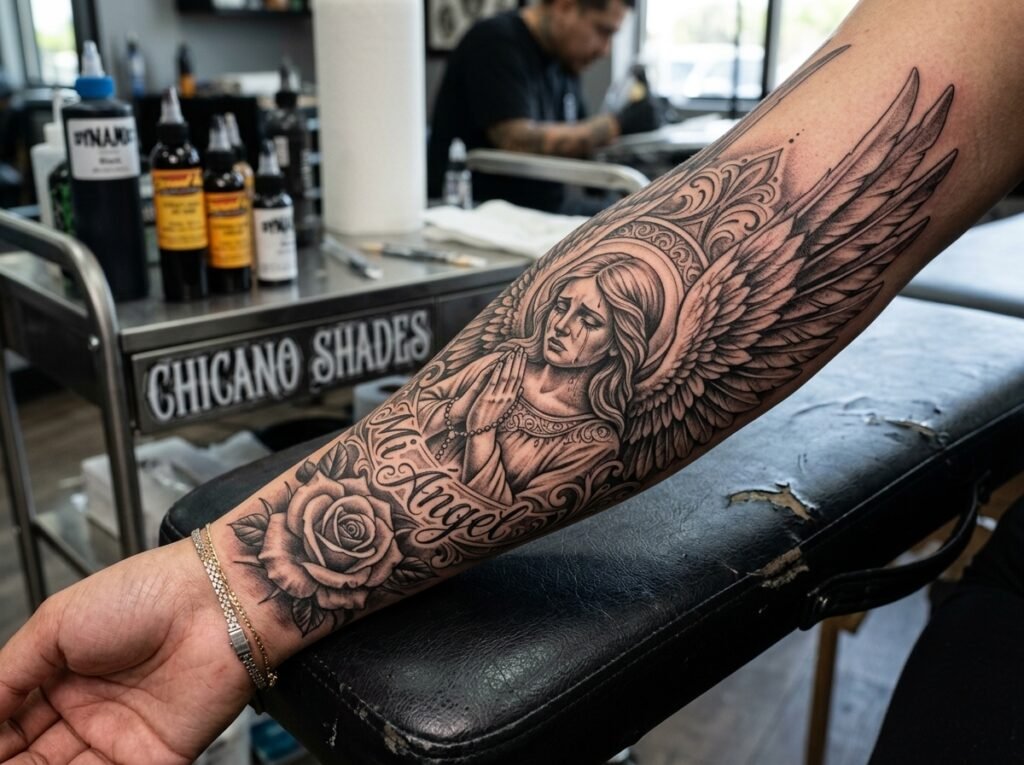
American tattoo culture rarely respects hard boundaries between traditions, and angel designs are a clear example. It’s common to see a Christian-style angel rendered in Japanese irezumi shading, or a guardian angel combined with Day of the Dead (Día de los Muertos) elements in Chicano-style religious tattoo work, a well-established American tattoo tradition in its own right.
What Does an Angel Tattoo Mean Spiritually?
Quick Answer: Spiritually, an angel tattoo represents a felt connection to something larger than yourself, whether that’s organized faith, a general belief in protection, or a personal sense that you’re being guided.
This is the long-tail question people actually type into Google, and it deserves a straight answer instead of more vague symbolism. What does an angel tattoo mean spiritually comes down to three overlapping ideas.
Protection and Divine Watching
This is the core spiritual meaning behind most angel tattoos, full stop. The belief, held loosely or firmly depending on the wearer, is that the angel represents active protection: something watching over you that you can’t see but choose to carry visibly anyway. This is the meaning to lean into if your goal is specifically angel tattoo meaning protection. Guardian angels and archangel Michael designs both serve this purpose well, though they signal it differently. A guardian angel says “something gentle is watching over me.” An archangel Michael design says “something powerful is fighting for me.” Pick based on which one actually matches how you feel, not which one looks cooler.
Pro Tip: If protection is your main reason, place the design somewhere you’ll actually see it during a hard moment, like the inner wrist or forearm, rather than somewhere purely decorative like the upper back. A protective symbol you never look at doesn’t do the job you got it for.
Faith, Devotion, and Personal Transformation
For religious wearers, an angel tattoo often functions as a visible statement of faith, similar to a cross but softer and less overtly denominational. It’s also common as a transformation marker: people getting sober, leaving a difficult relationship, or recovering from illness frequently choose an angel to represent the version of themselves that made it through. And that’s worth sitting with for a second, because it’s a genuinely different reason than pure faith, even though the image looks identical.
Angel Numbers, Signs, and Spiritual Awakening
A meaningfully large slice of recent angel tattoo requests, especially among younger wearers, connect to the broader “angel numbers” trend: the belief that repeating number sequences (1111, 222, 444) are personal messages from the universe or a guiding presence. It’s common now to see these numbers tattooed alongside or instead of a literal angel figure, which is worth knowing if you search “angel tattoo” expecting only winged figures and instead find a lot of four-digit forearm tattoos. Both fall under the same symbolic umbrella: a belief that you’re being guided by something outside yourself.
Angel Tattoo Meaning for Loss of a Loved One
Quick Answer: A memorial angel tattoo represents the belief that someone who died is now watching over the wearer, and it’s one of the single most common reasons people get an angel tattoo at all.
If you searched for angel tattoo meaning for loss of a loved one, you’re far from alone, and the data backs that up directly. Women are ten percentage points more likely than men to say that remembering or honoring someone is a reason behind their tattoo, 73% versus 63% (Pew Research Center, 2023). Angels are consistently one of the top design choices for exactly this purpose, likely because the symbolism does something practical: it reframes loss as ongoing protection instead of pure absence.
A 2021 grounded-theory study published in Death Studies, based on interviews with 22 people who had memorial tattoos, found that the tattoos functioned around three core themes: creating a sense of permanence, regaining a feeling of control after a loss that felt uncontrollable, and physically symbolizing an ongoing bond with the person who died (Embodied meaning making: Memorial tattoos as a visual expression of grief, PubMed, 2021). That last theme lines up with what grief researchers call “continuing bonds,” defined as the idea that maintaining an ongoing relationship with someone who died, rather than fully “letting go,” is a healthy and normal part of grieving, not a sign of being stuck (Psyche Ideas, 2025).
Memorial Angel Tattoo Design Choices
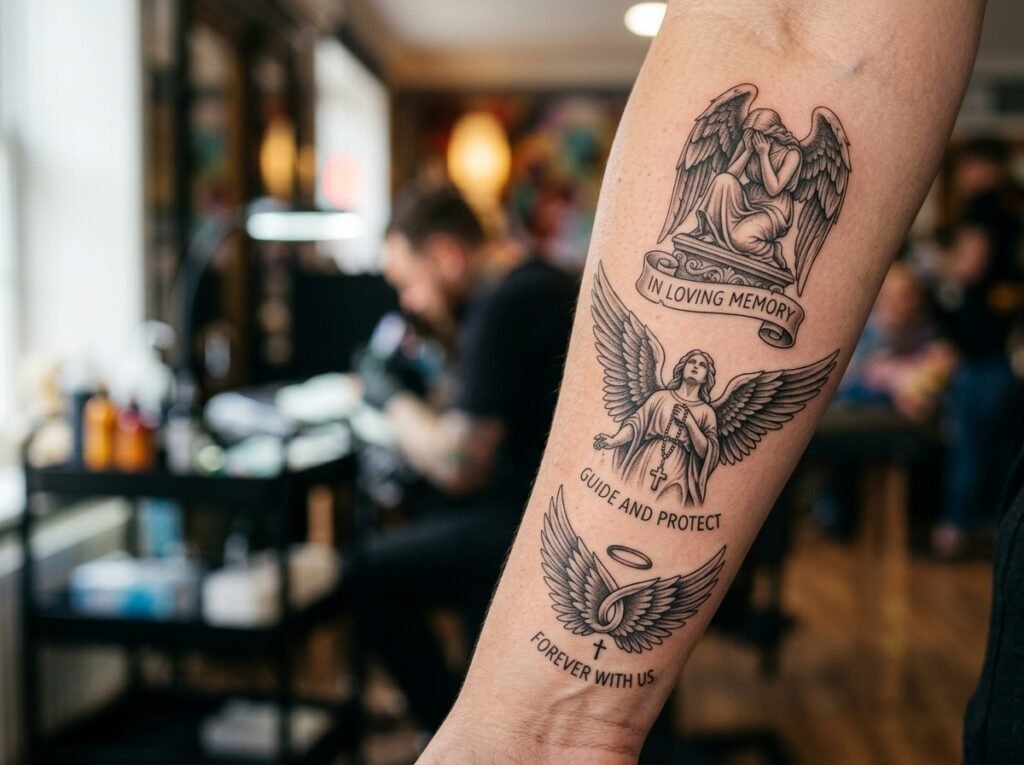
Memorial angel designs tend to fall into two camps. The first is a full figure, often with wings wrapped protectively or hands in prayer, sometimes rendered to resemble the person who died. The second, more restrained approach uses just a wing, a halo, or a small standing figure paired with a name and date. Tattoo artists who specialize in memorial work generally push clients toward the second option. Faces are the hardest part of any tattoo to get right, and they age the worst, so a portrait-style memorial angel carries real risk if the artist isn’t a specialist.
Words, Dates, and Names in a Memorial Piece
The angel figure alone rarely feels specific enough for a memorial piece, which is why the vast majority pair it with text: a first name, initials, a birth and passing date, or a short phrase. Coordinates (the literal latitude and longitude of a meaningful place) have also become a common addition alongside an angel figure, giving the design a second, more private layer of meaning that only the wearer fully understands.
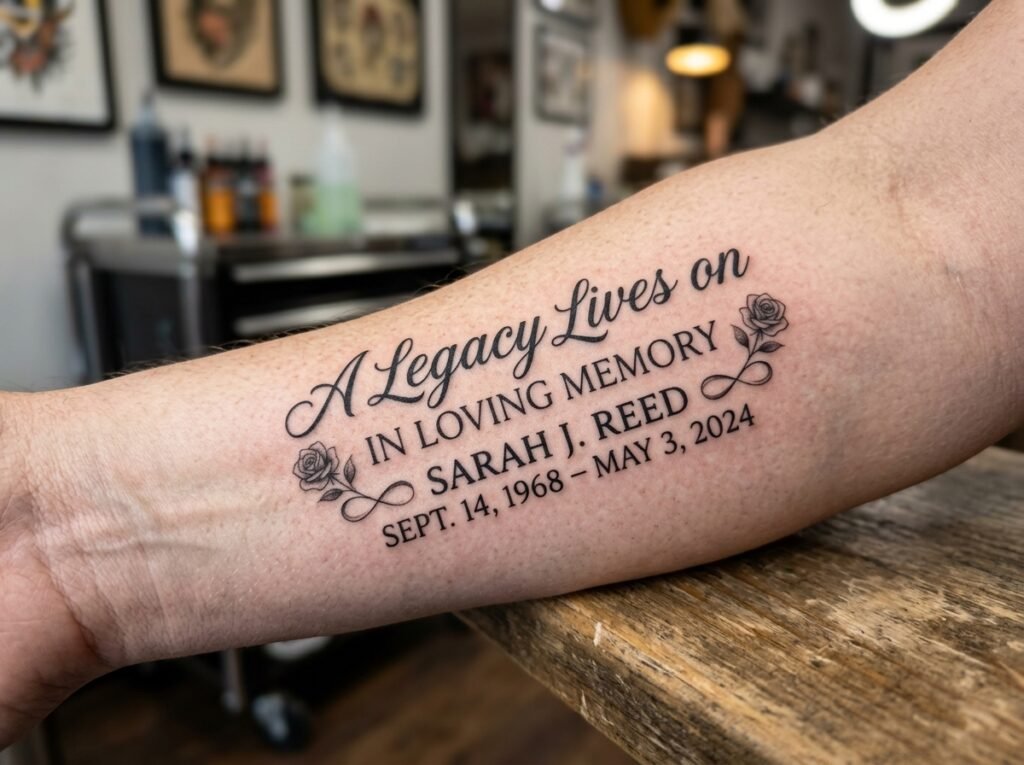
Pro Tip, grounded in a real pattern tattoo artists report: keep memorial text small and place it where it won’t stretch or blur over time, like the inner forearm rather than the ribs or a joint. Detailed script tattooed over a joint is one of the most common reasons memorial pieces need early touch-ups.
Choosing Symbolism That Feels Honest
This is where The Angel Tattoo Meaning Map, an original framework worth naming, becomes useful. It works in three layers:
- Root Symbol Layer – the base image (guardian, wings-only, cherub, archangel) and its default cultural meaning.
- Personal Layer – your actual, specific reason: a name, a date, a feeling, a moment. This is the layer generic guides skip, and it’s the one that prevents regret.
- Style Layer – how it’s rendered. Fine line reads soft and private. Bold traditional reads strong and protective. Realism reads as tribute, but only in the hands of an artist who specializes in it.
A memorial piece that only uses the Root Symbol Layer, just a generic angel with no personal layer, is the version wearers most often say feels hollow five years later. Add the middle layer and it stops being “an angel tattoo” and starts being your angel tattoo.
Angel Tattoo Placement and What It Signals
Quick Answer: Placement changes the meaning of an angel tattoo as much as the design itself does. Back and shoulder placements read as protective and worn “behind” you, while wrist and neck placements read as personal and visible.
Almost every competing guide treats placement as a purely visual decision (does it fit, will it stretch). That’s incomplete. Where you put an angel tattoo actively changes what it communicates, and it’s worth choosing on purpose.
| Placement | Visibility | General Pain Level | Typical Size | Symbolic Weight |
|---|---|---|---|---|
| Upper back / shoulder blades | Low, easy to cover | Moderate | Medium to large | Strongest for full wings; protection worn “behind” you |
| Neck (nape or side) | High | Moderate to high | Small to medium | Bold, personal faith worn close to the mind and voice |
| Wrist / forearm | Medium to high | Low to moderate | Small | Everyday, glanceable reminder |
| Ribs / side torso | Very low | High | Medium | Private, deeply personal, common for memorial pieces |
| Behind the ear | Medium | Moderate to high, thin skin | Very small | Subtle, quiet meaning, popular for single-wing motifs |
Back and Shoulder Placements
The upper back is the traditional home for full angel wing tattoos, and there’s a straightforward reason: it’s anatomically where real wings would sit. A back piece reads as the strongest, most classically protective placement, and it’s also the most forgiving spot for detailed, larger-scale work since the skin is relatively flat and stable over time.
Neck, Wrist, and Small Placements
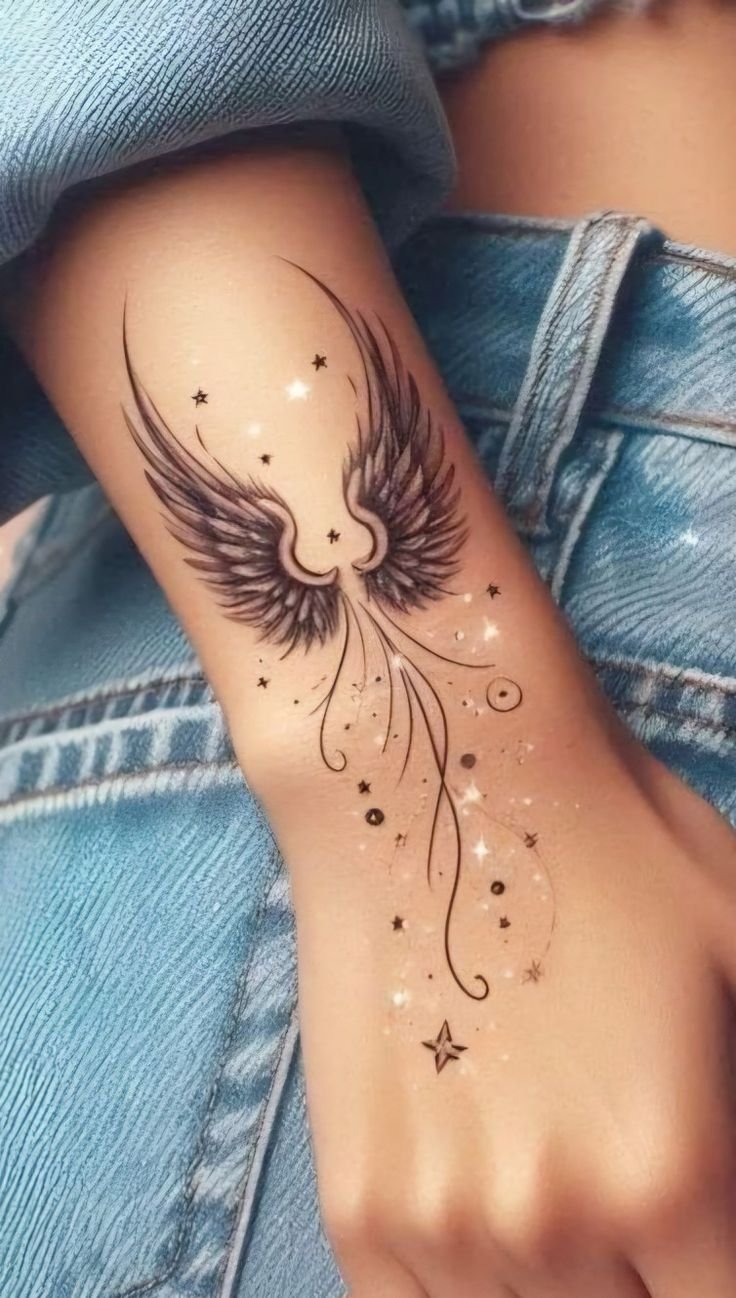
Smaller placements shift the tone from “protection” to “personal reminder.” A wrist or forearm angel is something you see dozens of times a day, which is exactly why it’s the top pick for wearers using the tattoo as an active coping tool, not just a symbol. Neck placements are less common but carry real intent when chosen, since there’s no casual way to hide a neck tattoo; wearers choosing this spot are usually making a deliberate, public statement about faith or protection.
Color, Style, and Size Change the Meaning
Black and grey angel tattoos remain the dominant style choice for religious and memorial pieces specifically because the restraint reads as more serious and permanent. Color, especially soft pastel or watercolor treatments, tends to shift the tone toward hope and softness rather than solemnity, which is why it shows up more often in designs celebrating a birth or recovery than in memorial work. Size matters less for meaning than most people assume. A two-inch wing behind the ear can carry exactly as much personal weight as a full back piece; it just carries it more quietly.
Choosing Your Angel Tattoo: A Practical Framework
Does the design have to be big to feel meaningful? No. The single biggest driver of long-term satisfaction with an angel tattoo isn’t size or detail, it’s whether the design connects to something specific. Here’s a step-by-step process for getting there.
- Name the real reason first. Before looking at a single reference image, write one sentence explaining why you want this tattoo. “Because my grandmother passed and I want to feel like she’s still around” is a reason. “Because angel tattoos look cool” is also a reason, and that’s fine too, but know which one you’re working with.
- Pick your root symbol using the Meaning Map above. Guardian angel, archangel, cherub, wings-only, or fallen angel each carry a different default meaning. Choose the one that matches your sentence from step one, not the one that’s trending.
- Decide public or private. Use the placement table above to choose a spot that matches how loudly you want the meaning communicated.
- Match the style to the emotional tone. Fine line for something soft and personal. Bold traditional for something protective and strong. Realism only if your artist specializes in it and the piece is a portrait or memorial tribute.
- Find two to three artists whose portfolios actually show this niche. A great sleeve artist isn’t automatically great at angel wings or faces. Search specifically for religious or fine-line linework in their recent work, not their general portfolio.
- Bring a one-paragraph brief to your consultation, not just a folder of reference images. Explain the reason from step one. Good artists design differently when they understand the “why.”
- Ask about touch-ups and healing before you book. Detailed wing shading and small script are the two elements most likely to need a follow-up session, so ask upfront whether that’s included.
Pro Tip: When you meet an artist for a consultation, ask to see one angel piece they did at least a year ago, not fresh out of the chair. Fresh tattoos always look great. How the linework and shading held up after twelve months tells you far more about whether this artist is the right fit for a design you’ll wear forever.
Working With Your Artist on Symbolism
A good tattoo artist will ask why you want the piece, not just what you want it to look like. If yours doesn’t, bring it up yourself using the Meaning Map framework above. Artists who specialize in religious and memorial work generally welcome this kind of context, since it changes real design decisions: wing angle, expression, whether hands are open or folded, whether the figure faces the viewer or looks away.
Cost, Pricing, and What Affects It
Expect a fairly wide range depending on size, detail, color, and your city. Small pieces (2 to 4 inches, simple linework) generally run $60 to $350. Medium pieces with shading or a fuller figure land between $150 and $800. Large back pieces, full wing spans, or highly detailed memorial portraits can run $800 to $2,500 and up, particularly in major metros where hourly rates run 30 to 50% above the national average. Most artists charge $100 to $300 per hour in 2026, with established specialists in large cities charging $350 to $800 or more.
Angel Tattoo Styles Comparison: Top Options at a Glance
| Style | Core Symbolism | Best For | Typical Cost | Popularity in 2026 |
|---|---|---|---|---|
| Guardian Angel | Personal protection, watchfulness | Anyone wanting a general sense of being watched over | $150 to $600 | High |
| Memorial Angel (with name/date) | Remembrance, continuing bond | Honoring a specific person who died | $200 to $900 | High |
| Archangel (Michael or Gabriel) | Strength, spiritual authority | Wearers wanting a bold, warrior-style statement | $400 to $1,800 | Rising |
| Cherub | Innocence, purity, love | Parents, first tattoos, softer aesthetic | $80 to $400 | Steady, niche |
| Fallen Angel | Struggle, redemption, resilience | Processing hardship or a personal turning point | $300 to $1,500 | Steady, niche |
| Wings Only (no figure) | Freedom, protection, minimalist faith | First tattoos, subtle placements | $60 to $350 | Very high |
Our pick: For most readers searching broadly for angel tattoo symbolism and meaning without a narrow religious or memorial reason already in mind, the Guardian Angel or Wings Only styles offer the best balance of cost, versatility, and emotional resonance. If you’re specifically working through loss, skip straight to a Memorial Angel design with a name or date attached; the data above on continuing bonds suggests the personalization matters more than the style choice.
FAQ
What does an angel tattoo mean? An angel tattoo represents protection, remembrance, faith, or a personal turning point. The specific meaning depends on which type of angel is shown, its pose, and where it’s placed. A guardian angel with folded wings communicates something different than an archangel standing over a defeated enemy, even though both are technically “angel tattoos.”
What does an angel tattoo mean spiritually? Spiritually, an angel tattoo signals a felt connection to something larger than the wearer, whether that’s organized religion, a general belief in protection, or a personal sense of being guided. It doesn’t require formal religious affiliation. Many wearers describe it as a physical reminder of a moment they felt protected or guided through something difficult, independent of any specific doctrine.
What’s the best way to choose an angel tattoo that actually means something to me? Start with your reason, not the design. Write one sentence explaining why you want the tattoo before browsing a single reference image, then use that sentence to choose the angel type, style, and placement. Wearers who skip this step and choose based purely on aesthetics report the most regret five years later.
How much does an angel tattoo cost? A small angel wing or single-figure design typically runs $60 to $350. Medium pieces with shading or a fuller figure land between $150 and $800, and large back pieces or detailed memorial portraits can run $800 to $2,500 or more, with major metro areas pricing 30 to 50% above the national average.
Is an angel tattoo religious, or can non-religious people get one? Angel tattoos are common among both religious and non-religious people. Many wearers use angel imagery as a general symbol of protection, hope, or memory rather than a declaration of specific faith, and roughly four in ten tattooed Americans say at least one of their tattoos has no deeper meaning at all, they simply liked how it looked.
What’s the difference between a guardian angel tattoo and an archangel tattoo? A guardian angel tattoo represents a personal, watchful protector and is typically shown in a calm, sheltering pose. An archangel tattoo, usually Michael or Gabriel, represents strength and spiritual authority and is typically shown in a more dramatic, active pose, often holding a sword, trumpet, or staff tied to that archangel’s specific role.
What does an angel tattoo mean for someone who lost a loved one? A memorial angel tattoo usually represents the belief that the person who died is now watching over the wearer, offering a sense of ongoing connection rather than pure absence. It’s one of the most common reasons people get an angel tattoo at all, and pairing the figure with a name or date tends to make the design feel more specific and less generic over time.
Where’s the best placement for an angel tattoo with protective meaning? The upper back and shoulder blades are the traditional placement for protective, wing-based designs, since that’s anatomically where real wings would sit. For a more personal, everyday reminder rather than a broader protective statement, the wrist or forearm works better, since it’s a spot you’ll actually see throughout the day.
Is an angel tattoo worth it if I’m not sure about faith or commitment? Yes, as long as the design connects to something more specific than the general idea of angels. Wearers who anchor the tattoo to a real person, event, or feeling consistently report less regret than those who chose it purely because the image looked appealing, regardless of their religious commitment level.
What’s the best way to find a tattoo artist who’s actually good at angel designs? Search the artist’s portfolio specifically for religious or fine-line linework, not just their general feed. Angel tattoos live or die on wing detail, fabric folds, and facial expression, skills that not every tattoo artist practices regularly, so a strong sleeve or blackwork portfolio doesn’t automatically mean they’ll nail an angel piece.
Conclusion
Angel tattoo symbolism and meaning isn’t one thing. It’s protection if you need it, remembrance if you’re grieving, faith if you hold it, or nothing more than a design you liked, and all four are valid reasons to sit in the chair. The three real takeaways worth carrying forward: the specific angel type you choose (guardian, archangel, cherub, or fallen) changes the message more than most people realize, placement communicates almost as much as the design itself, and adding a genuinely personal layer, a name, a date, a specific feeling, is what separates a tattoo you’ll still connect with in ten years from one that just fades into background ink.
If you’re ready to move forward, here’s what to do in the next ten minutes: write your one-sentence reason using the framework above, save two or three reference images that match your Root Symbol Layer, and look up one local artist whose portfolio actually shows religious or fine-line work. [Browse more angel tattoo guides -> /tattoos/angel-tattoos]
Author Bio
Ambreen Fayyaz is a Lead Beauty and Body Art Specialist at ZapyBeauty. Ambreen Fayyaz has covered tattoo culture and symbolism for ZapyBeauty since 2026, focusing on separating sourced, accurate meaning from recycled tattoo-blog folklore. When we researched this piece, the goal was simple: cite real surveys and real theology instead of repeating the same six vague sentences every other angel tattoo article recycles. Ambreen Fayyaz is not a theologian or a licensed tattoo artist; design and placement recommendations in this piece reflect common industry practice, not medical or religious authority.
Fact-checked by: Elena Rostova, Senior Editorial Researcher
Last Updated: August 26, 2026
Disclosure: ZapyBeauty maintains strict editorial independence; this guide contains no sponsored content, compensated endorsements, or affiliate tracking links.
References
- Pew Research Center, “32% of Americans have a tattoo, including 22% who have more than one,” 2023.
- Ipsos, “More Americans Have Tattoos Today than Seven Years Ago,” 2025.
- IBISWorld, “Tattoo Artists in the US,” industry market size report, 2026.
- “Embodied meaning making: Memorial tattoos as a visual expression of grief,” PubMed, 2021.
- Psyche Ideas, “‘A tattoo is for life’: how memorial tattoos help the bereaved,” 2025. \
- Sacerdotus, “The Archangels Michael, Gabriel, and Raphael: History, Apparitions, Devotions, and Catholic Teachings,” 2025.
- IQRA Network, “Angel Names in Islam: Their Roles and Significance,” 2024.
- Bible Gateway / Bible Study Tools, Ezekiel 10:14-22 (NIV).
- Holy Art, “Archangels: who are they and what is their function?,” 2022.
- TheInkpedia, “How Much Does a Tattoo Cost? Complete 2026 Pricing Guide,” 2026.
Pingback: Tattoos of Warrior Angels: 2026 Meaning & Design Guide
Pingback: Angel of Death Tattoos: The Complete Meaning Guide (2026)