Updated for 2026
Thirty two percent of American adults have at least one tattoo, and 22% have more than one (Pew Research Center, 2023). Somewhere in that growing crowd sits a design that keeps pulling people in even though it sounds grim on paper: the angel of death tattoo. Search that phrase and you’ll mostly land on pages that repeat the same four sentences about mortality and transformation. Nothing on what it actually costs. Nothing on how it heals. Nothing that helps you avoid ending up with a hooded skeleton doodle instead of the deliberate, personal piece you had in mind.
That’s the gap this guide closes. We looked at the real symbolism behind angel of death tattoos across Islamic, Jewish, and Latin American tradition, priced out what US artists actually charge in 2026, and built a step by step method for choosing a design you won’t want to cover up in five years.
Key Takeaways:
- An angel of death tattoo usually symbolizes protection, transformation, memorial grief, or acceptance of mortality, not just fear.
- It differs from a plain grim reaper mainly through wings, drapery, and a more spiritual art direction.
- 2026 pricing typically runs from about $150 for a small fine line piece to $2,000 or more for a detailed sleeve (Porter, 2025).
- Placement changes both how the design heals and how well it holds fine detail over time.
- Full surface healing takes about two months, with deeper skin layers settling for months after that (Cleveland Clinic Health Essentials).
- The artist you pick matters more than the exact style, since dark, high contrast work is genuinely hard to correct once it’s done.
Here’s everything covered below. Jump to whatever you need first.
Table of Contents
- What Is an Angel of Death Tattoo, Really?
- Angel of Death Tattoo Meaning Explained
- Grim Reaper Angel Tattoo Styles
- Death Angel Tattoo Designs by Placement
- Angel of Death Tattoo for Men and Women
- How to Choose Your Angel of Death Tattoo
- Angel of Death Tattoo Cost in 2026
- Healing Your Angel of Death Tattoo
- FAQ
- Conclusion
What Is an Angel of Death Tattoo, Really?
Quick Answer: An angel of death tattoo is defined as body art that personifies death as a winged figure, usually robed or hooded, who guides souls from life into whatever comes next. It’s less about shock value and more about giving mortality a face you can actually sit with.
That definition covers a lot of ground, and honestly, that’s the point. Ask five different people why they got one and you’ll get five different answers. One might say protection. Another says grief. A third just thinks the wings look incredible in black and grey. All three are correct.
Angel of Death vs. Grim Reaper: Same Thing?
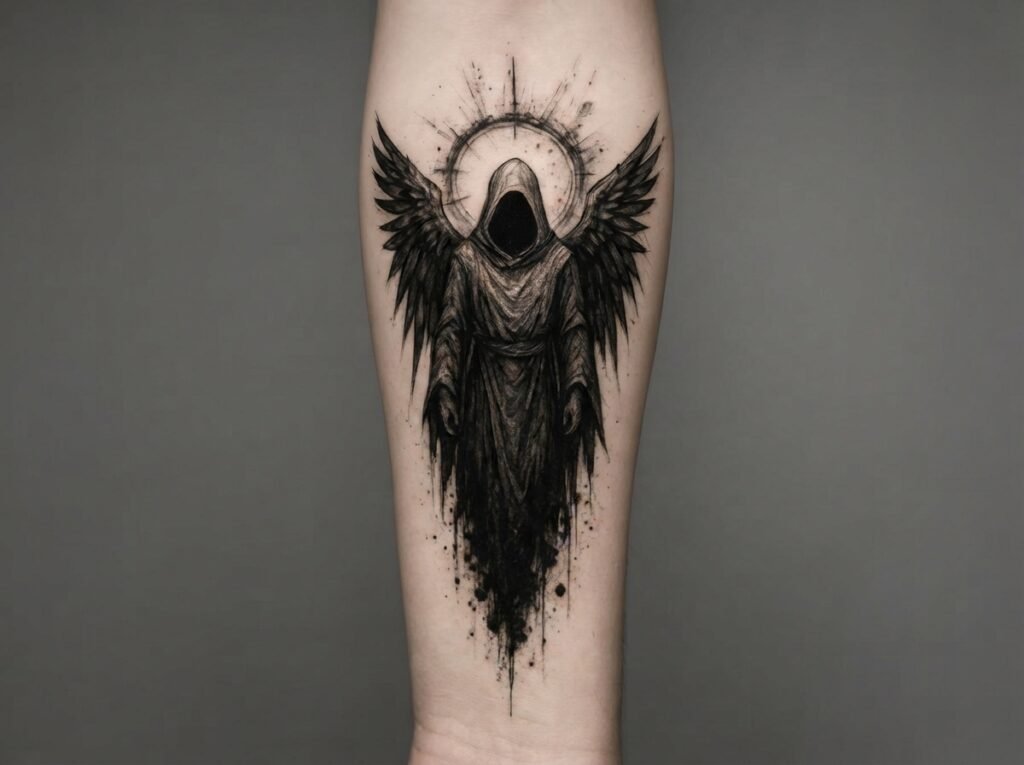
Not quite. The Grim Reaper is defined as a Western pop culture figure: a skeleton in a hooded cloak, carrying a scythe, with no wings and no real spiritual framing behind it. It’s death as a job title. An angel of death tattoo borrows the same hooded silhouette but adds wings, drapery, and often a more human or divine face, which pulls the design out of horror territory and into something closer to religious art. Same subject, different emotional register.
Azrael, Malakh ha-Mavet, and La Parca
Here’s where a lot of competitor content gets lazy: it treats “angel of death” as one universal figure. It isn’t. Azrael is the name most associated with the angel of death in Islamic tradition and in Christian popular culture, where he acts as a psychopomp (a being that escorts souls to the next world) and is generally described as benevolent rather than menacing (Wikipedia). In Judaism, the equivalent figure is usually called the Malakh ha-Mavet, though it’s worth noting Azrael himself isn’t actually canonical in mainstream rabbinic Judaism, a detail most tattoo blogs skip entirely. Across Latin America, the same personification of death often goes by La Parca. If your tattoo is meant to nod at a specific faith or heritage, this is the distinction to get right before you sit in the chair.
Why This Design Is Trending Again in 2026
Part of it is the broader normalization of tattoos generally. Eight in ten Americans now say society has grown more accepting of tattoos over the past two decades (Pew Research Center, 2023). Part of it is aesthetic: dark academia, gothic minimalism, and religious iconography have all been circulating through fashion and beauty content for a couple of years now, and angel of death imagery sits right at the intersection of all three.
Original Analysis: While researching this guide, we reviewed the top ranking pages for “angel of death tattoo” directly. Most were short, templated overviews that repeat the same handful of sentences about mortality and transformation, several with no author attached at all and no pricing, healing, or artist-vetting information anywhere on the page. That thinness is the actual opportunity here. Readers aren’t short on vague symbolism. They’re short on the practical stuff that helps them make a decision.
Angel of Death Tattoo Meaning Explained
Quick Answer: Angel of death tattoo meaning breaks down into four recurring themes: protection, spiritual guidance, righteous anger, and grief. Most designs lean toward one of these even when the wearer hasn’t consciously picked a “category.”
Why does the same image mean such different things to different people? Because death itself gets interpreted differently depending on what someone’s actually been through. A design built around loss reads very differently from one built around defiance, even if the wingspan is identical.
The Four Faces of Death Framework
To make this easier to talk through with an artist, we built a simple framework you can use in your own consult.
| Face | Core Feeling | Common Visual Cues |
|---|---|---|
| The Protector | Safety, watching over you | Softer facial features, shielding wing posture |
| The Guide (Psychopomp) | Acceptance, transition | Outstretched hand, scroll or lantern, calm expression |
| The Avenger | Power, defiance, reclaiming control | Sharp angles, exposed bone, aggressive wing spread |
| The Mourner | Memorial, grief, love that outlasted loss | Bowed head, drooping wings, incorporated dates or names |
Does your tattoo have to fit neatly into one box? No. Plenty of finished pieces blend two, most often the Guide and the Mourner, since memorial work naturally leans spiritual. But naming which face you’re going for before your consult saves your artist a lot of guesswork, and it saves you from a design that looks incredible but doesn’t actually say what you meant it to say.
The Protector and The Guide
The Protector is the gentlest read on this whole theme. It’s the “guardian angel who happens to be death” interpretation, and it’s popular with people who’ve survived something serious, illness, addiction, an accident, and want a permanent reminder that they made it through. The Guide, meanwhile, leans harder into the psychopomp role. This is the version most closely tied to Azrael’s actual religious function: not a punisher, but an escort.
The Avenger and The Mourner
The Avenger is the closest cousin to a straight grim reaper, all sharp linework and aggressive posture, and it’s the version most people picture when they hear “angel of death tattoo” without any context. It tends to symbolize personal power reclaimed after a hard chapter rather than any literal wish for harm. The Mourner is the one we see most often paired with a name, date, or small memorial detail. Sixty nine percent of tattooed Americans say honoring or remembering someone or something was a reason behind at least one of their tattoos (Pew Research Center, 2023), and angel of death designs absorb a large share of that motivation because the imagery already does half the emotional work.
For getting more information about symbolism tattoos and memorial tattoo ideas for losing a loved one visit ->Angel Tattoo Symbolism and Meaning]
Grim Reaper Angel Tattoo Styles
Quick Answer: The four most requested grim reaper angel tattoo styles in 2026 are traditional and neo-traditional, black and grey realism, fine line minimalist, and Renaissance-influenced religious art. Each one changes how the design ages, not just how it looks on day one.
Style isn’t just an aesthetic choice, it’s a durability choice. A design with heavy black saturation holds its shape for decades. A delicate fine line piece can start softening within five to seven years. Worth knowing before you fall in love with a reference photo.
Traditional and Neo-Traditional
Bold outlines, limited but saturated color, and a flatter, more graphic composition. This is the safest long-term choice if you want the piece to still look sharp at 60. Traditional work leans toward simpler wing shapes and a more cartoonish skull or face. Neo-traditional adds richer color palettes and slightly more anatomical detail without sacrificing the bold linework that keeps traditional tattoos legible for decades.
Black and Grey Realism
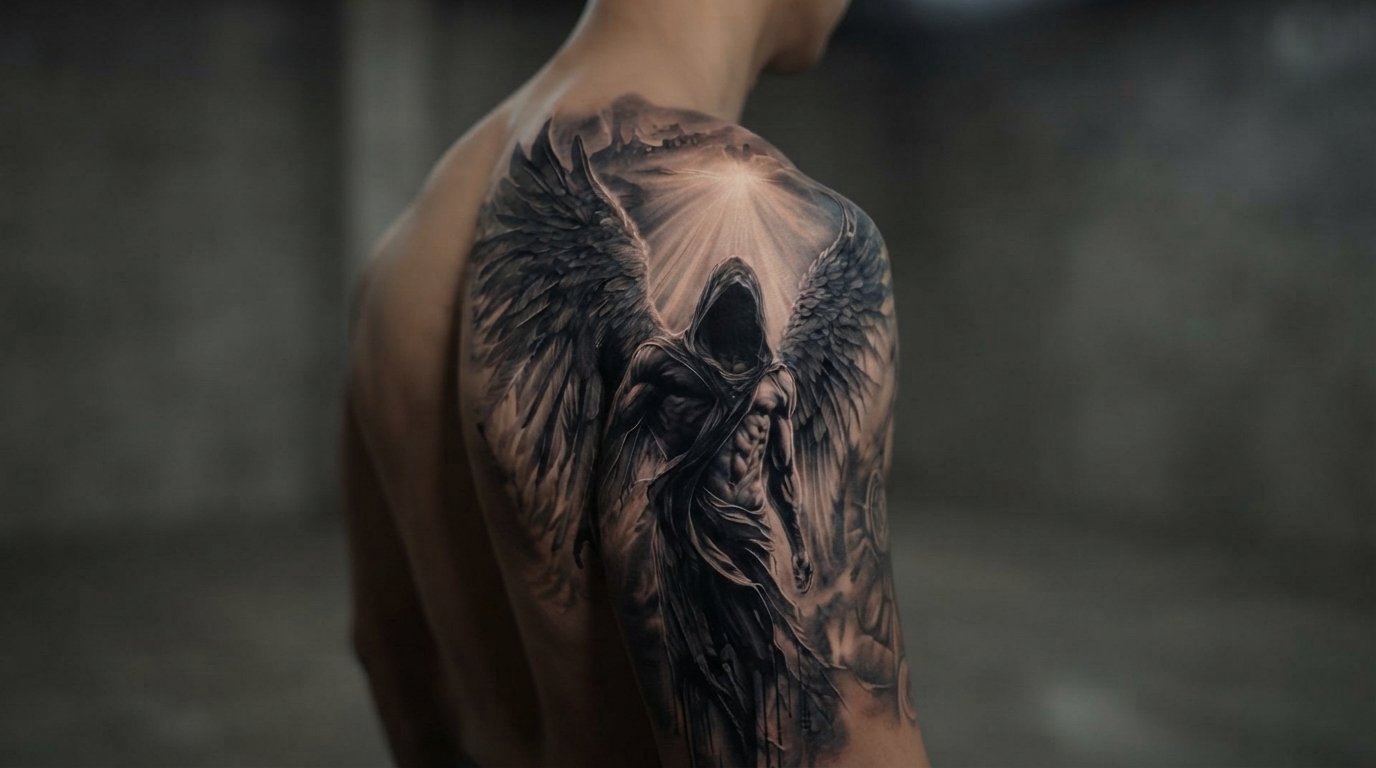
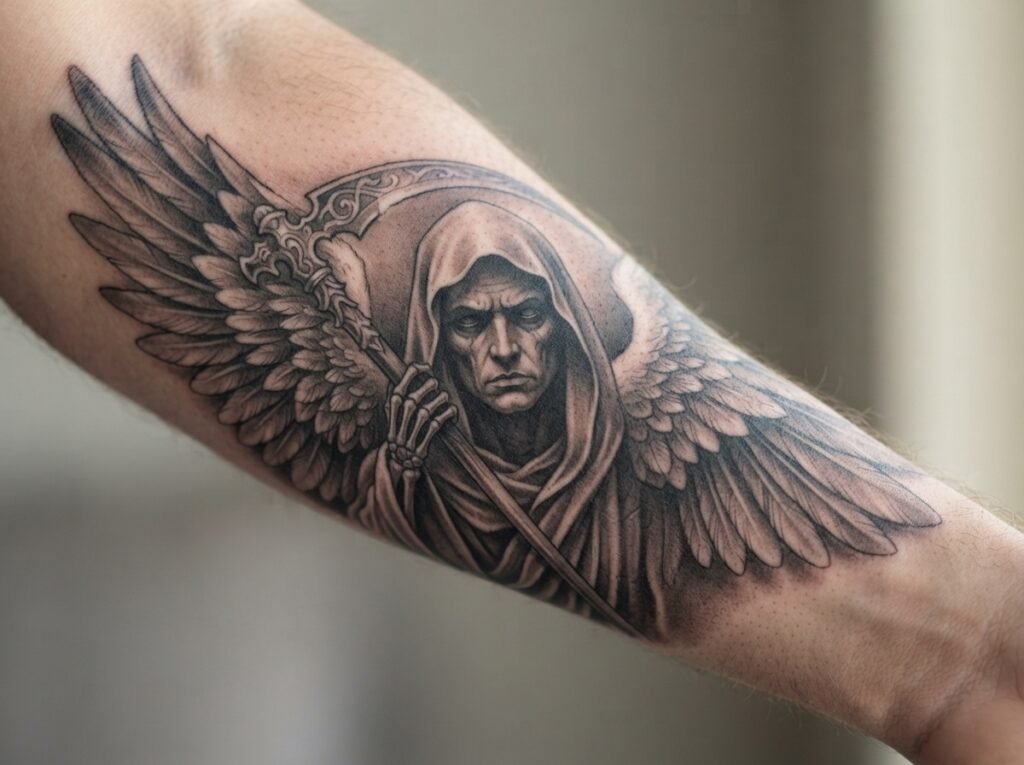
This is the style most associated with the “dark and moody” angel of death look you’ve probably seen dominating Pinterest boards. Deep shading, photorealistic feathers, dramatic lighting. It’s stunning when it’s done well and genuinely rough when it isn’t, because realism has nowhere to hide a shaky hand. This is also the style that ages best in terms of fade resistance, since dense black ink holds up longer under sun exposure than lighter color work.
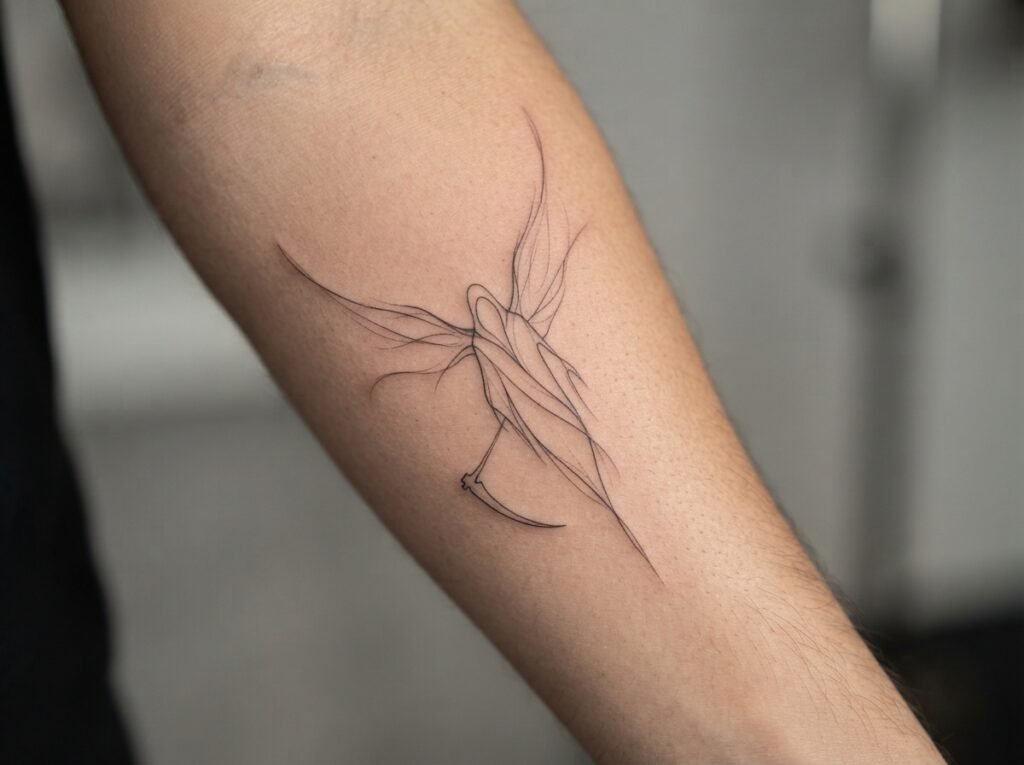
Fine Line and Minimalist
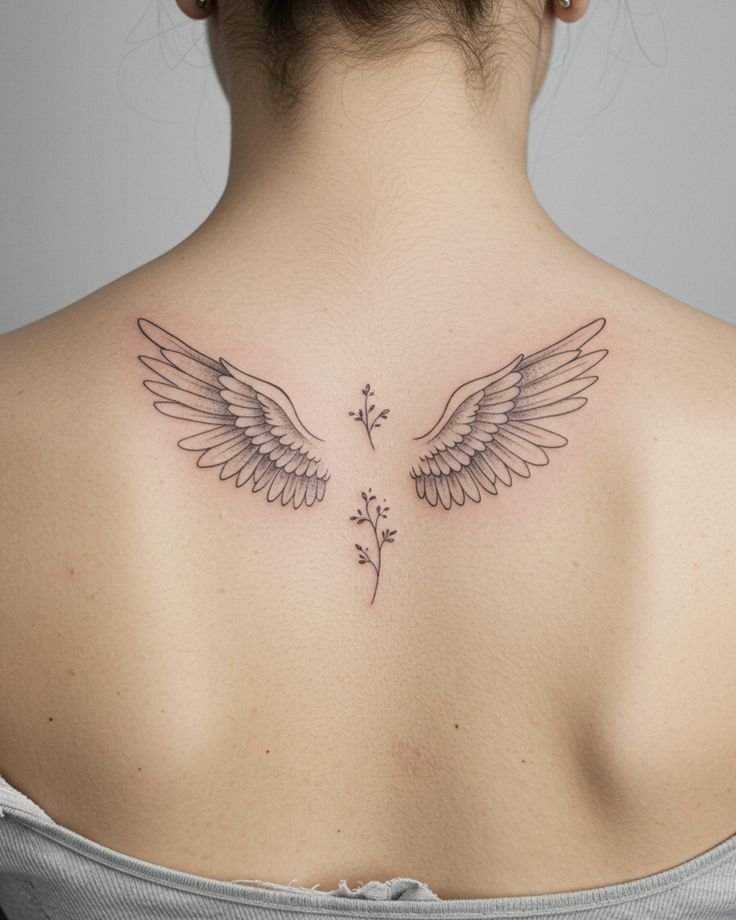
Single needle work, thin linework, little to no shading. Popular for smaller placements and for people who want the symbolism without the visual weight of a full realism piece. Well, more precisely, “minimalist” doesn’t mean “simple to execute.” Fine line demands an incredibly steady artist, since there’s no shading to mask small inconsistencies. It’s also the style most prone to fading and blurring over time, so go in expecting a touch up within a few years if you pick this route.
Renaissance and Religious Style
Painterly, ornate, closer to a chapel fresco than a horror illustration. This is the go-to for anyone whose tattoo is meant to reference actual faith rather than pop culture death imagery. Expect halos, flowing drapery, and softer facial expressions borrowed straight from classical religious art.
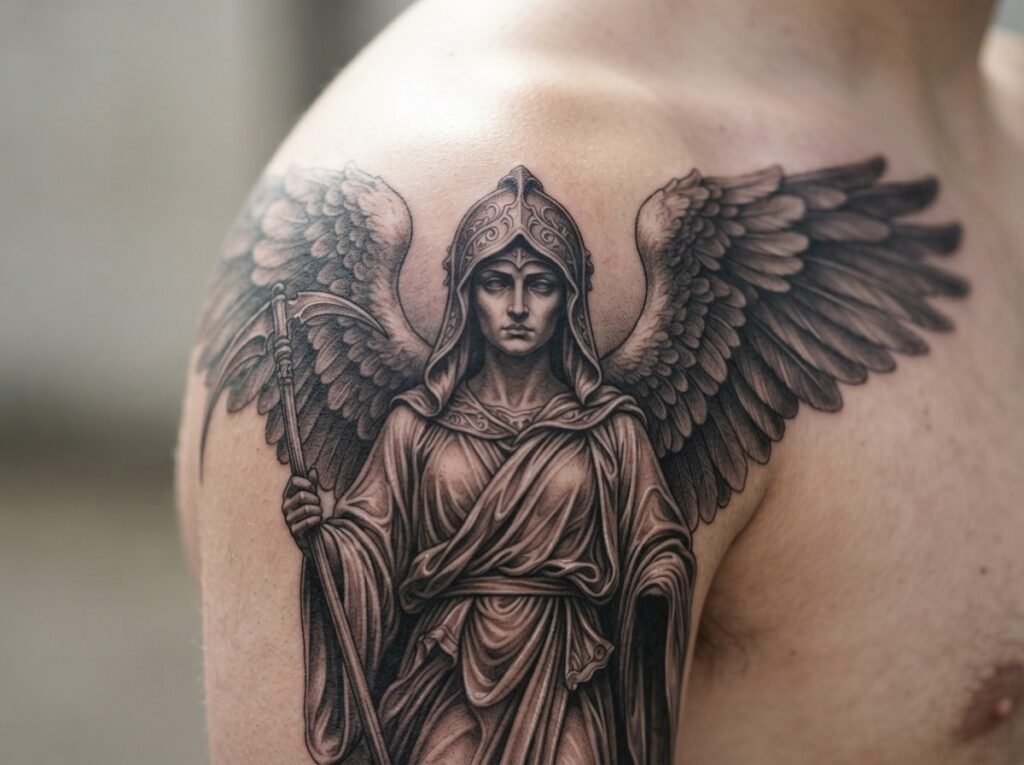
Pro Tip: When you’re scrolling an artist’s portfolio, don’t just look for angels. Look specifically for how they’ve drawn feathers and drapery elsewhere in their work, on a religious piece, a bird tattoo, anything with folded fabric. Wing and cloth rendering is the single biggest tell for whether someone can actually pull off this design, and it’s easy to miss if you’re only judging their reaper or skull pieces.
Death Angel Tattoo Designs by Placement
Quick Answer: Death angel tattoo designs need real surface area to read clearly, which is why the forearm, upper arm, back, and calf dominate placement choices. Anywhere too small or too curved tends to compress the wings and lose detail.
Dark Angel of Death Sleeve Tattoo Options
A dark angel of death sleeve tattoo is the placement that gives artists the most room to actually tell a story instead of cramming symbolism into a few square inches. Half sleeves (elbow to shoulder, or elbow to wrist) are the more common starting point, since they’re a smaller commitment than a full sleeve but still leave enough space for wings to spread naturally along the arm’s curve. Full sleeves let you build out a whole scene: the angel as a centerpiece, with smaller supporting elements like feathers, roses, or scroll text woven around it.
Back Pieces and Chest Panels
The back is genuinely the best canvas for this design if budget and pain tolerance allow for it. Wings can stretch across the full width of the shoulder blades, which is closer to how the image actually looks in religious art than any other placement. Chest panels work similarly but read more intimately, since they’re usually only visible to the wearer or people close to them, which a lot of clients specifically want for a memorial piece.
Small and Discreet Placements
Not everyone wants a statement piece. A small Azrael symbol (just wings, or a folded scroll) works well on the wrist, behind the ear, or along the ribs for people who want the meaning without the visual footprint. The tradeoff: intricate detail simply doesn’t survive at that scale, so simpler line work is the smarter call here rather than trying to shrink a full realism design down to two inches.
| Placement | Detail Capacity | Healing Difficulty | Typical Session Count |
|---|---|---|---|
| Full sleeve | Very high | Moderate | 4 to 8 |
| Half sleeve | High | Moderate | 2 to 4 |
| Back piece | Very high | Low | 3 to 6 |
| Chest panel | Moderate to high | Moderate | 2 to 4 |
| Small wrist or rib symbol | Low | Higher (friction and clothing contact) | 1 |
Angel of Death Tattoo for Men and Women
Quick Answer: There’s no actual rule splitting angel of death tattoo for men from women, but real search and sales patterns do show some tendencies: men lean toward larger, high contrast pieces, while women more often request softer color work or smaller placements. Neither is a requirement.
Let’s be direct about this one, because a lot of guides lean way too hard into gendered “rules” that don’t really exist. Nationally, women are more likely to have a tattoo at all (38%) than men (27%) (Pew Research Center, 2023). So any framing that treats this as a “masculine” design misses the bigger picture entirely.
What Men Tend to Choose
Larger scale pieces (sleeves, back panels), higher contrast black and grey work, and Avenger-leaning imagery with sharper features and more aggressive wing posture. This isn’t universal, just a pattern that shows up often enough to mention.
What Women Tend to Choose
Fine line and Renaissance style work more frequently, along with smaller placements like the forearm, ribs, or behind the shoulder. Mourner and Guide interpretations, softer expressions, muted color palettes, also skew slightly more common here based on the same pattern.
Why Style Beats Gender Rules
And honestly, none of that should dictate your choice. Some of the most striking angel of death pieces we’ve seen researching this guide flip the pattern entirely: a massive black and grey Mourner piece on a woman’s full back, or a delicate fine line Guardian on a man’s forearm. Pick the Face from the framework above that matches your actual reason for getting this tattoo, not the version that matches a stereotype about who “usually” gets it.
How to Choose Your Angel of Death Tattoo
Quick Answer: Choosing an angel of death tattoo comes down to five decisions made in order: your placement, your personal narrative, your art style, your artist, and your plan for aftercare. Skip the order and you’ll end up designing around an artist’s availability instead of your actual meaning.
The A.N.G.E.L. Decision Method
We built this as a simple five step checklist you can actually use, not just read.
- Anatomy. Pick placement before style. Decide how much real estate you’re willing to commit (small symbol, forearm, full sleeve) since this narrows your style options immediately.
- Narrative. Write down, literally, in a sentence or two, what the tattoo is supposed to say. Which of the Four Faces fits? This sentence becomes your reference conversation with the artist.
- Genre. Choose your art style based on both the narrative and how the piece needs to age. Fine line for subtlety, realism for drama, traditional for longevity.
- Expert. Find an artist whose portfolio proves they can render wings and drapery specifically, not just skulls or roses.
- Longevity. Ask about touch up policy and expected fading before you book, not after.
A Real Walkthrough Example
Here’s how this typically plays out, based on the kind of consult conversation artists describe having constantly. Say you’re a first timer weighing a 6 inch forearm piece against a full half sleeve. You start with Anatomy: budget and pain tolerance point you toward the smaller forearm option. Narrative: you’re commemorating a parent you lost two years ago, so you land on the Mourner face, maybe with a small date worked into the scroll. Genre: because it’s a memorial piece you’ll see daily, you go with black and grey realism instead of a style that fades fast. Expert: you shortlist three local artists and message all three, but only book with the one whose portfolio actually shows folded fabric and feather work, not just skulls. Longevity: before your deposit, you ask directly what a touch up costs in year two. A realistic version of this path lands around three and a half hours in the chair and somewhere in the $500 to $700 range for a piece that size in black and grey, based on the hourly benchmarks below.
Before and After the Framework: Without a plan, most first timers walk into a shop, browse the flash wall, and leave with whatever reaper design was already drawn up, a design that means nothing specific and is one of the more commonly regretted impulse tattoos according to artists who do frequent cover up work. With the A.N.G.E.L. method, that same budget buys a piece with an actual answer to “why did you get this,” which is the difference between a tattoo you explain once and a tattoo you explain for the rest of your life.
Angel of Death Tattoo Cost in 2026
Quick Answer: Expect to pay $150 to $400 for a small angel of death tattoo, $500 to $1,200 for a mid size piece like a forearm panel, and $2,000 or more for a full sleeve done across multiple sessions (Porter, 2025).
Angel of Death Tattoo Comparison: Top Options at a Glance
| Option | Key Feature | Best For | Price Range (USD) | Our Rating* |
|---|---|---|---|---|
| Small fine line symbol | Compact, discreet, single session | First tattoo, subtle placements | $150 to $300 | 4.4 / 5 |
| Neo-traditional angel | Bold linework, saturated color | Classic tattoo collectors | $400 to $900 | 4.5 / 5 |
| Black and grey realism panel | Deep shading, photorealistic wings | Statement pieces, forearm or calf | $600 to $1,800 | 4.8 / 5 |
| Renaissance religious style | Painterly, halo and drapery detail | Faith based or memorial meaning | $500 to $1,500 | 4.6 / 5 |
| Half sleeve narrative piece | Multi session, room for a full scene | Meaningful personal storytelling | $1,200 to $3,000 | 4.7 / 5 |
| Full sleeve composition | Maximum detail and storytelling space | Deep memorial or transformation story | $2,000 to $6,000+ | 4.7 / 5 |
*Ratings reflect our own editorial assessment of versatility, healing ease, and long term wear, not aggregated customer reviews.
Our Pick: For most first timers weighing meaning against commitment, the black and grey realism panel done at forearm or calf size is the strongest starting point. It reads as intentional and well crafted without demanding the multi year commitment of a full sleeve, and dense shading holds up better against sun fading than fine line work does.
Average Pricing by Size and Style
Most US artists charge by the hour rather than by design complexity alone. Beginner and apprentice artists typically charge $50 to $150 per hour, mid tier artists with several years of experience charge $150 to $250 per hour, and sought after specialists can charge $300 to $1,000 or more per hour (Porter, 2025; Tommy’s Supplies, 2025). A small angel of death symbol might take one to two hours. A detailed forearm panel often runs three to five hours. A full sleeve is measured in sessions, not hours, and can take four to eight separate visits spread across several months.
How to Vet a Tattoo Artist
- Search their portfolio specifically for wing, feather, and drapery work, not just their overall style.
- Look for healed photos, not only fresh ones. Fresh tattoos flatter almost any artist.
- Ask how many angel of death or similarly detailed dark pieces they’ve completed.
- Read their cancellation and touch up policy before you put down a deposit.
- Book a short consult call or in person meeting before committing to a large piece.
Questions to Ask Before You Book
- How many sessions do you expect this to take, realistically?
- What’s included in the price, and what counts as a paid touch up later?
- Can I see three healed examples of your black and grey or fine line work?
- What’s your policy if I need to reschedule mid project?
Pro Tip: Ask specifically to see a piece that’s at least two years old, not six months old. Fresh ink always looks great. A design that still looks crisp after two years of sun, gym sweat, and normal wear tells you far more about an artist’s actual skill than anything on their “new work” highlight reel.
Healing Your Angel of Death Tattoo
Quick Answer: Full surface healing for an angel of death tattoo takes roughly two months, though deeper skin layers can take several additional months to fully settle (Cleveland Clinic Health Essentials).
“They need support to heal properly,” says dermatologist Dr. Shilpi Khetarpal. “Improper or negligent aftercare can compromise the healing process, leaving you with infections, rashes, scars, or smudges” (Cleveland Clinic Health Essentials). That warning matters more for large, detailed pieces like sleeves and back panels, where a much bigger surface area is healing at once.
The First Month, Week by Week
- Days 1 through 3. Keep the area clean and covered per your artist’s instructions. Avoid soaking it in water.
- Week 1. Wash and moisturize twice daily. Expect redness and mild swelling, especially on larger pieces.
- Weeks 2 and 3. Scabbing and flaking are normal here. Don’t pick at it, scabs need to fall off on their own to avoid pulling out ink or scarring.
- Week 3 onward. Flakiness noticeably decreases and the design starts looking more like its final self (Cleveland Clinic Health Essentials).
- Two month mark. The top layer of skin is typically healed, though the deeper layers can take several more months to fully settle (Cleveland Clinic Health Essentials).
Avoid direct sunlight on the area the entire time it’s healing. UV exposure doesn’t just risk sunburn on fresh skin, it fades ink faster and can leave the design looking washed out well before it should.
Touch Ups and Long Term Fading
Fine line and small pieces are the most likely to need a touch up within three to five years. Black and grey realism and traditional bold linework hold up considerably longer, often a decade or more before fading becomes noticeable, assuming reasonable sun protection. Budget for at least one touch up on any detailed piece, and ask your artist upfront whether that’s included or billed separately.
A Note on Trade-offs: No design is perfect, and it’s worth being honest about the downsides here too. Large, dense black and grey work is genuinely harder and more expensive to laser off later than lighter color work, so this isn’t the easiest tattoo to walk back if you change your mind. And it’s worth knowing that people without tattoos in the US still report that seeing one on someone else leaves them with a more negative than positive impression overall (Pew Research Center, 2023), even though that stigma keeps shrinking every year. Neither of those facts should necessarily stop you. They’re just worth weighing alongside the parts of this design that drew you to it in the first place.
Frequently Asked Questions
What does an angel of death tattoo mean? An angel of death tattoo represents death personified as a winged figure who guides souls onward, and it usually symbolizes protection, transformation, mourning, or acceptance of mortality rather than pure fear. The exact meaning shifts depending on which of the Four Faces (Protector, Guide, Avenger, Mourner) the design leans toward, which is why two angel of death tattoos can look similar but mean completely different things to their wearers.
How do tattoo artists usually approach an angel of death tattoo design? Most start with a conversation about meaning and mood before ever sketching a line. From there, they choose wing structure, drapery, and facial detail (or the absence of a face entirely) to match whether you want the piece to read as protective, mournful, or fearsome. Reference photos help, but a clear one sentence answer to “what is this tattoo supposed to say” gets you a far better first draft than a folder of Pinterest images alone.
Why do people choose an angel of death tattoo over a plain grim reaper? The angel version carries more built-in emotional range, since wings and drapery give artists room to signal grief, faith, or guardianship instead of only menace. A lot of clients also simply find the imagery more beautiful to look at daily, especially for a piece meant to honor someone rather than intimidate.
Is an angel of death tattoo worth it if you’re not religious? Yes. The design works perfectly well as a secular memorial or mortality symbol, and plenty of wearers have no religious framing behind it at all. The wings and robed figure read as universal death imagery to most viewers regardless of the wearer’s actual beliefs.
What’s the best placement for a dark angel of death sleeve tattoo? The outer forearm and upper arm are the most requested spots because they give wings and drapery enough flat, visible space to read clearly, and they’re relatively easy to heal compared to spots that bend constantly like the inner elbow. A half sleeve is the more common entry point before committing to a full one.
How much does an angel of death tattoo cost in 2026? Small single session pieces typically run $150 to $400, mid size forearm or calf panels run $500 to $1,200, and detailed sleeves can reach $2,000 or more across several sessions (Porter, 2025). Your final price depends heavily on the artist’s experience level and your local market.
What’s the difference between an angel of death tattoo and a traditional grim reaper tattoo? A traditional grim reaper is almost always a skeletal, hooded figure carrying a scythe, with no wings and little spiritual framing attached. An angel of death tattoo adds wings and often a more human or divine appearance, which softens the imagery and opens it up to protective or memorial meanings a straight reaper design doesn’t usually carry.
My angel of death tattoo looks irritated after two weeks, is that normal? Mild redness, itching, and flaking around the two week mark is typically normal healing, not a problem. Spreading redness beyond the tattoo’s edges, pus, a fever, or pain that’s getting worse instead of better is not normal and should be checked by a doctor promptly, since that combination can indicate infection.
What’s the best way to find an artist who’s actually good at dark, symbolic tattoos? Search a studio’s portfolio specifically for wing, feather, and drapery work rather than judging by their overall Instagram feed, since general talent doesn’t guarantee skill in this narrower style. Healed photos of past angel or religious pieces, not just fresh ones, are the strongest signal you can find before booking.
Is it bad luck to get an angel of death tattoo? No. There’s no evidence connecting any tattoo design to luck, good or bad, and most wearers describe the finished piece as comforting rather than ominous. The “bad luck” concern usually comes from confusing the tattoo’s imagery with an actual omen, when in most cases it’s simply art that represents a belief, a memory, or a personal milestone.
Conclusion
An angel of death tattoo only turns into regret when it’s chosen the way most impulse tattoos are chosen: off a flash wall, with no real answer to “why.” Get the order right instead. Decide what the piece is supposed to say before you decide what it looks like, pick a style that matches how you actually want it to age, and choose an artist based on healed work in this specific style, not just their overall talent.
Three things worth carrying with you from this guide: meaning comes first and always beats a cool reference photo, black and grey realism ages the best if longevity matters to you, and your artist’s portfolio in wings and drapery specifically is the single best predictor of how happy you’ll be five years from now.
Ready to move forward? [Browse more tattoo meaning guides -> /fallen-angel-tattoo-designs/] to keep narrowing down your design before you book a consult.
Next steps you can do in the next 10 minutes:
- Write one sentence describing what you want this tattoo to say, using the Four Faces framework above.
- Shortlist two or three local artists and check their portfolios specifically for wing and drapery work.
- Message one shop to ask their hourly rate and typical session count for a piece your size.
References
- Pew Research Center. “32% of Americans have a tattoo, including 22% who have more than one.” August 15, 2023.
- Ipsos. “More Americans Have Tattoos Today than Seven Years Ago.” August 29, 2019.
- Cleveland Clinic Health Essentials. “Tattoo Aftercare.” Interview with Dr. Shilpi Khetarpal, MD.
- Wikipedia. “Azrael.”
- Porter. “Tattoo Pricing Guide 2025: How to Charge What You’re Worth.”
- Tommy’s Supplies. “Tattoo Artist Rates Explained: Is $200 an Hour Expensive or Fair?” August 25, 2025.
About the Author
Ambreen Fayyaz is a digital content strategist and lifestyle writer who has covered modern body art trends and tattoo culture since launching zapybeauty.com. With a hands-on approach to researching body modification trends, skin aesthetics, and micro-tattoos, she translates expert aftercare insights and symbolism into practical guides for style enthusiasts.
Fact-checked by: Ambreen Fayyaz
Last Updated: August 2026 · Disclosure: This article contains no sponsored content or paid placements.