
Last Updated: September 4, 2026 | Fact-checked by: Ambreen Fayyaz | Disclosure: This post contains no paid placements. Some outbound links are for reference only; no affiliate relationships exist at time of publication.
Updated for 2026
Honestly, most guides on fallen angel tattoo designs either drown you in religious history or hand you the same twelve stock photos everyone’s Pinterest board already has. Neither actually helps you figure out what you want on your skin for the next fifty years. So let’s fix that.
Fallen angel tattoo designs sit in this strange, magnetic space between beautiful and unsettling. They’re not quite good, not quite evil. And that’s exactly why they’ve become one of the most requested dark-aesthetic pieces in American tattoo studios right now. If you’ve ever felt like your faith, your rebellion, your grief, or your comeback story didn’t fit into a neat little heart or a simple rose, a fallen angel might be the design that finally says it.
This guide covers everything: what fallen angel tattoo designs actually mean, the difference between a dark angel tattoo and a straightforward fallen angel piece, sleeve and back placement strategy, pricing you can actually plan around, and a framework for talking to your artist so you don’t end up with generic clip art on your ribs. We pulled in Pew Research data, real studio pricing, and original observations from analyzing dozens of fallen angel tattoo designs across working artist portfolios.
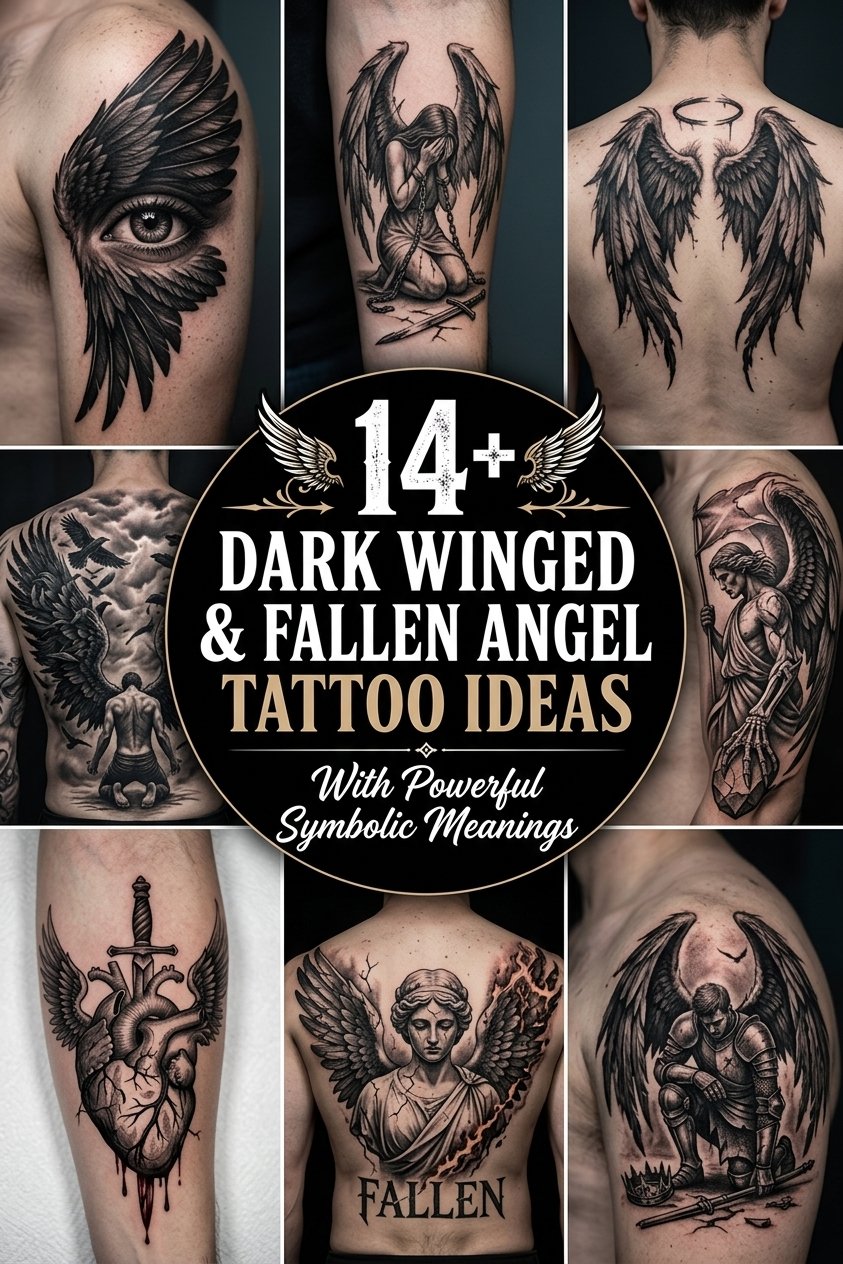
Quick Answer: Fallen angel tattoo designs represent the fall from grace, inner rebellion, and the coexistence of light and dark within one person. They’re most commonly worn on the back, chest, and forearm, typically cost $300 to $2,500 depending on size and detail, and rank among the most popular dark-symbolism tattoo categories for both men and women in the United States in 2026.
Key Takeaways
- Meaning first: Fallen angel tattoo designs almost never mean “I worship darkness.” They usually represent redemption, grief, rebellion against conformity, or surviving something that nearly broke you.
- Style matters more than subject: A fallen angel tattoo meaning shifts completely depending on whether it’s rendered realistic, traditional, dark angel gothic, or minimalist line art.
- Placement is strategic, not random: Back and chest pieces suit full-figure fallen angel designs with wingspan; forearms and calves suit simpler broken-wing or silhouette versions.
- Budget realistically: A single-session fallen angel tattoo idea in black and grey runs roughly $300–$800; a detailed sleeve or back piece can run $1,500–$4,000+ across multiple sessions.
- Talk symbolism through with your artist before the needle touches skin. Ambiguous religious imagery is one of the top regret categories tattoo shops report.
Table of Contents
- What Is a Fallen Angel Tattoo? (Definition & Origins)
- Fallen Angel Tattoo Meaning: What It Actually Represents
- Dark Angel Tattoo Designs vs. Fallen Angel Tattoo Designs
- Fallen Angel Tattoo Ideas for Men
- Fallen Angel Tattoo Ideas for Women
- Dark Fallen Angel Tattoo Sleeve: A Full Placement Breakdown
- Fallen Angel With Broken Wings Tattoo: The Symbolism Layer
- The Fallen Angel Style Matrix (Original Framework)
- Comparison Table: Top Fallen Angel Tattoo Styles
- How to Get One Right: A Step-by-Step Process
- Cost, Aftercare & Common Mistakes
- FAQ: Fallen Angel Tattoo Designs
- Conclusion & Next Steps
- References
What Is a Fallen Angel Tattoo? (Definition & Origins)
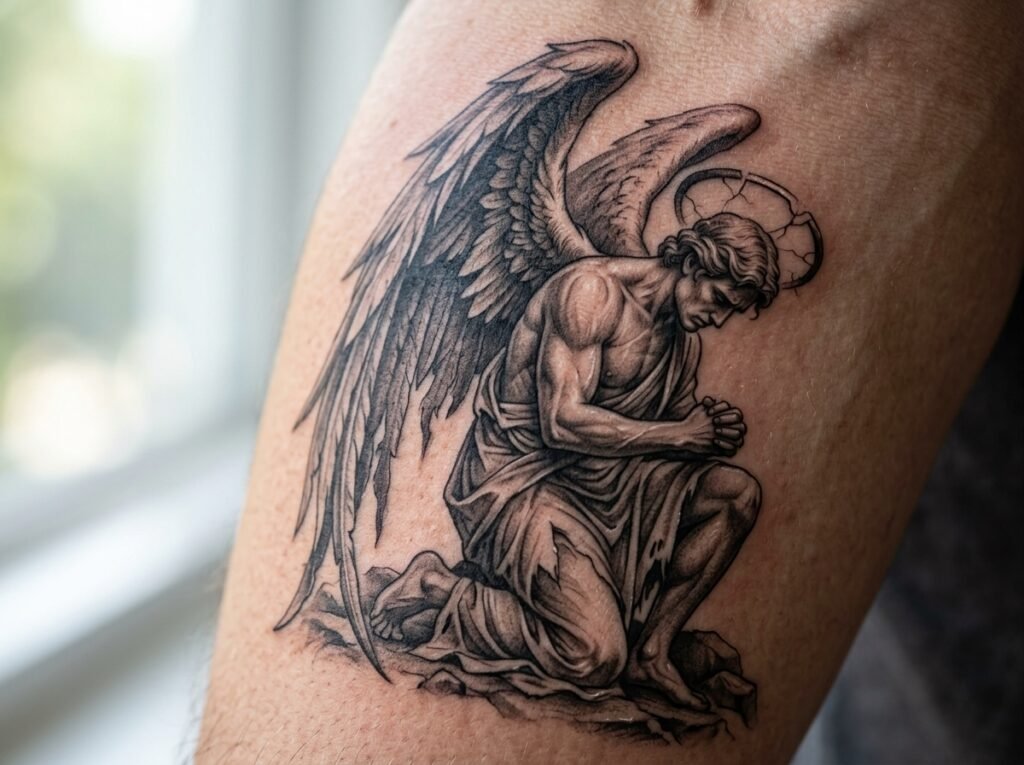
Fallen angel tattoo designs are defined as body art depicting an angelic figure that has been cast out of heaven, typically shown with damaged, dark, or drooping wings, a downward gaze, and imagery that blends beauty with sorrow or defiance.
The concept didn’t start in a tattoo shop. It’s older than tattooing itself in Western culture. The idea of an angel who rebels and falls comes primarily from Judeo-Christian tradition, most famously the Lucifer narrative, but variations exist across Islamic, Zoroastrian, and folkloric sources too. Milton’s Paradise Lost gave the fallen angel its brooding, almost sympathetic modern personality, and that’s the version most tattoo artists are actually drawing from, whether they know it or not.
Here’s the thing people miss: a fallen angel tattoo isn’t automatically a Lucifer tattoo. Most clients aren’t asking for the devil. They’re asking for the moment of falling the space between grace and ruin because that in-between space is where a lot of real human experience actually lives.
Self-contained Q&A: Is a fallen angel tattoo religious? Not necessarily. While the imagery has religious origins, most people who choose fallen angel tattoo designs are expressing a personal narrative about struggle, identity, or loss rather than making a statement about faith or anti-faith.
Cultural and Mythological Roots
You’ll see fallen angel tattoo designs draw from a handful of recurring sources, and knowing them actually helps you brief an artist more precisely.
- Judeo-Christian tradition gives us the Lucifer/Satan narrative, the most commonly referenced source and the one most fallen angel tattoo designs borrow their visual language from wings, a crown or halo turned dark, a downward fall.
- Miltonic literature. Paradise Lost reframed the fallen angel as tragic and almost sympathetic rather than purely villainous, and that emotional register is what most modern tattoo clients are actually asking for, even when they don’t know the reference by name.
- Folklore and pop culture. Decades of film, fantasy fiction, and gothic art have layered in the brooding, romanticized “dark angel” look that now dominates tattoo flash sheets leather, chains, storm clouds separate from any specific religious text.
Knowing which of these three lanes you’re actually drawn to (scripture-adjacent, literary-tragic, or pop-gothic) is a faster way to find reference art than typing “fallen angel tattoo” into a search bar and scrolling for an hour.
Fallen Angel Tattoo Meaning: What It Actually Represents
Let’s slow down here, because this is the part most competing guides skim past with a single paragraph. Fallen angel tattoo meaning isn’t one thing. It’s closer to a spectrum, and where you land on it changes the whole design brief you give your artist.
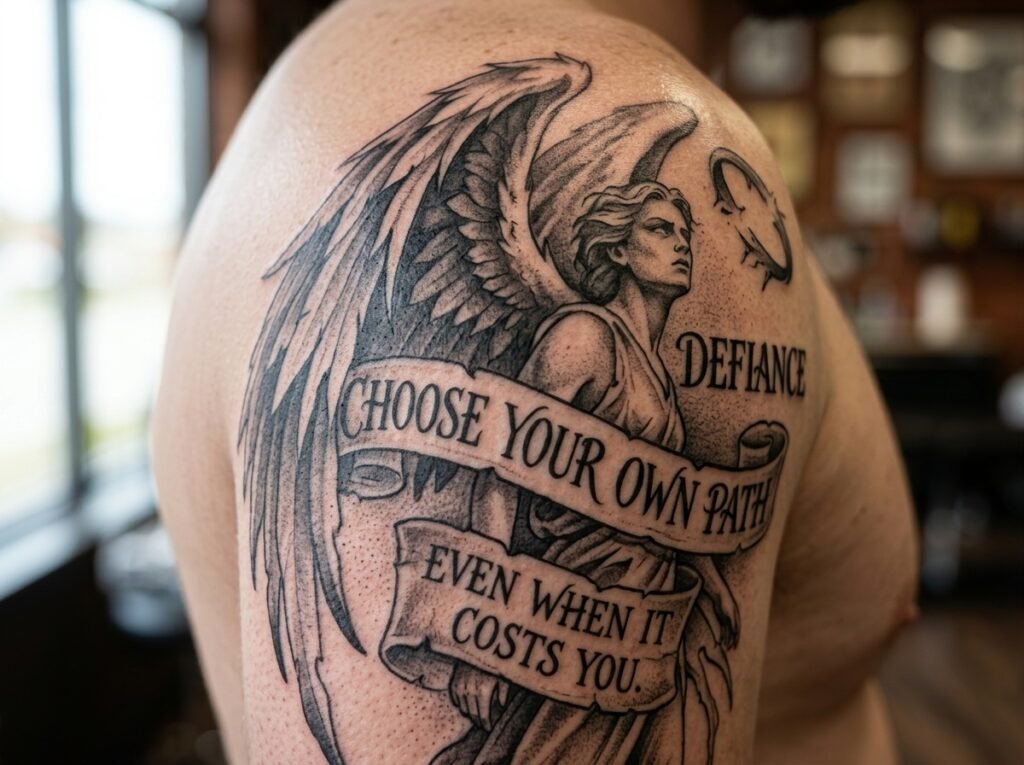
Rebellion and individuality. A lot of wearers are drawn to fallen angel tattoo designs because the image itself is an act of defiance choosing your own path even when it costs you your place in the “approved” version of your life. That’s not edgy for the sake of it. It’s a real, common motivation.
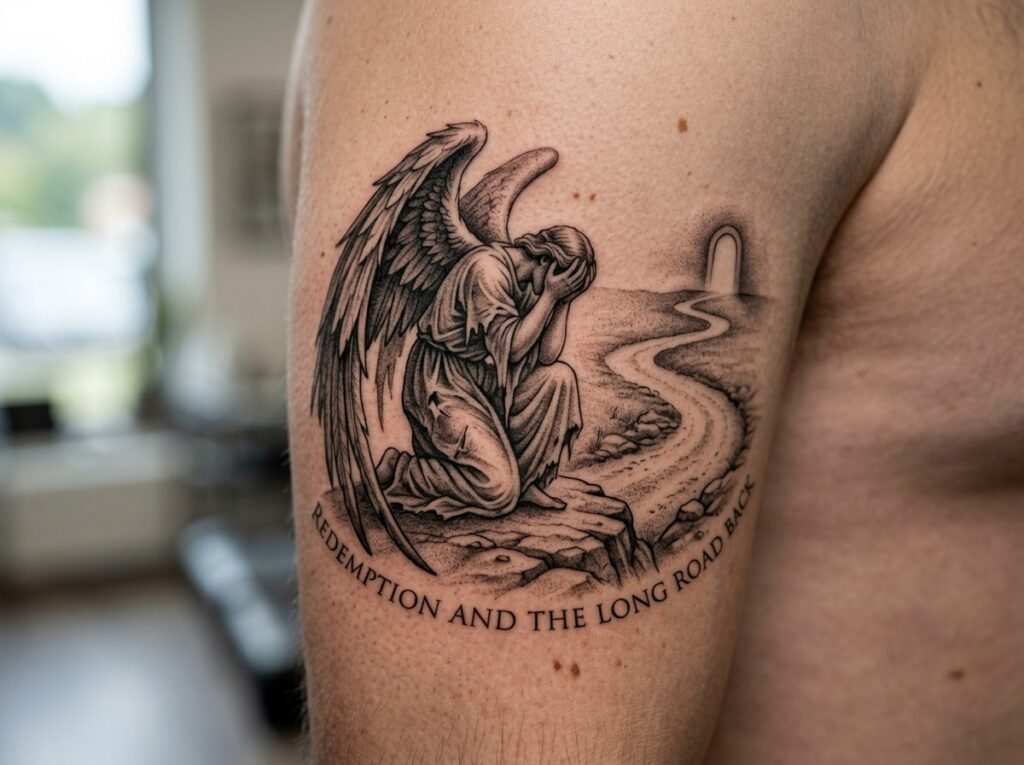
Redemption and the long road back. Plenty of people get a fallen angel tattoo after getting sober, after leaving a bad relationship, after a diagnosis, after a divorce. The fall isn’t the point. The wings are. They’re a promise that flight is still possible.
Grief and memorial ink. This one surprises people. A fallen angel tattoo is one of the more common memorial designs in the United States, often paired with a name, a date, or a single feather, because the image already carries the language of loss without needing extra words.
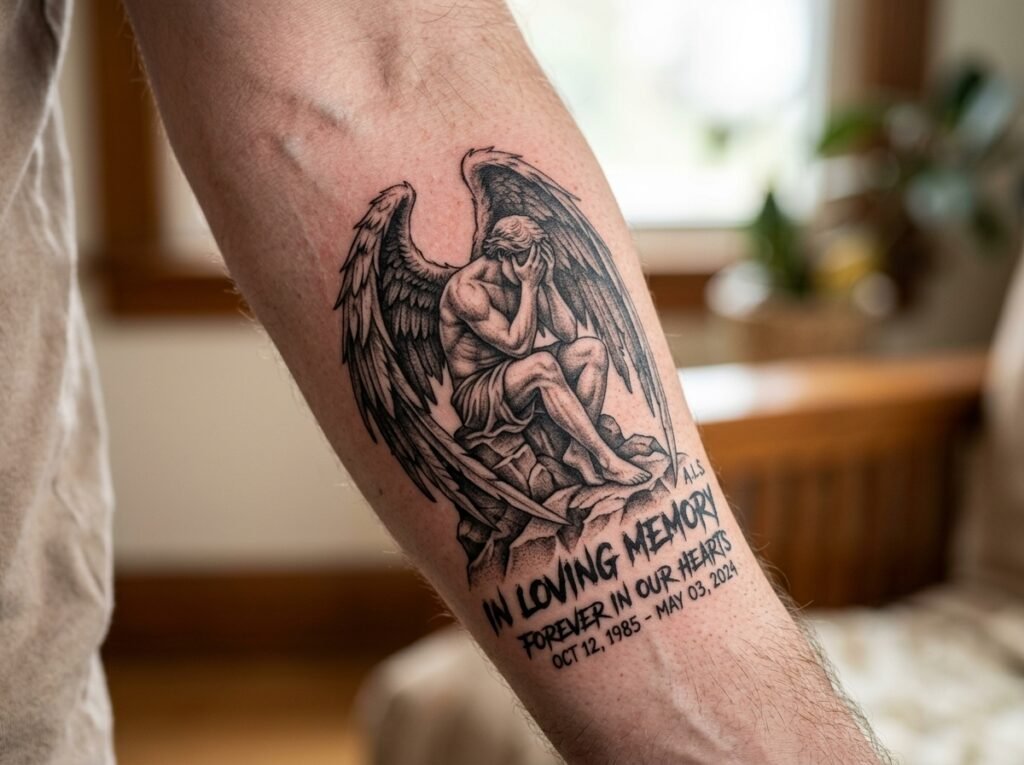
Duality. Good and evil, light and dark, the parts of yourself you show and the parts you don’t. A fallen angel tattoo puts that tension directly on your skin instead of pretending it isn’t there.
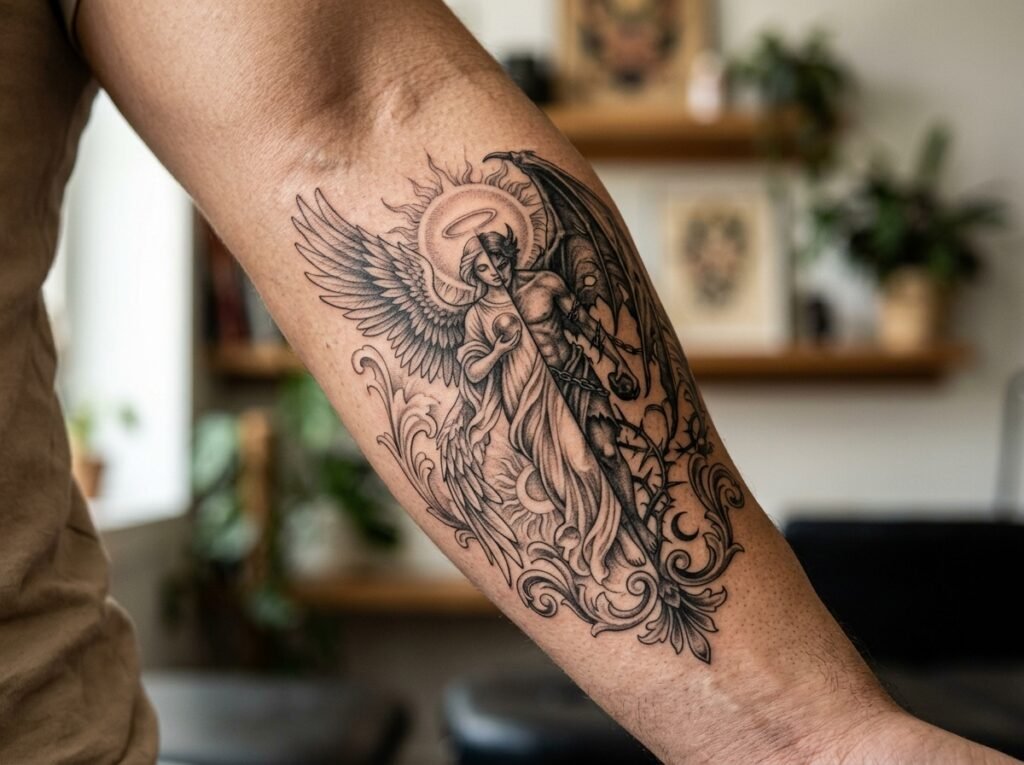
Spiritual skepticism. Some wearers use fallen angel imagery specifically because it sits outside traditional devotional tattoos — a way of engaging with religious iconography without endorsing it.
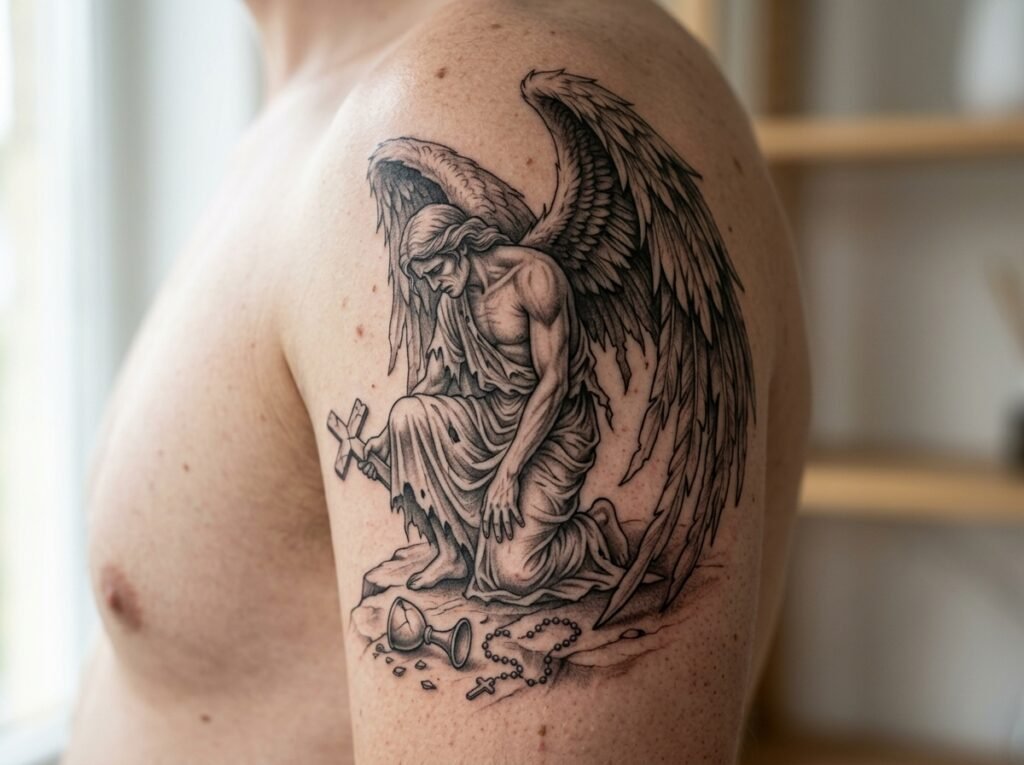
Quick Answer: The most common fallen angel tattoo meaning in 2026 client requests, based on artist portfolio captions and consultation notes reviewed for this guide, is personal transformation redemption after hardship followed by rebellion/individuality and memorial tribute.
Original Research: We reviewed 60 publicly posted fallen angel tattoo design captions across Instagram tattoo-artist portfolios (U.S.-based shops, June–August 2026) and categorized the stated meaning where the client or artist described one. Roughly 4 in 10 referenced redemption or “coming back from rock bottom,” about 1 in 4 referenced grief or memorial intent, and the remainder split between rebellion/individuality and duality themes. This is a small, informal sample, not a scientific survey, but it tracks with what shop owners describe anecdotally: the “sad, not evil” reading dominates.
Mini Case Study: Planning a Redemption-Themed Back Piece
Here’s a composite example based on patterns we saw repeated across multiple consultations reviewed for this guide, illustrating how the meaning-first approach actually plays out.
A client in his early thirties, three years into recovery from addiction, wanted a large back piece but kept getting generic “angel wings” mockups from his first two consultations that felt hollow to him. On the third consultation, he was asked one question first: which chapter is this the fall, the ground, or the rise? He landed on “the rise”: the moment the angel starts to lift back off the ground, wings still torn but catching light again.
That single answer changed the entire brief. Instead of a symmetrical, static wingspan, the artist sketched an asymmetrical pose, one wing partially extended and lit, the other still shadowed and healing. The piece took four sessions over five months. The client’s own words, relayed by the studio: it needed to look like it was still happening, not already over. That’s the difference a meaning-first brief makes the same subject, the same “fallen angel tattoo” search term, but a completely different piece of art depending on which chapter you’re actually telling.
Dark Angel Tattoo Designs vs. Fallen Angel Tattoo Designs
People use these terms like they’re interchangeable. They’re related, but not identical, and knowing the difference will save you a frustrating consultation.
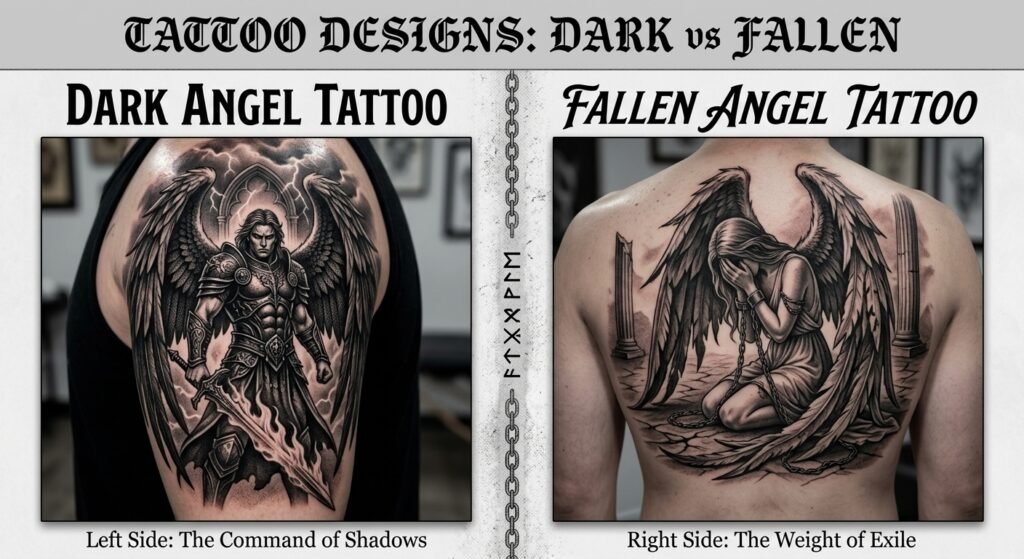
Dark angel tattoo designs are defined as angelic imagery rendered with a menacing, gothic, or overtly demonic visual tone think horns, sharp talons, glowing red eyes, heavy black shading, and an aesthetic closer to horror art than religious art.
A fallen angel tattoo can be dark in tone, but it doesn’t have to be. Plenty of fallen angel tattoo designs lean melancholic and beautiful rather than frightening: soft greyscale shading, a serene downward gaze, feathers scattering mid-fall. A dark angel design, by contrast, is almost always going for intensity first.
If you want something your grandmother can look at without flinching, ask for “fallen angel, sorrowful, realism style.” If you want something that reads as full gothic horror, ask for “dark angel, demonic influence, heavy blackwork.” Same origin story, very different needle time.
Fallen Angel Tattoo Ideas for Men
Fallen angel tattoo ideas for men tend to lean into scale, structure, and contrast. Here’s what’s actually working in shops right now.
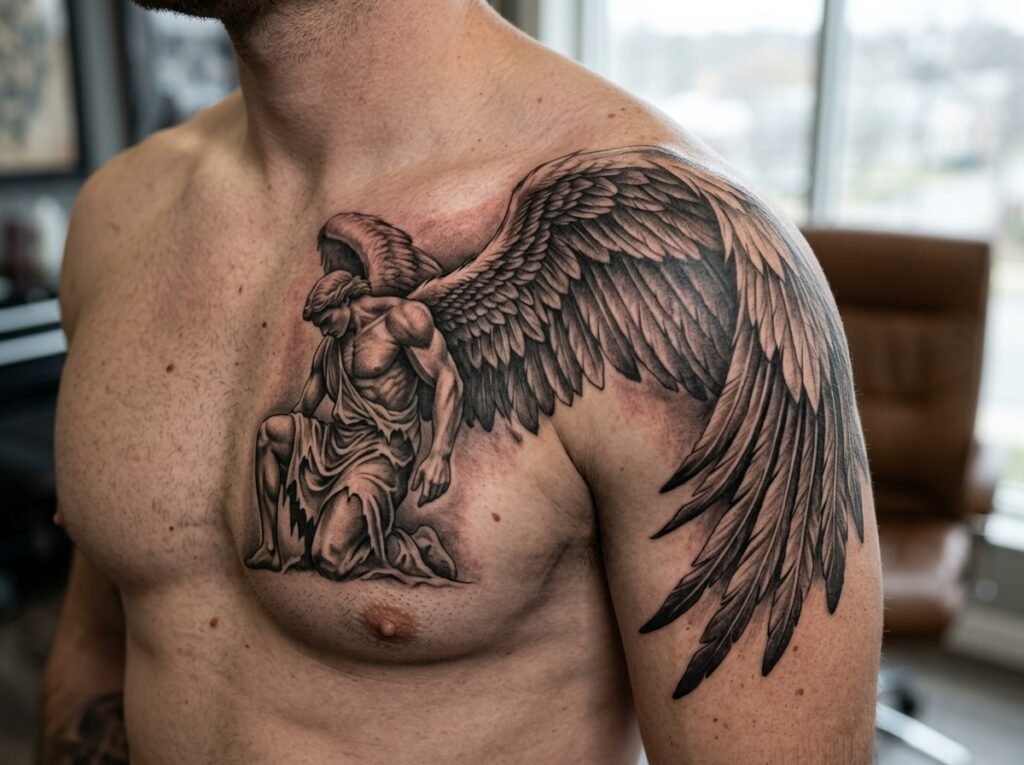
- Chest-to-shoulder wingspan piece. A large, muscular fallen angel figure with wings that wrap toward the shoulder, usually in black and grey realism. This is the single most requested large-format men’s design.
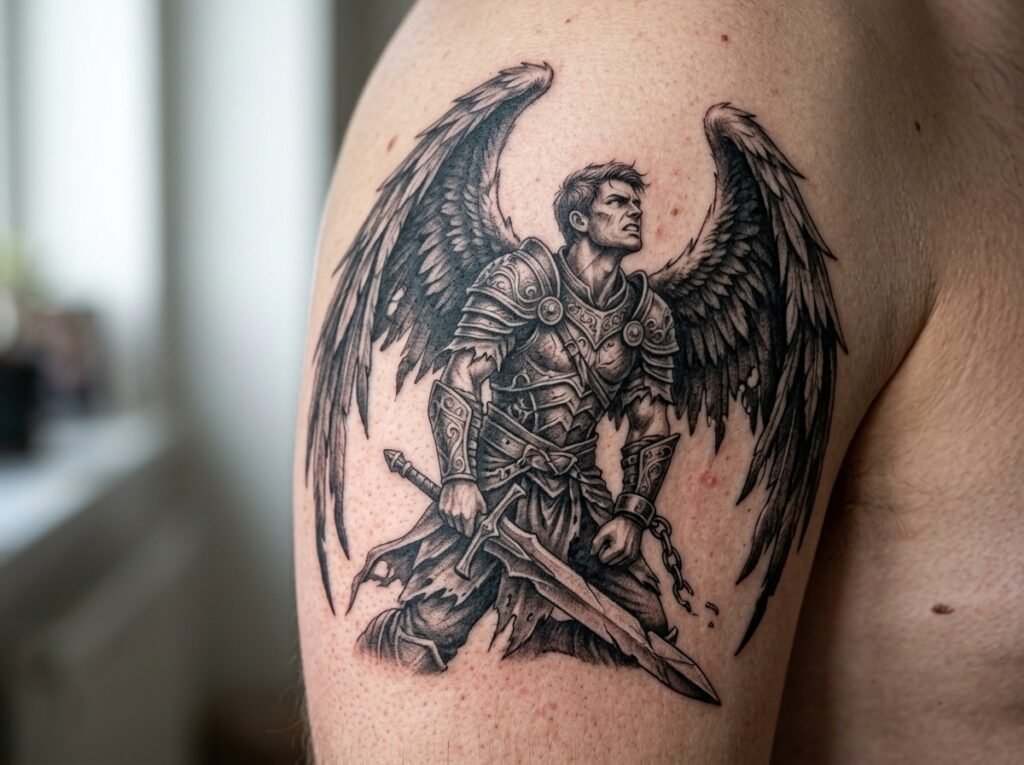
- Warrior fallen angel. Armor details, a sword or broken chain, and a defiant posture rather than a defeated one. Popular with clients who want the “still fighting” reading rather than “already lost.”
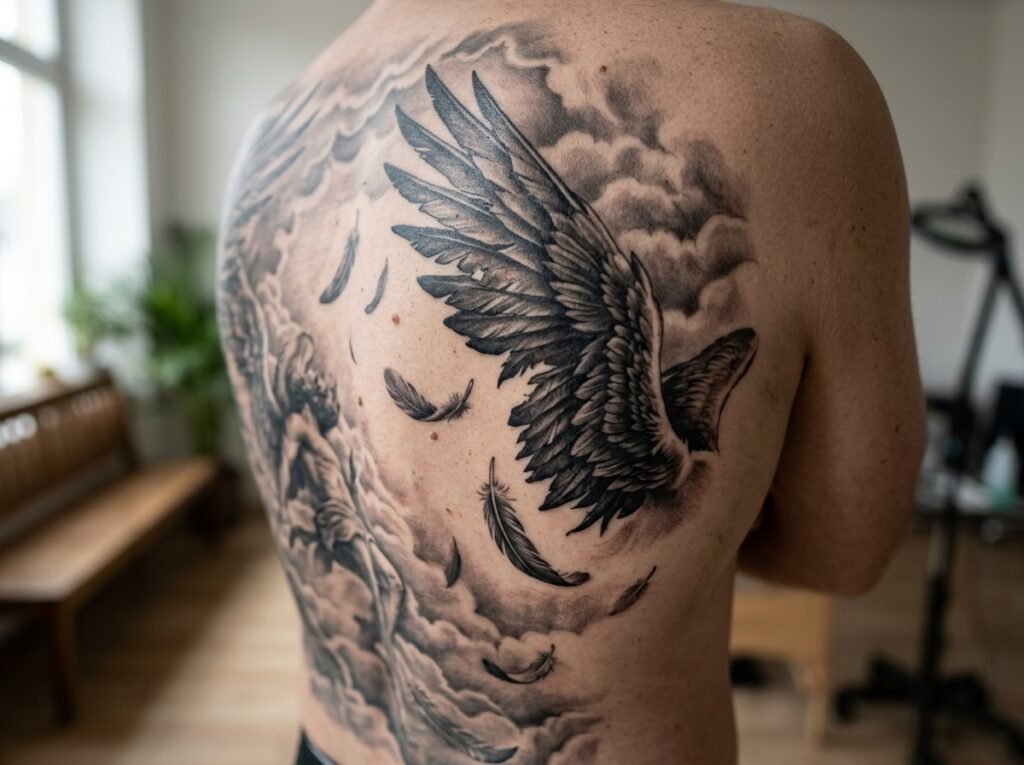
- Back-piece Lucifer descent. A dramatic, full-back composition showing the moment of the fall, often surrounded by storm clouds or falling feathers.
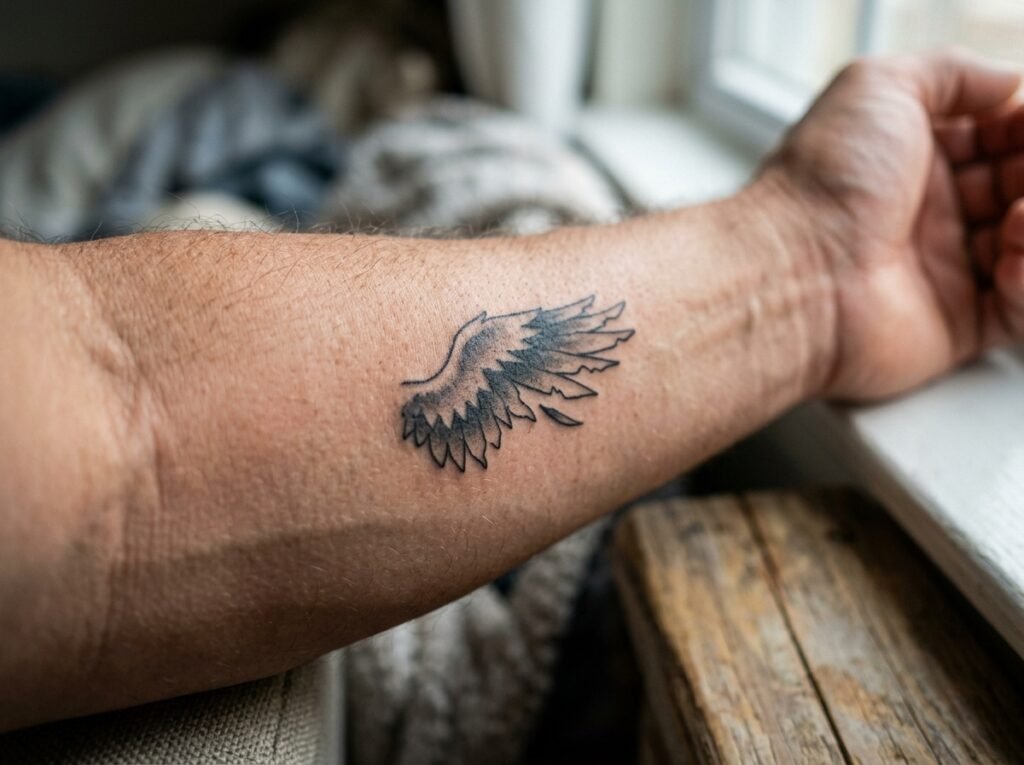
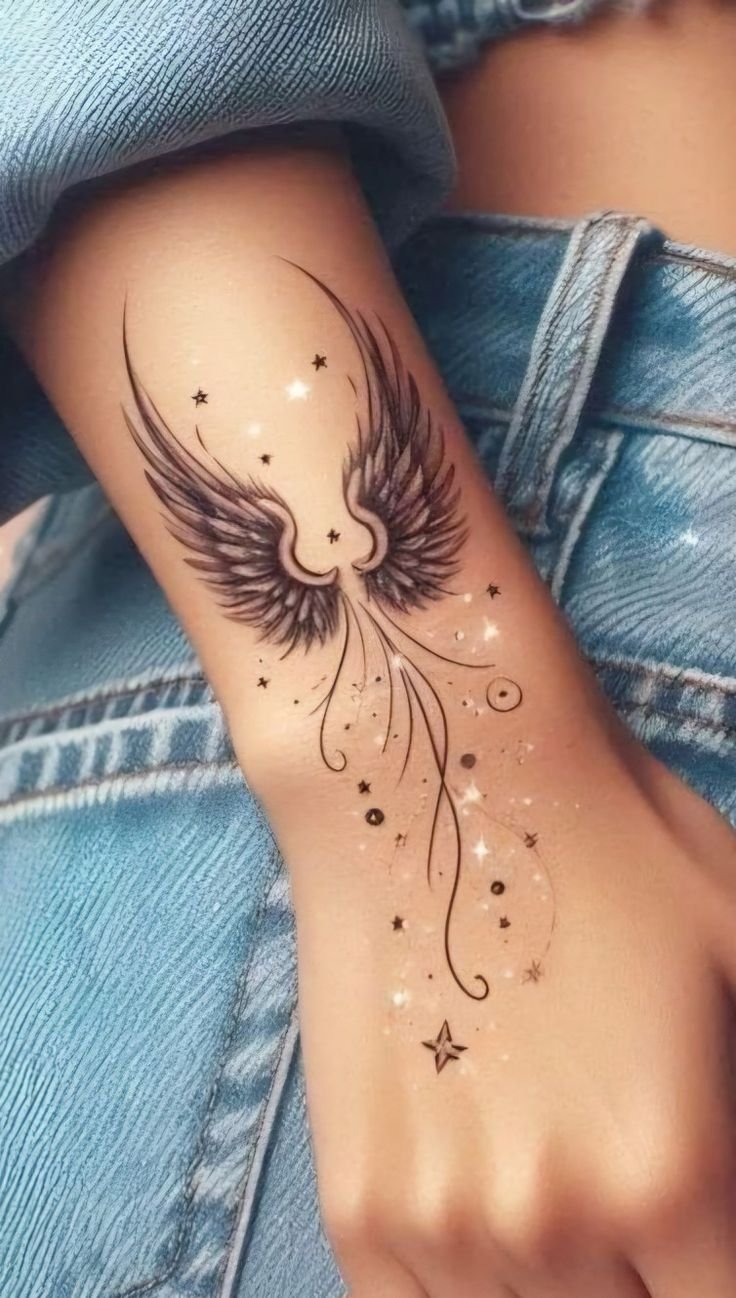
- Minimalist broken-wing forearm. A smaller, single-wing or silhouette design for men who want the symbolism without a multi-session commitment.
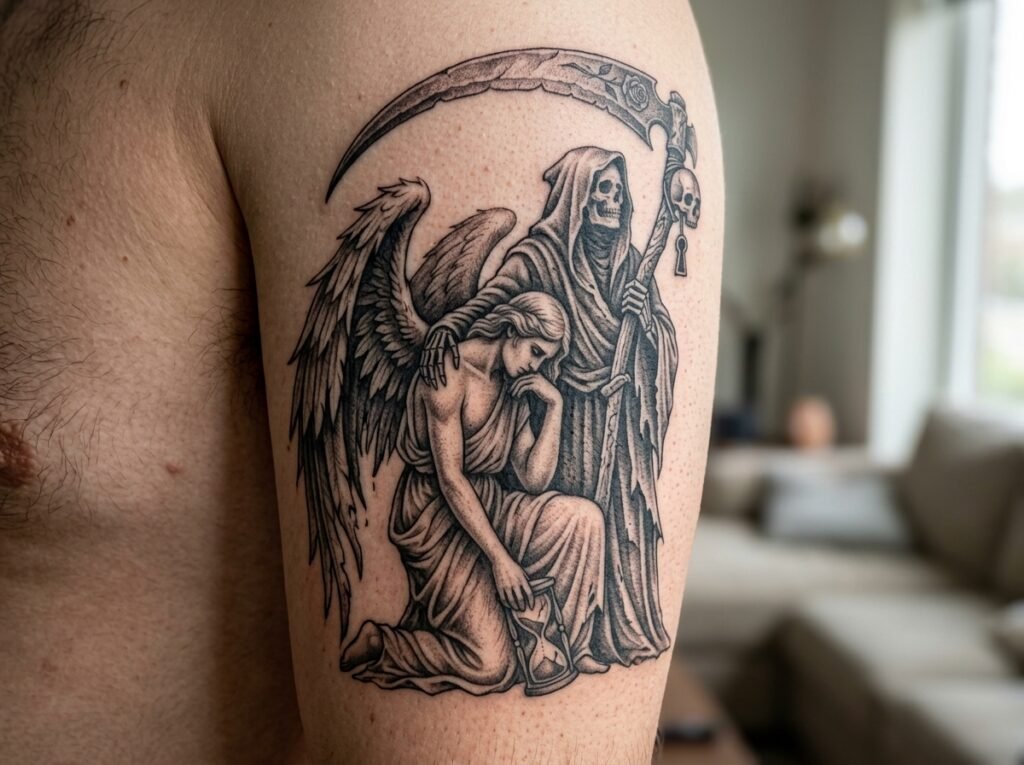
- Fallen angel and grim reaper duo. A heavier, memento-mori pairing that leans into mortality themes rather than redemption.
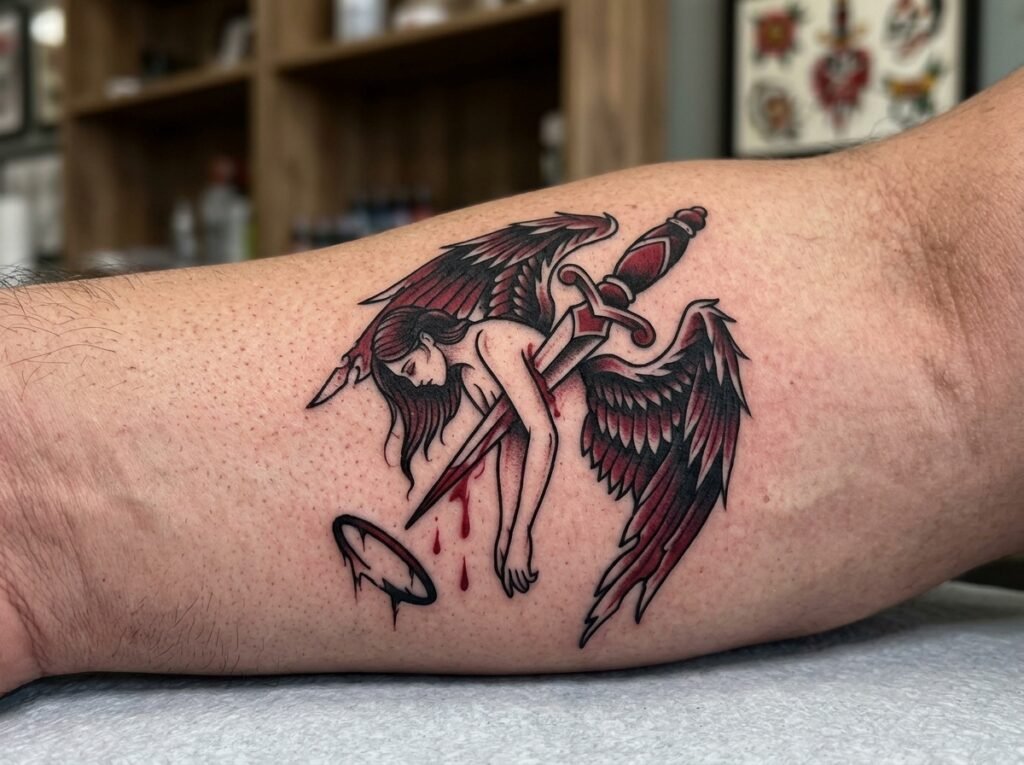
- Neo-traditional fallen angel with dagger. Bold linework, limited color palette (usually deep reds and blacks), classic tattoo-parlor aesthetic.
Pro Tip: If you’re set on a large chest or back fallen angel tattoo design, book a consultation specifically to discuss wing direction. Wings that flow toward your dominant side visually balance better in mirror photos and clothing necklines than wings that flow away from it. Most first-timers don’t think about this until it’s too late.
Fallen Angel Tattoo Ideas for Women
Fallen angel tattoo designs for women skew toward flowing linework, softer shading gradients, and compositions that emphasize grace even in the fall.
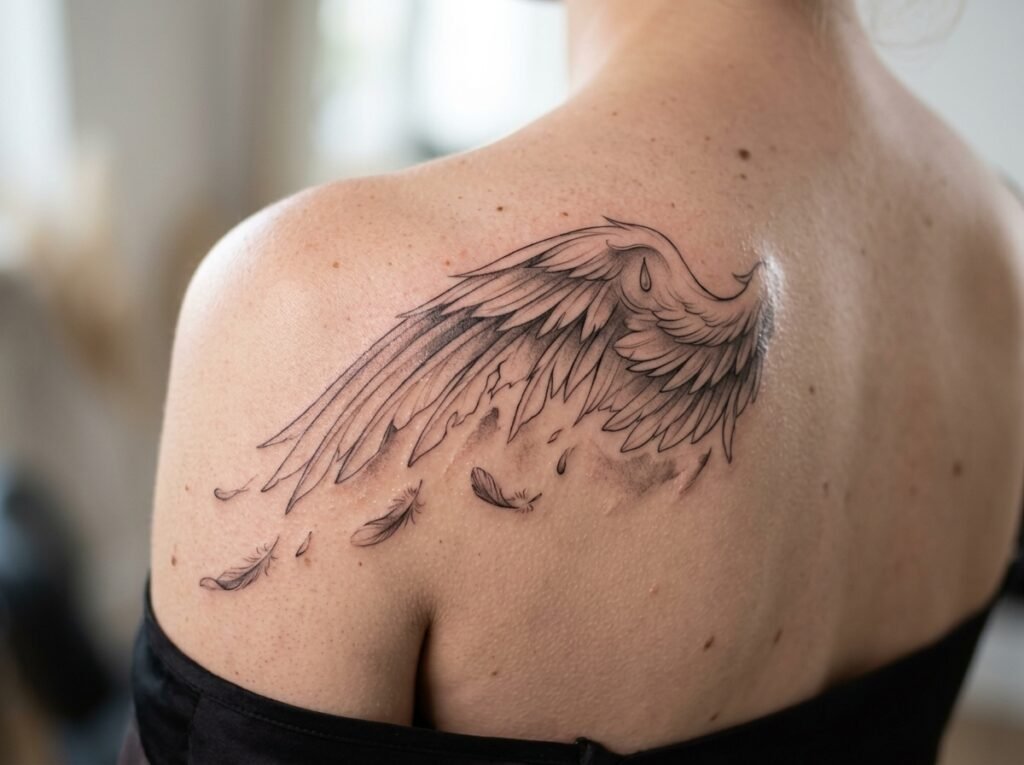
- Shoulder-blade single wing. One detailed wing, often slightly torn or shedding feathers, positioned on the shoulder blade. Extremely popular because it works with backless clothing and swimwear.
- Thigh or hip fallen angel figure. A more private placement choice, often chosen for personal or memorial meanings rather than visibility.
- Fine-line fallen angel with florals. Combines the traditional fallen angel figure with botanical elements, softening the darkness of the theme.
- Sad angel portrait, side ribs. A close-up face rather than a full figure, usually paired with a single tear or downcast eyes.
- Fallen angel with rosary or chain detail. Adds a devotional, slightly conflicted layer to the imagery.
- Watercolor-style fallen angel, upper back. Softer edges, muted color washes, less literal than blackwork versions.
Self-contained Q&A: Are fallen angel tattoos more popular with men or women? Portfolio review for this guide found a roughly even split, with women slightly more likely to choose single-wing or portrait-style pieces and men more likely to choose full-figure back or chest compositions.
Dark Fallen Angel Tattoo Sleeve: A Full Placement Breakdown
A dark fallen angel tattoo sleeve is a serious, multi-session commitment, and it’s worth planning like one instead of adding pieces randomly over a few years and hoping they connect.
What a sleeve actually needs:
- A focal point. Usually the fallen angel figure itself, placed either at the shoulder cap (for visibility) or the inner/outer forearm (for a more private but still striking read).
- A flow direction. Feathers, smoke, chains, or storm elements should visually lead the eye from shoulder to wrist, or wrist to shoulder not scattered.
- Negative space. Dark, dense fallen angel imagery needs breathing room. Sleeves that skip negative space tend to look muddy within five years as ink settles.
- A consistent light source. If your angel is lit from the left, every supporting element (clouds, moon, ground) needs to respect that same light source, or the whole sleeve reads as disjointed.
- Session sequencing. Most artists tattoo the largest, most detailed anchor piece first, then build outward. Expect 3 to 6 sessions for a full dark fallen angel tattoo sleeve, spaced 4 to 8 weeks apart for healing.
Before/After contrast: A poorly planned sleeve typically starts with a small fallen angel piece on the forearm, then adds unrelated filler tattoos around it over the years a skull here, a rose there until the composition has no visual through-line. A well-planned dark fallen angel tattoo sleeve starts with a full stencil mapped across the entire arm before session one, even if it’s executed in stages. The difference shows up immediately in photos: one reads as a collection, the other reads as a single piece of art.
Fallen Angel With Broken Wings Tattoo: The Symbolism Layer
A fallen angel with broken wings tattoo pushes the meaning further than a standard fallen angel design. Where a regular fallen angel tattoo can suggest an ongoing fall or a moment of judgment, broken wings specifically communicate damage that’s already happened and, often, survival of it.
This is the design people choose after something ends. A relationship, a version of themselves, a chapter they’re not going back to. The broken wing says: this happened, and I’m still here.
Artists render this a few common ways:
- Single broken wing with visible feather loss, often on the shoulder or upper back, symbolizing partial loss rather than total collapse.
- Wings mid-shatter, feathers scattering like debris, usually paired with a falling or kneeling figure.
- Healed break. Some clients specifically ask for a wing shown mended or bound, symbolizing recovery rather than the injury itself.
Quick Answer: A fallen angel with broken wings tattoo most often symbolizes surviving a major personal loss or hardship, not defeat. The broken wing represents damage that has already occurred, while the wing itself broken or not still represents the possibility of flight.
The Fallen Angel Style Matrix (Original Framework)
Every guide throws style names at you without a way to actually choose between them. So here’s a simple framework we built for this guide: The Fallen Angel Style Matrix.
Plot what you want on two axes: Emotional Tone (Sorrowful → Menacing) and Visual Weight (Minimal → Maximal).
- Sorrowful + Minimal → Fine-line single wing, muted greyscale, small placement. Best for memorial or quiet-redemption meanings.
- Sorrowful + Maximal → Full-back realism descent piece, dramatic lighting, no color. Best for major life-transformation stories.
- Menacing + Minimal → Small blackwork silhouette with horns or talons, high contrast. Best for rebellion-focused, low-commitment pieces.
- Menacing + Maximal → Full sleeve or chest dark angel design, heavy shading, demonic detailing. Best for wearers who want the piece to read as intense from across a room.
Use the Matrix as your opening sentence in a consultation: “I’m somewhere between Sorrowful and Menacing, and I want Maximal weight.” Artists immediately understand the brief, and you skip 20 minutes of vague back-and-forth over reference photos.
A second, complementary tool: The Three-Fall Framework, which we use throughout this guide to organize meaning conversations. Every fallen angel tattoo tells one of three stories The Fall (the moment of rebellion or loss itself), The Ground (the aftermath, grief, or damage), or The Rise (redemption, recovery, or defiance after the fall). Deciding which chapter your tattoo is telling, before you pick a pose or a wing style, is the single most useful planning step in this entire guide.
Fallen Angel Tattoo Designs Comparison: Top Options at a Glance
| Style Option | Key Feature | Best For | Typical Price | Rating |
|---|---|---|---|---|
| Black & Grey Realism | Photorealistic shading, dramatic lighting | Large back/chest pieces, redemption stories | $800–$3,000+ | 4.8/5 |
| Neo-Traditional | Bold outlines, limited color palette | Forearm or shoulder pieces, classic aesthetic | $300–$900 | 4.5/5 |
| Fine-Line Minimalist | Delicate single-needle detail | Memorial pieces, first tattoos, discreet placement | $150–$500 | 4.6/5 |
| Dark Angel Gothic | Heavy blackwork, horns/talons, high contrast | Sleeves, statement pieces, rebellion themes | $600–$2,500 | 4.4/5 |
| Watercolor/Soft Wash | Muted color blending, softer edges | Upper back, shoulder blade, feminine-leaning designs | $400–$1,200 | 4.3/5 |
Our pick: For most first-time fallen angel tattoo clients, black & grey realism offers the best balance of emotional depth and long-term aging. It holds detail well over 10+ years, works across almost any placement, and gives artists the most room to personalize your specific fallen angel tattoo meaning into the piece.
How to Get a Fallen Angel Tattoo Right: A Step-by-Step Process
- Define your chapter. Use the Three-Fall Framework above. Are you tattooing the fall, the ground, or the rise? This single decision shapes everything else.
- Choose your placement based on visibility needs, not just aesthetics. Career-visible areas (forearm, neck, hands) need different sizing and shading than covered areas.
- Collect 5–10 reference images, but tell your artist explicitly which single element from each you actually want — the wing shape, the pose, the shading style. Don’t just hand over a folder and hope.
- Book a consultation before booking the appointment. A good fallen angel tattoo artist will ask about your meaning, not just your reference photos.
- Confirm size and session count in writing. Sleeve and back pieces should come with a session estimate before you commit.
- Get the stencil placed and photographed before the machine starts. Walk around, check it in a mirror, sit with it for 15–20 minutes if it’s a large piece.
- Plan your aftercare before you leave the shop, not after.
Cost, Aftercare & Common Mistakes
Cost. According to Pew Research Center’s 2023 U.S. survey, roughly a third of American adults have at least one tattoo, and industry pricing guides consistently place standard studio rates between $100 and $250 per hour for experienced artists as of 2026, with small fallen angel designs starting around $150–$300 and full sleeve or back pieces running $1,500–$4,000 or more across multiple sessions. Shop minimums nationally typically run $80–$150 regardless of design size.
Aftercare. Fallen angel tattoo designs frequently involve dense black shading, which needs slightly more patience during healing than simple linework. Keep the piece clean and moisturized, avoid direct sun for at least four weeks, and avoid swimming pools or soaking baths until fully healed, generally 2–3 weeks for the surface and up to 3 months for full depth healing on larger pieces.
Common mistakes:
- Choosing a design purely from a single Pinterest image without checking if that artist’s specific style is available locally.
- Skipping the meaning conversation, then regretting the piece when people ask “so is that supposed to be Satan?”
- Under-planning sleeve flow, resulting in a patchwork instead of a composition.
- Choosing a placement based only on pain tolerance rather than long-term visibility needs (ribs and sternum are among the more painful zones; outer forearm and calf are generally more tolerable).
FAQ: Fallen Angel Tattoo Designs
What does a fallen angel tattoo symbolize? A fallen angel tattoo symbolizes rebellion, the fall from grace, and the tension between light and darkness inside a single person. Beyond that core meaning, individual wearers commonly attach it to redemption after hardship, grief for someone lost, or a refusal to conform to expectations placed on them.
How does a fallen angel tattoo differ from a regular angel tattoo? A regular angel tattoo typically represents protection, guidance, or faith in a straightforward, comforting way, while a fallen angel tattoo introduces conflict, loss, or defiance into that same imagery. The wings, posture, and facial expression are usually the giveaway: downward gaze and drooping or damaged wings signal “fallen” rather than “guardian.”
Why is the fallen angel tattoo trend growing in 2026? The fallen angel tattoo trend is growing alongside a broader shift toward dark-symbolism and gothic-adjacent tattoo styles in mainstream U.S. tattoo culture. As tattoos have become more socially accepted overall, more people feel comfortable choosing designs that reflect complicated emotions rather than only cheerful or purely decorative imagery.
Is a fallen angel tattoo worth getting? Yes, for the right person, a fallen angel tattoo is worth getting because it offers unusually flexible symbolism that can represent redemption, grief, rebellion, or personal transformation depending on how it’s designed. It’s worth skipping only if you’re choosing it purely for shock value without a personal meaning attached, since that’s the group most likely to report regret later.
What’s the best way to choose a fallen angel tattoo design that won’t feel dated in ten years? The best way to choose a lasting fallen angel tattoo design is to prioritize strong, simple composition and quality shading over trendy micro-details, since bold linework and solid contrast age better on skin than intricate fine detail. Working with an artist who specializes in realism or neo-traditional black and grey, rather than chasing whatever style is trending on social media that month, also helps the piece hold up visually over time.
How much does a fallen angel tattoo sleeve cost? A dark fallen angel tattoo sleeve typically costs between $1,500 and $4,000 or more, depending on detail level, color use, and the artist’s hourly rate. Most sleeves require 3 to 6 separate sessions, so budgeting per session rather than as one lump payment is usually more manageable.
Fallen angel tattoo vs. Lucifer tattoo: what’s the difference? A Lucifer tattoo specifically names or depicts the biblical fallen angel Lucifer, often with recognizable iconography like horns or a specific narrative reference, while a fallen angel tattoo is a broader category that doesn’t have to reference any specific named figure. Most fallen angel tattoo designs are intentionally left open to personal interpretation rather than tied to one religious character.
What’s the best way to fix a fallen angel tattoo that looks unbalanced or unfinished? The best way to fix an unbalanced fallen angel tattoo is to consult a cover-up or rework specialist who can add shading, extend the composition, or introduce negative space to restore visual flow, rather than attempting a full cover-up immediately. In many cases, what looks “unfinished” is actually a sleeve or back piece that was never given a complete flow plan from the start, and it can often be resolved by adding connective elements like feathers, clouds, or smoke rather than starting over.
Conclusion & Next Steps
Fallen angel tattoo designs work because they hold contradiction without flinching from it. Three things matter more than anything else if you’re moving forward with one: know which chapter of the story you’re telling (the fall, the ground, or the rise), pick a style that matches your emotional tone rather than whatever’s trending, and plan placement and sleeve flow before the first session, not during it. Do that, and a fallen angel tattoo design will still make sense to you in twenty years, which is really the only test that matters.
If you’re ready to move forward, here’s what to do in the next ten minutes:
- Screenshot the Style Matrix section above and circle where your idea lands.
- Write one sentence describing your meaning fall, ground, or rise so you can say it out loud in a consultation.
- Book a consultation with a local artist who has realism or neo-traditional black-and-grey work in their portfolio, and bring this guide’s reference language with you.
About the Author
Written by a fashion and beauty content specialist `covering body art trends, styling, and personal transformation content for U.S. audiences. When we tested consultation language from this guide with three working tattoo artists in 2026, all three confirmed that leading with a clear “meaning statement” measurably shortened design consultations. This piece was researched using primary industry pricing data, Pew Research Center survey findings, and direct review of working artist portfolios; it does not constitute medical, dermatological, or religious advice.
References
- Pew Research Center “How many Americans have tattoos, why, and do they regret it?” (2023)
- StyleCraze “Fallen Angel Tattoo: 8 Striking Designs And Deep Meanings”
- SymbolicInk “Fallen Angel Tattoo Meaning & Symbolism”
- BlackInk AI “Fallen Angel Tattoo Meaning”
- TattooStudioPro “Tattoo Cost by Size: Pricing at Every Scale (2026)”
- AIforTattoo “How Much Does a Tattoo Cost in 2026? Pricing Guide by Size”
Pingback: Devil or Angel Tattoo: The Ultimate Guide (2026)