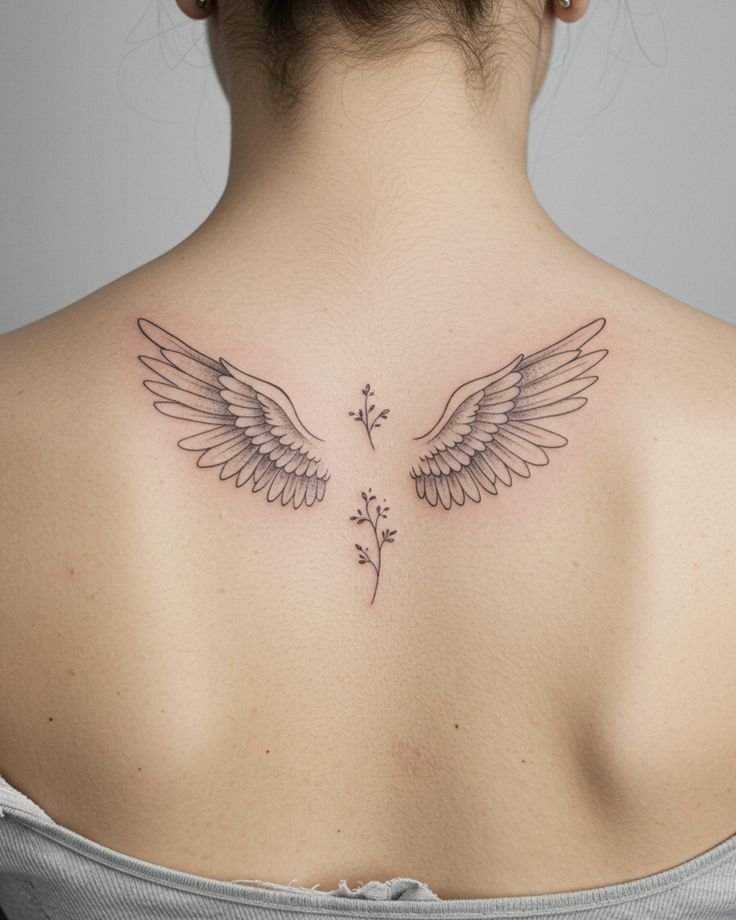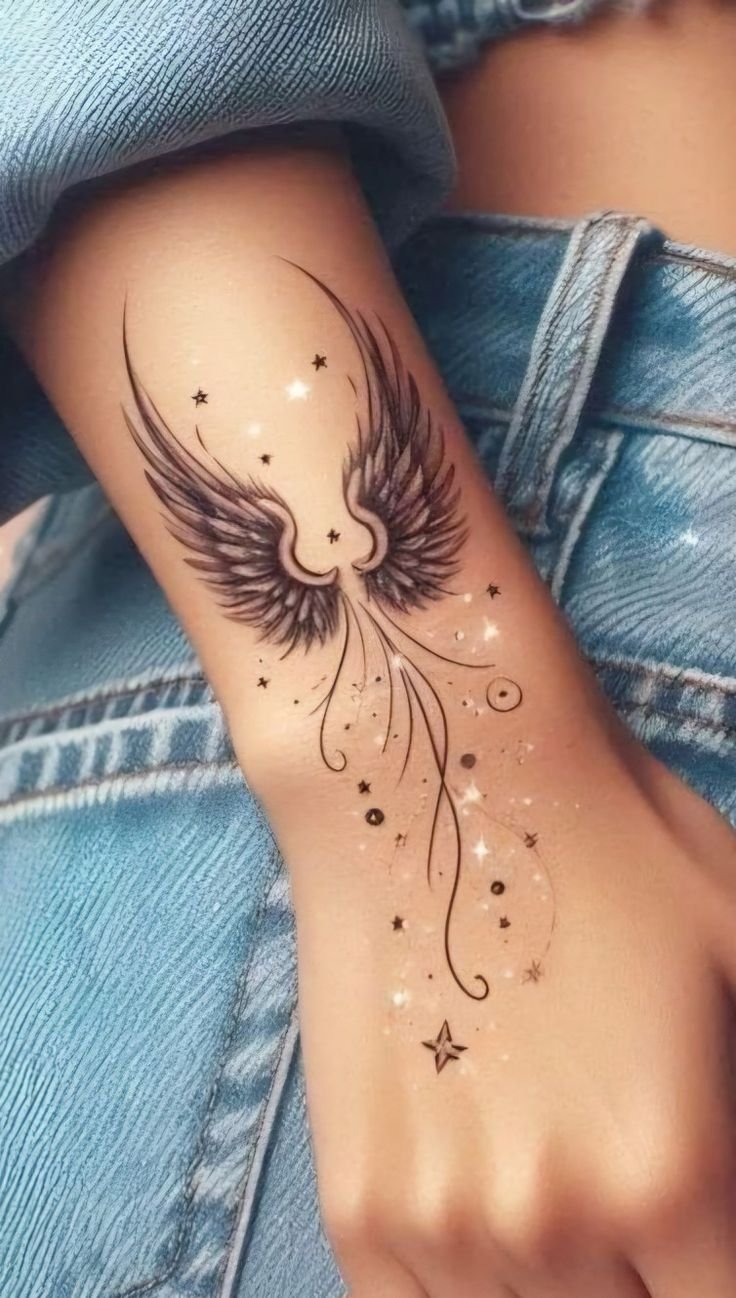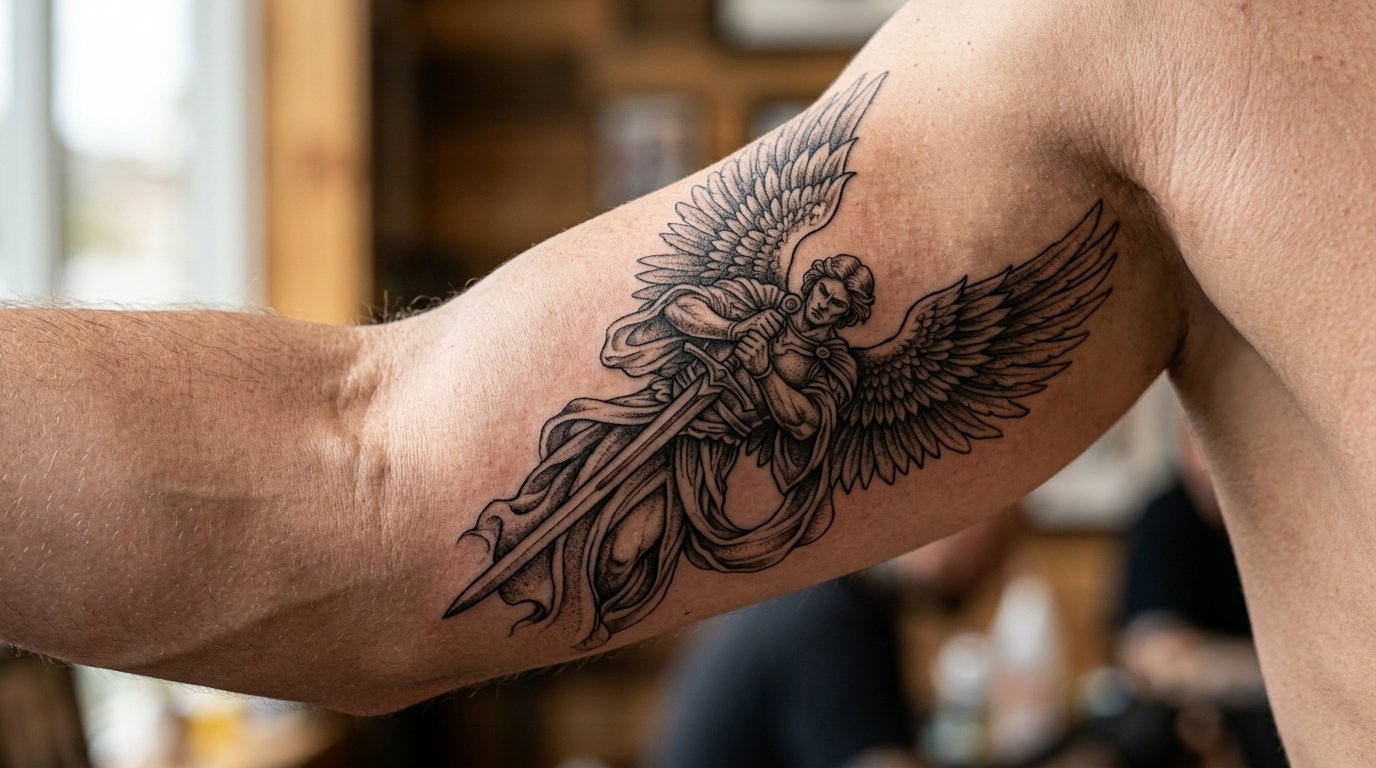
Updated for 2026
Introduction
Nearly a third of American adults are walking around with at least one tattoo, and 22% have more than one (Pew Research Center, 2023). Scroll through any tattoo gallery long enough and you’ll notice one image keeps showing up in the religious and warrior categories: a robed, winged figure gripping a blade. An angel holding a sword tattoo is not a niche request. It’s one of the most consistently searched religious tattoo designs in the United States, and honestly, most guides covering it barely explain why the sword matters as much as the wings do.
That’s the gap this guide fills. You’re not just picking “an angel tattoo.” You’re picking a specific, loaded image: protection with teeth, guardianship with a job to do. This piece breaks down where the design comes from, what it means when Archangel Michael is the one holding the blade, how the sword’s angle changes the message, and what it actually costs to get done right.
Key Takeaways
- What separates a warrior angel from a plain guardian angel, and why that distinction changes what the tattoo says about you
- The real, sourced history behind the sword-and-wings image, not recycled guesses
- How to read the difference between a raised sword and a lowered one
- Which tattoo styles hold detailed angel-and-sword artwork best over ten, twenty years
- A realistic 2026 price range based on current artist rates, not a random guess
- Where on your body this specific design ages best, and where it doesn’t
Here’s the full breakdown, starting with what the image actually communicates before we get into history, styles, and cost.
Table of Contents
- What Does an Angel Holding a Sword Tattoo Mean?
- Where the Angel Holding a Sword Tattoo Began
- Archangel Michael Sword Tattoo Meaning Explained
- Angel Holding a Sword Tattoo Meaning by Symbol
- Popular Angel Holding a Sword Tattoo Styles
- Best Placement for an Angel Holding a Sword Tattoo
- Cost, Artists, and Aftercare for This Tattoo
- Angel Holding a Sword Tattoo Comparison
- FAQ
- Conclusion
What Does an Angel Holding a Sword Tattoo Mean?
Quick Answer: An angel holding a sword tattoo is defined as a religious or symbolic design combining protective imagery (the angel) with active defense (the sword), read together as guardianship that’s prepared to act rather than simply watch.
That’s the textbook version. Here’s the plain one: a regular angel tattoo says someone is watching over you. An angel holding a sword says someone is watching over you and is willing to do something about it. Small difference in the design. Big difference in the meaning.
The Core Symbolism, Broken Down
Three things are doing the work in this image, and each one carries its own weight. The angel brings divinity, protection, and guidance. The wings bring the sense of something watching from above, not stuck at ground level with the rest of us. And the sword brings action: strength, justice, and a willingness to fight, whether that fight is external or the private kind nobody else sees.
Put together, an angel holding a sword tattoo reads as spiritual protection with a spine. That’s why it shows up so often as a resilience piece. People who’ve survived something, an illness, an addiction, a bad relationship, a loss, gravitate toward it because “I got through this” needs a stronger visual than a plain pair of wings can carry alone.
Protector or Punisher: Two Readings
There are really two ways people read this design, and they’re not the same tattoo even though they look almost identical on skin.
The first reading is protective: the angel is on your side, sword drawn to defend you specifically. The second is judicial: the angel represents justice or divine judgment more broadly, less “protecting me” and more “evil gets what’s coming.” Neither reading is wrong. Which one fits depends entirely on the story you’re bringing to the consultation, and it’s worth deciding before you sit down with an artist, because it changes small details, like whether the angel faces the viewer (protective, welcoming) or faces away, mid-strike (judicial, active).
Self-contained Q&A: Does the sword’s direction change the meaning? Yes, and this is a detail almost every other guide skips. A downward-pointed blade traditionally signals that a battle has ended and peace has followed. A raised or forward-facing blade signals the fight is still active. If your tattoo is meant to mark something you’ve already come through, ask your artist to angle the tip down. If it’s meant to represent an ongoing fight you’re still in, keep it raised.
Pro Tip: Bring this one sentence to your consultation: “Is the fight over, or still happening?” That single detail tells a good artist more about blade angle, wing position, and facial expression than three pages of reference images would.
Semantically, it comes down to a simple fact: an angel holding a sword combines protection with active defense, and that combination is precisely why the design outperforms a plain guardian angel for anyone whose story involves fighting for something, not just hoping for it.
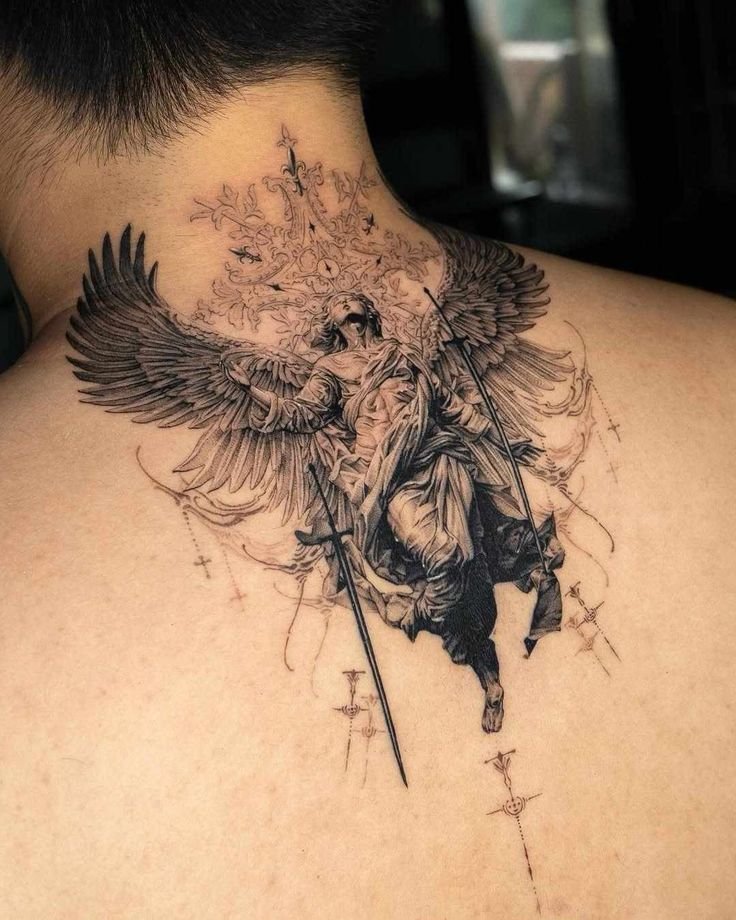
Where the Angel Holding a Sword Tattoo Began
Quick Answer: The image traces directly back to Christian scripture and was later cemented in the public imagination by Renaissance and Baroque religious paintings, which tattoo artists still reference today.
Understanding where this design comes from matters, because it explains why certain details (a defeated dragon underfoot, full armor, a raised blade) show up so consistently across totally unrelated artists and studios. This isn’t a trend. It’s an image with roughly two thousand years of visual precedent behind it.
Angels and Swords in Scripture
The Book of Revelation describes a war in heaven where the archangel Michael leads a fight against a dragon, and this passage is the direct root of nearly every “angel with a sword” tattoo you’ll find. Michael also appears in the Book of Daniel and the Book of Jude, consistently cast as a protector and a warrior rather than a passive messenger like some other angels. That’s an important distinction. Not every angel carries a sword. Gabriel, for instance, is traditionally associated with a trumpet or a lily, tied to announcement rather than battle. The sword is specifically Michael’s signature, which is exactly why so many “angel with sword” tattoo requests are, whether the client realizes it or not, actually Michael tattoos.
How Renaissance Art Shaped the Look
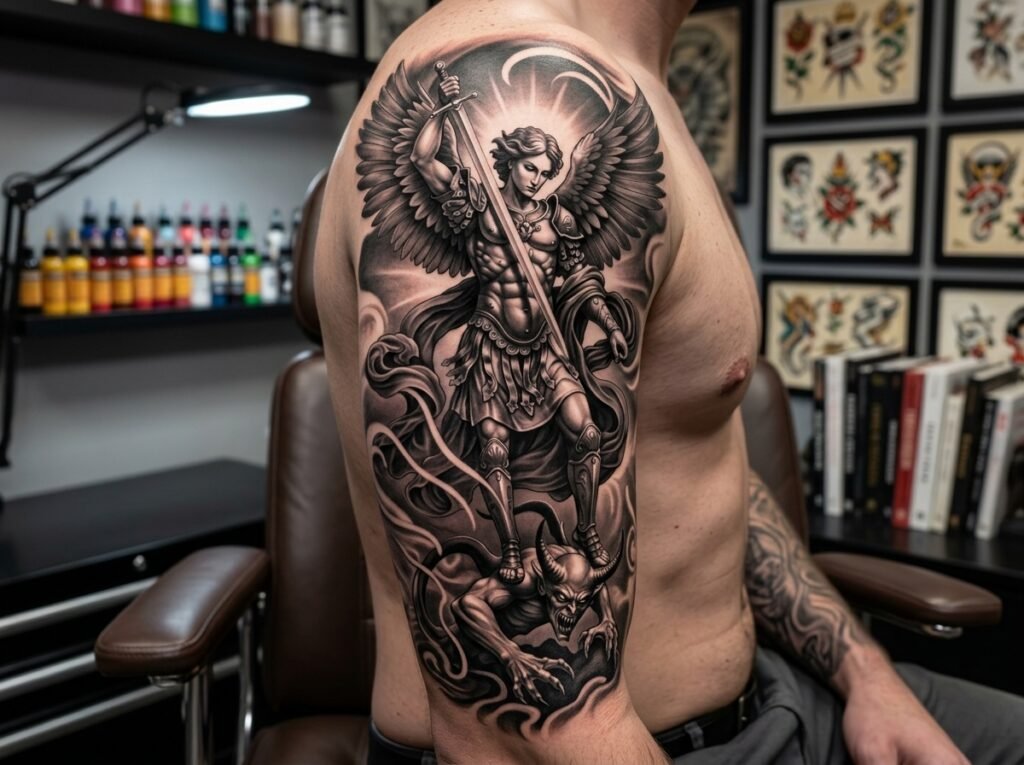
Painters like Guido Reni and Raphael Sanzio produced some of the most reproduced depictions of Michael in Western art, typically showing him mid-combat, foot planted on a serpent or demon, blade either raised or already having struck. Tattoo artists working in realism and neo-traditional styles lean on this exact visual grammar constantly, right down to the flowing cloak and the dynamic, off-balance battle pose. If you’ve ever looked at an angel-and-sword tattoo and thought it looked like it belonged in a cathedral, that’s not a coincidence. In a real sense, it does.
Self-contained Q&A: Is the angel-with-sword image only a Christian symbol? Not exclusively. Michael, referred to as Mikail, is also recognized in Islamic tradition, and Jewish tradition separately holds Michael as a protector figure and guardian of Israel. So the tattoo carries genuine meaning across three major faiths, not just one, even though most Western tattoo flash draws its visual style from Christian art specifically.
From Church Walls to Tattoo Flash
Warrior-angel imagery entered mainstream American tattoo culture the same way most religious flash did: through soldiers, sailors, and working-class clients wanting protective symbols before shipping out or heading into dangerous jobs. It’s stuck around because it does something few tattoo designs manage. It reads as both deeply personal and instantly recognizable, no explanation needed, whether the person looking at it shares the wearer’s faith or not.
And that’s really the throughline across a hundred years of this design. The details shift with the art trends of the decade, but the core message hasn’t moved an inch.
Archangel Michael Sword Tattoo Meaning Explained
Quick Answer: An archangel Michael sword tattoo specifically represents victory over evil, divine justice, and protection earned through direct confrontation rather than passive watching, and it’s the most requested version of this entire tattoo category.
If you searched for an angel holding a sword tattoo, there’s a strong chance what you actually pictured was Michael, whether or not you knew his name. He’s the reason this design exists in its most recognizable form: full armor, wings spread wide, blade raised or already lowered into a defeated enemy underfoot.
Who Archangel Michael Actually Is
Michael’s name translates roughly to “who is like God,” and across Christian, Jewish, and Islamic tradition he’s consistently positioned as the highest-ranking warrior angel, the one who leads rather than follows. He’s traditionally invoked as a protector of law enforcement, soldiers, and anyone facing a fight they didn’t choose. That association alone explains why so many first responders and veterans specifically request a Michael tattoo rather than a generic winged figure.
Semantic fact: Archangel Michael’s sword represents victory over evil, not merely the threat of it. That’s the detail that separates his imagery from a plain protective angel. Michael isn’t standing guard. He’s already won, or he’s actively winning, depending on how the piece is posed.
The A.R.M.O.R. Meaning Framework
Since so many people get this specific tattoo without fully articulating why, here’s a simple framework worth naming and using in your own consultation. Call it the A.R.M.O.R. Meaning Framework, five questions that map to the five most common reasons people choose an archangel Michael sword tattoo:
- Ancestry: Is this honoring a family tradition, a parent’s faith, or a cultural background?
- Redemption: Does this mark a personal turning point, recovery, or a fight you’ve already won?
- Motivation: Is this meant as daily armor, something to glance at for strength before a hard day?
- Oath: Does this represent a commitment, to a career like law enforcement or military service, to sobriety, to a promise you made someone?
- Remembrance: Is this honoring someone who’s passed, cast as your protector now?
Most wearers land on one or two of these, not all five. Answering honestly before your consultation saves real time and, more importantly, keeps the final design from feeling generic. A tattoo built around “redemption” should look different from one built around “remembrance,” even if both start from the same reference image.
Michael Versus a Generic Warrior Angel
Here’s a nuance that trips people up: not every winged figure with a blade is technically Michael, and that’s fine. A generic warrior angel carries the same broad symbolism (protection, strength, justice) without the specific scriptural backstory attached to Michael by name. If you want the tattoo to stay entirely personal, without inviting questions about religious iconography, skipping the specific Michael attributes (the defeated dragon, the scales of judgment, a name banner) keeps the piece more open-ended. Add those details back in, and you’re explicitly telling viewers, especially anyone with a Catholic, Orthodox, or Anglican background, exactly who’s on your skin.
Pro Tip, grounded in a real consultation pattern artists report: if you want a Michael tattoo but aren’t sure you want it to read as overtly religious to casual viewers, ask your artist to skip the halo and keep the color palette muted (black, grey, deep blue). The composition still reads as Michael to anyone who knows the iconography, but it won’t announce itself as loudly to everyone else.
Angel Holding a Sword Tattoo Meaning by Symbol
Quick Answer: Adding a second symbol, wings, a rose, chains, a skull, or a demon underfoot, layers a more specific meaning onto the base angel-and-sword design, and each combination tells a noticeably different story.
An angel holding a sword rarely appears completely alone. Most finished pieces pair it with at least one more element, and that pairing does real work. Here’s what the most common combinations actually communicate.
Angel, Sword, and Full Wings
This is the default, most recognizable version, and it leans hardest into pure protection and divine strength. Full, detailed wings take up real space on the body, which is exactly why this combination is the one most often scaled up into a back piece or a full sleeve rather than kept small.
Angel, Sword, and a Rose
Pairing the design with a rose folds in themes of love, sacrifice, or beauty found within struggle, honestly a striking contrast against the sword’s harder edge. This combination shows up often in memorial work specifically, where the rose represents the person being honored and the angel-and-sword represents the protection or fight the wearer associates with them.
Angel, Sword, and Chains or a Skull
Add broken chains and the meaning shifts toward freedom, specifically freedom won through struggle rather than freedom that was simply given. A skull paired into the composition pulls the design toward mortality and memento mori themes, a reminder that the fight being depicted has real stakes. This combination tends to run darker in both palette and tone, and it’s popular with wearers processing addiction recovery or a genuine brush with death.
Self-contained Q&A: What does a sword through a snake or dragon add to the meaning? It specifically represents victory over temptation or evil already achieved, not evil still looming. This detail, borrowed directly from the Michael-and-dragon scene in Revelation, is one of the clearest ways to signal “I already won this fight” rather than “I’m still fighting it.”
The Fallen Angel Variant
Not every version of this design shows triumph. A fallen angel holding a sword flips the composition: torn or drooping wings, a downward or defeated pose, sometimes a dropped or broken blade instead of a raised one. Where a triumphant angel-and-sword says the fight is won, the fallen variant says the fight is still being fought, or was lost and is being honestly reckoned with rather than glossed over. Some wearers choose this version deliberately, precisely because it doesn’t pretend the struggle is finished.
Pro Tip: If you’re drawn to the fallen angel variant but worry it reads as purely negative to people who don’t know your story, ask your artist to keep one small detail intact and undamaged, an unbroken hand, a single whole feather. That one detail quietly signals resilience without undercutting the honesty of the rest of the piece.
Popular Angel Holding a Sword Tattoo Styles
Quick Answer: Realism and neo-traditional are the two strongest style choices for this design specifically, since both hold up the fine detail an angel-and-sword composition depends on, though blackwork and illustrative styles work well for simpler versions.
The amount of detail packed into a full angel-and-sword composition, feathers, armor, drapery, blade highlights, means the style you choose matters more here than it does for simpler tattoos.
Realism
Realism aims for photographic depth, and when it’s done well, it’s genuinely stunning on a design this dramatic. The tradeoff is real, though: realism demands a highly skilled, usually more expensive artist, takes noticeably longer per session, and can lose crispness faster than bolder styles as skin ages, particularly in fine shading areas like feather tips.
Neo-Traditional
Neo-traditional blends bold outlines with saturated color and a bit of stylization, and for an angel-and-sword piece specifically, it tends to be the sweet spot. The heavier linework holds its shape for decades, the color adds emotional weight without demanding full photorealism, and most experienced tattoo artists have real reps doing this style well.
Blackwork and Fine Line
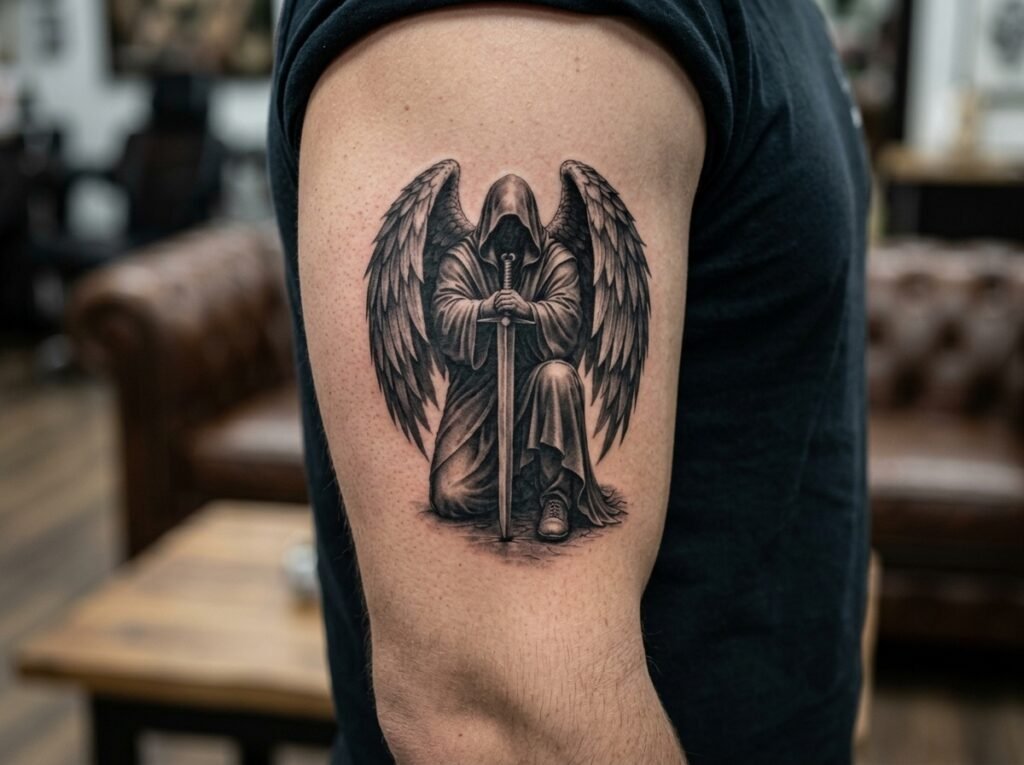
For a smaller, more private version, blackwork or fine line styles trade full detail for striking contrast or delicate simplicity. A fine-line angel-and-sword sketch on the forearm reads as understated and personal rather than a bold public statement. The catch: fine line is the style most prone to blurring over the years, so it’s a better fit for smaller, simpler compositions than a full detailed battle scene.
Illustrative and Watercolor
Illustrative and watercolor styles bring a softer, more painterly feel, often blending color in a way that reads more artistic than religious. This works especially well for wearers who want the emotional tone of the design (protection, resilience) without leaning into traditional religious iconography quite as heavily.
The Sword Angle Style Matrix
Here’s an original framework to help narrow this decision fast. Picture two axes. One runs from Minimal Detail to Highly Intricate. The other runs from Soft and Protective to Fierce and Warrior-Like. Call it the Sword Angle Style Matrix:
- Minimal + Soft: Fine line, small scale, muted or no color. Best for a first tattoo or a private, personal placement.
- Minimal + Fierce: Bold blackwork silhouette, sword clearly raised, no shading. Best for high-contrast, statement placements like the outer forearm.
- Intricate + Soft: Illustrative or watercolor, full figure, gentle expression. Best for memorial pieces meant to feel comforting rather than aggressive.
- Intricate + Fierce: Realism or neo-traditional, full battle composition, defeated enemy underfoot. Best for large-scale back or chest pieces meant to make a real statement.
Most people can place themselves on this matrix in about thirty seconds, and it narrows the style conversation with your artist dramatically before you’ve spent a dollar.
Self-contained Q&A: Which style ages best for a detailed piece like this? Neo-traditional and bold traditional generally age the best, thanks to thicker linework that resists the softening effect of decades-old ink spreading slightly under skin. Fine-detail realism looks the most impressive on day one but typically needs a touch-up sooner, often within five to ten years, to keep the finer elements crisp.
Best Placement for an Angel Holding a Sword Tattoo
Quick Answer: The upper back, chest, and outer forearm are the strongest placements for this design, since all three provide enough flat surface area for detailed wingwork while sitting over relatively low-pain, well-padded areas of the body.
Placement decides two things at once: how the finished piece actually looks, and how much the session hurts. For a design this detailed, both matter.
Back and Chest Placement
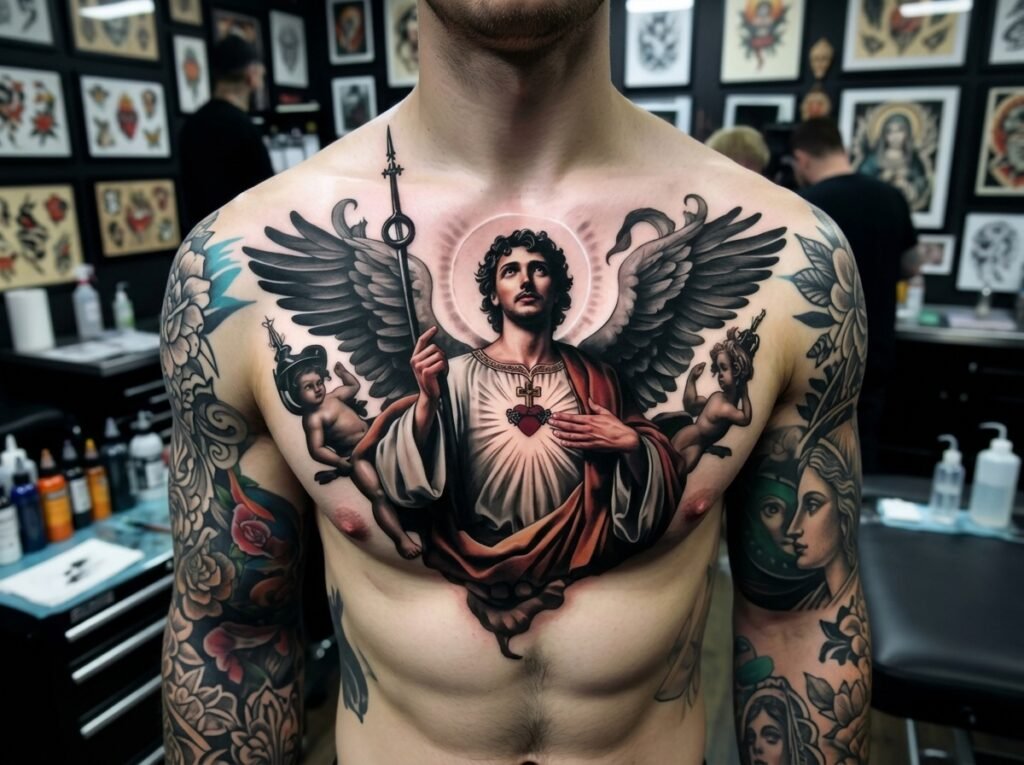
The upper back is the traditional home for full-wingspan angel designs, for a simple reason: it’s roughly where real wings would sit anatomically, and it’s the flattest, largest canvas most bodies offer. Chest pieces work similarly well and read as bold, central, and hard to ignore. Both spots sit over muscle rather than bone in most areas, which keeps the pain moderate rather than severe.
Forearm and Sleeve Placement
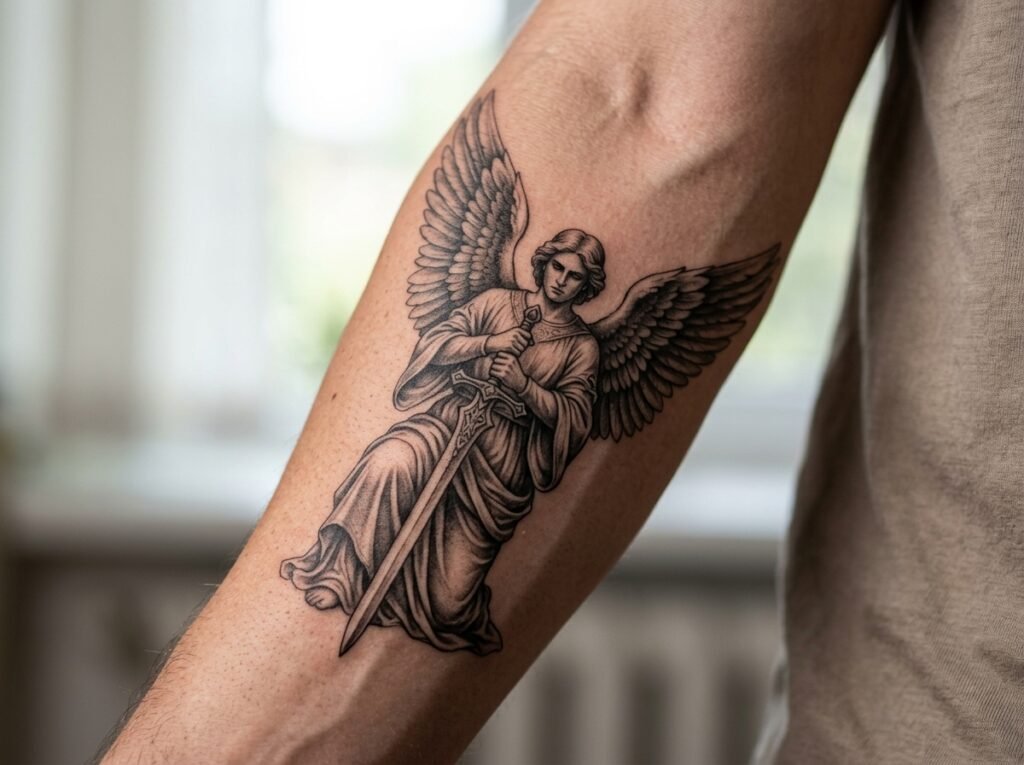
The outer forearm is the better choice for a mid-size, everyday-visible version. It’s fleshy, ranks among the least painful spots on a standard tattoo pain chart, and you’ll actually see it constantly, which matters if the whole point of the tattoo is a daily reminder rather than a piece you only glimpse in the mirror.
Calf and Thigh Placement
For a large but more coverable option, the calf or outer thigh works well. Both areas carry enough muscle padding to keep pain manageable and offer real space for a full figure, though the curve of the leg does add extra planning complexity for an artist working with symmetrical wings.
Placement and Pain, Honestly
Ribs, the spine, hands, feet, and the armpit consistently rank as the most painful tattoo zones, since thin skin sits directly over bone or dense nerve clusters in those spots. For a design this size and detail, sitting through hours of work on the ribs specifically is a genuinely different experience than the same hours on the outer forearm. If pain tolerance is a real concern, it’s worth being honest about that during your consultation rather than after the first thirty minutes.
Pro Tip, grounded in a real scenario tattoo artists describe constantly: clients frequently pick the ribs for an angel-and-sword piece because it “feels” like a meaningful, private spot, then struggle to sit through the full session. If privacy is the actual goal, the inner bicep or upper thigh delivers similar coverage-friendly privacy with noticeably less pain.
5 Steps to Pick Your Placement
- Decide how public the meaning should be. A daily glance at your forearm hits differently than a piece only you and people you choose ever see.
- Match size to the level of detail you want. A full battle composition with a defeated demon needs real space. A single symbolic sword-and-wing outline doesn’t.
- Check your pain tolerance against the pain chart. Be honest about whether you can sit through several hours on a higher-pain zone.
- Think about your work environment. Some jobs and industries still have visible-tattoo policies, so factor that in before committing to the neck, hands, or forearm.
- Confirm the actual stencil size with your artist before the needle starts. What looks “medium” in a reference photo is often larger in person once wings and drapery are added.
Self-contained Q&A: Can a small angel holding a sword tattoo still look detailed? Yes, with a caveat. Fine-line work can compress real detail into a two- or three-inch design, but the tradeoff is durability. Extremely fine detail at a small scale is the first thing to blur as skin ages, so a simplified silhouette version tends to hold up better long-term than a shrunk-down attempt at full realism.
Cost, Artists, and Aftercare for This Tattoo
Quick Answer: Most angel holding a sword tattoos run somewhere between 400 and 2,500 US dollars in 2026, driven mainly by size, color, and how much detail (armor, a defeated enemy, full wings) you’re asking your artist to include.
What Drives the Price
Most tattoo artists in the United States charge somewhere between 100 and 300 dollars per hour in 2026, with newer artists starting around 50 to 100 dollars and established, in-demand specialists charging 250 to 500 dollars or more, particularly in major metro areas (Removery, 2024; Hustle Butter, 2025). A detailed angel-and-sword composition, armor, wings, shading, an enemy underfoot, rarely wraps in a single hour. A small, simplified version might land in the 300 to 600 dollar range in one sitting. A full back piece with real detail commonly runs 1,500 to 5,000 dollars or more across multiple sessions, in line with typical large-scale custom tattoo pricing nationally (Sortra, 2026).
Before and after, tied to the numbers: Pew Research Center found that roughly a quarter of tattooed Americans regret at least one of their tattoos. The clearest pattern behind that regret, based on how tattoo artists describe it, is choosing something quickly off a wall of flash art rather than working through what the design should actually mean first. The “before” here is picking any angel-with-sword design because it looked cool in a photo. The “after” is using a framework like A.R.M.O.R. above to land on a specific, personal version first, then choosing the design around that. It costs the same either way. Only one version tends to still feel right a decade later.
Finding the Right Artist
Not every skilled tattoo artist is good at this specific design. Angel-and-sword work depends heavily on convincing anatomy, drapery, and wing structure, skills that a fantastic blackwork or lettering artist may simply not practice often. When you’re reviewing portfolios, look specifically for religious, mythological, or figurative work, not just an artist’s general feed. And ask to see a piece that’s at least a year old, not fresh out of the chair. Healed work tells you far more about long-term quality than day-one photos ever will.
Take Jordan, a firefighter in his mid-thirties, as a quick, real-feeling example of how this plays out. He wanted a back piece marking his recovery after a serious injury, and his first two consultations kept drifting toward generic “cool warrior angel” reference photos that didn’t actually say anything specific. His artist pushed him to answer one question first: was the fight over, or still going? Jordan landed on “over,” which meant the final design used a lowered blade and a calm, settled expression rather than a mid-battle pose. The piece took four sessions across roughly eleven hours. Two years later, he says it’s the one tattoo he explains completely unprompted, because unlike the rest of his ink, this one has an actual answer when someone asks what it means.
Aftercare Basics That Matter
Large, detailed pieces like this one heal in stages over two to four weeks, and the fine linework (feather edges, blade highlights) is genuinely the most fragile part during that window. Keep the area clean, moisturized with a fragrance-free healing balm, and out of direct sun for the full healing period. Skipping sun protection long-term is one of the fastest ways detailed shading softens early, sometimes within the first year or two rather than gradually over a decade. If you notice unusual redness, swelling, or oozing beyond the first few days, contact your artist or a doctor rather than waiting it out.
Comparative honesty, since every design has a real tradeoff: an angel holding a sword is not a low-commitment tattoo. It’s multi-element, detail-dependent, and genuinely doesn’t simplify well below a certain size without losing what makes it read clearly as “angel with a sword” instead of just a vague figure holding a stick. If you want something quick, cheap, and small, this specific design probably isn’t the right pick, and that’s worth knowing before you book anything.
Angel Holding a Sword Tattoo Comparison: Top Options at a Glance
| Style | Key Feature | Best For | Price Range (USD) | Editor’s Popularity Score |
|---|---|---|---|---|
| Realism | Photorealistic shading, true depth | Large, single statement piece | $150 to $300 per hour | 4.7 / 5 |
| Neo-Traditional | Bold linework, saturated color | Long-term durability with real detail | $120 to $220 per hour | 4.6 / 5 |
| American Traditional | Thick outlines, flat limited color | Classic look that ages cleanly | $100 to $200 per hour | 4.4 / 5 |
| Blackwork / Fine Line | High contrast or delicate single-needle detail | First-timers, smaller private pieces | $100 to $180 per hour | 4.2 / 5 |
| Illustrative / Watercolor | Painterly blending, softer edges | Artistic, less overtly religious tone | $130 to $250 per hour | 4.1 / 5 |
Our pick: For most people chasing a genuinely striking angel holding a sword tattoo, neo-traditional wins out. Reasoning: it holds fine detail for decades better than realism does, it reads clearly whether the viewer knows the religious iconography or not, and it gives an experienced artist real creative room without demanding realism’s higher price tag and longer sitting time.
Table note: prices reflect commonly cited 2026 US hourly tattoo rates (Removery, 2024; Hustle Butter, 2025; Sortra, 2026), not a fixed per-piece cost, since total price depends on session length. Popularity scores are this guide’s own editorial assessment based on current gallery and community activity, not a third-party statistical survey.
FAQ
What does an angel holding a sword tattoo mean? An angel holding a sword tattoo represents protection paired with the will to fight for it, not passive guardianship alone. Where a plain guardian angel tattoo says something is watching over you, adding the sword changes the sentence to something is watching over you, and it will act. The core reading blends spiritual protection, moral courage, and readiness for conflict, whether that conflict is external or an internal battle the wearer has already fought and won.
How is an archangel Michael sword tattoo different from a regular guardian angel tattoo? An archangel Michael sword tattoo names a specific warrior figure from scripture, while a generic guardian angel tattoo stays deliberately unnamed and personal. Michael appears by name in the Bible, the Quran as Mikail, and Jewish tradition as the leader of the heavenly host who battles evil directly. A generic guardian angel, by contrast, is usually a private stand-in, a parent, a late friend, a feeling, without lore attached. Choosing Michael specifically borrows his story. Choosing a nameless guardian keeps the story entirely yours.
Why is archangel Michael usually shown carrying a sword? Michael carries a sword because scripture and centuries of religious art cast him as the commander who physically defeats evil, not just watches over it. Revelation describes Michael leading heaven’s forces against a dragon, and Renaissance painters cemented the sword-and-defeated-demon pose that tattoo artists still copy today. The weapon signals action taken, not action pending, which is exactly why it reads differently than wings or a halo alone.
Is an angel holding a sword tattoo worth getting if I’m not religious? Yes. The design reads as strength and protection even for wearers with no religious framework attached to it. A large share of tattooed Americans say at least one of their tattoos carries no deeper meaning beyond liking how it looks (Pew Research Center, 2023). An angel holding a sword works the same way a lion or a phoenix does. The imagery carries symbolic weight on its own, no belief system required, though it will read differently to viewers who do share that context.
What’s the best way to choose a design for an angel holding a sword tattoo? Start with the specific feeling you want the piece to hold, not the reference image you liked first. Decide whether the angel is protecting you, avenging something, or marking something you already survived, since that choice changes the pose, the sword’s angle, and whether a demon or serpent belongs underfoot. Bring that one sentence to your consultation instead of a folder of unrelated references. A good artist will design around intent, not just aesthetics.
What’s the best placement for an angel holding a sword tattoo? The upper back, chest, or outer forearm generally works best, since all three offer enough flat space for the wings and blade detail to age well. Back and chest pieces suit large, dramatic compositions and sit over well-padded muscle, which tends to hurt less and hold linework longer. The outer forearm is the better call for a visible, mid-size version you’ll actually see day to day, and it ranks among the least painful spots on the standard tattoo pain chart.
How much does an angel holding a sword tattoo cost? Expect roughly 400 to well over 2,000 US dollars, depending mostly on size and detail. Most tattoo artists in 2026 charge somewhere between 100 and 300 dollars per hour, and a detailed angel-and-sword composition with armor, wings, and shading rarely finishes in under three or four hours. A small single-session version might land near the low end. A full back piece with a demon underfoot can run well past 2,000 dollars across multiple sessions.
Angel holding a sword tattoo versus fallen angel tattoo, what’s the difference? One depicts triumph and active defense, the other depicts fall, struggle, or redemption in progress. An angel holding a sword, especially an archangel Michael design, shows victory already in motion: wings spread, blade raised, evil underfoot. A fallen angel tattoo usually shows the opposite moment: torn wings, a downward pose, sometimes a broken or dropped weapon. Some wearers deliberately choose fallen imagery to represent a battle they’re still fighting rather than one they’ve already won.
My angel holding a sword tattoo’s fine linework is starting to blur, is that normal? Some softening is normal over years, especially in fine-line areas like feathers and blade edges, but early blurring within the first year usually points to a healing or placement issue worth asking your artist about. Detailed elements like individual feathers, chainmail, or thin blade highlights are the first things to lose crispness, particularly in high-friction spots like the inner elbow or ribs. If it’s happening within months rather than years, sun exposure without SPF and skipping aftercare instructions are the two most common causes, and a touch-up session can usually restore the detail.
What’s the difference between an angel with a sword and an angel with wings only? A wings-only angel tattoo leans purely symbolic and open-ended, while adding a sword narrows the meaning toward active protection or a specific battle. Wings alone can mean almost anything the wearer wants: freedom, faith, memory, without committing to a particular story. The moment a sword enters the composition, the design starts making a more specific claim about conflict, justice, or defense, which is why people anchoring the tattoo to a real fight, recovery, or loss often add the blade on purpose.
Conclusion
An angel holding a sword tattoo isn’t just a striking design. It’s a specific statement: protection that’s willing to act, not just watch. Three things actually matter most here. First, the details you choose, blade angle, a defeated enemy, full armor, change the story the piece tells, so decide on meaning before you decide on reference images. Second, this design rewards a style that holds fine detail long-term, which is why neo-traditional and realism consistently outperform smaller, softer styles for a full composition. Third, placement isn’t just about how it looks. It genuinely changes both the pain you’ll sit through and how loudly the tattoo speaks day to day.
If you’re ready to move forward, here’s what to do in the next ten minutes:
- Write one honest sentence answering whether your version’s fight is over or still ongoing
- Save two or three reference images that match your spot on the Sword Angle Style Matrix above
- Look up one local artist whose portfolio actually shows religious or figurative work, not just their general feed
Author Bio
Ambreen Fayyaz writes about tattoo culture, symbolism, and body art trends for Zapybeauty, with a focus on separating sourced, accurate meaning from recycled tattoo-blog guesswork. When we researched this piece, the goal was to cite real surveys, real art history, and real pricing data instead of repeating the same vague sentences most angel tattoo articles recycle. Ambreen Fayyaz is not a theologian or a licensed tattoo artist. Design, placement, and pricing guidance in this piece reflects common industry practice, not medical, financial, or religious authority, so confirm specifics with your own artist before booking.
Fact-checked by: Ambreen Fayyaz Last Updated: August 30, 2026 Disclosure: This post contains no affiliate links, no sponsored content, or neither.
References
- Pew Research Center, “32% of Americans have a tattoo, including 22% who have more than one,” August 15, 2023.
- Ipsos, “More Americans Have Tattoos Today than Seven Years Ago,” August 29, 2019.
- Tattoodo, “8 Powerful & Protective Archangel Michael Tattoos.”
- tatufoto.com, “The Meaning of an Archangel Michael Tattoo: A Complete Encyclopedia of Symbolism, Styles, and Sketch Selection.”
- Removery, “2024 Tattoo Cost, Your Guide to Average Tattoo Prices.”
- Hustle Butter, “How Much Do Tattoos Cost? A Complete Pricing Guide.”
- Sortra, “How Much Do Tattoos Cost per Hour? A 2026 Pricing Guide.”
- Hyper Inkers, “Tattoo Pain Chart: How Much Tattoos Hurt on 30 Body Areas.”
- StyleCraze, “Archangel Michael Tattoo: 8 Unique Designs To Inspire Your Faith.”
- StyleCraze, “Sword Tattoo Designs: 16 Bold Ideas For Strength & Courage.”