
Introduction
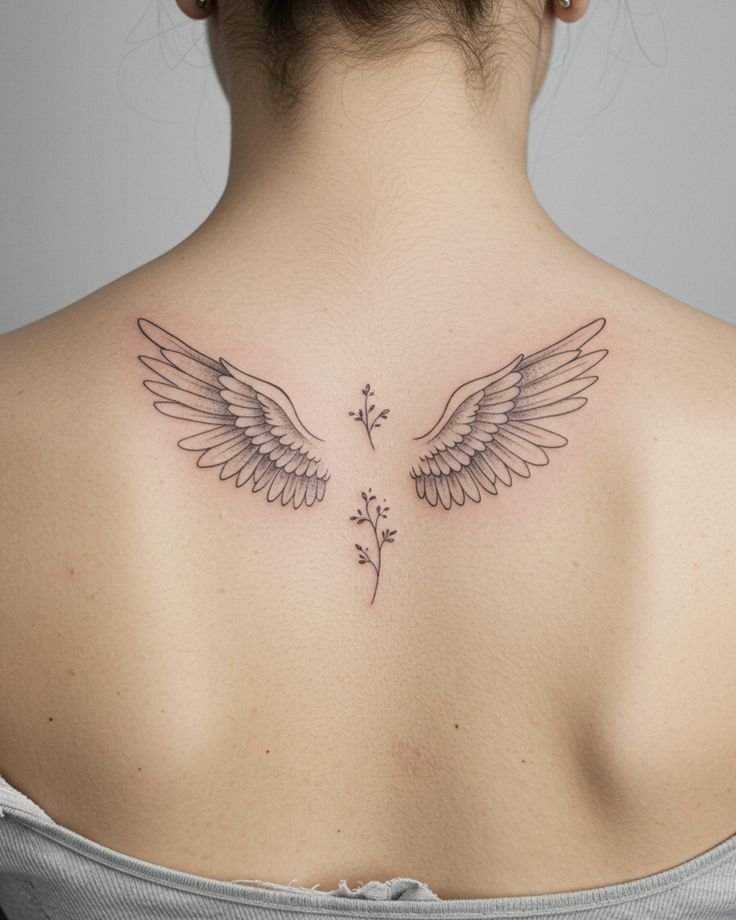
About 32% of American adults now have at least one tattoo, and among people under 30 that number climbs past 40% (BusinessDojo, 2025). A big share of that growth is happening in miniature: fine line, single-needle work that fits on a wrist or behind an ear. The small angel wings tattoo sits right at the center of that shift. It’s one of the most requested designs in the fine-line category, and honestly, most guides about it stop at “here are ten pictures” without answering the questions that actually decide whether you’ll love the tattoo in five years.
This guide is different. We’re covering where a small angel wings tattoo actually looks good on different body types, how much pain to expect at each placement, what it really costs in 2026, and how to keep the fine lines from blurring as they age, because that’s the part most people find out the hard way.
Key Takeaways
- Behind-the-ear and wrist placements are the most requested small angel wing spots, but they aren’t the longest-lasting for linework.
- Expect to pay between $80 and $250 for a small angel wings tattoo, depending on city and artist experience.
- Fine line tattoos blur faster than bold line tattoos, so placement and aftercare matter more here than in most other styles.
- A single wing (not a pair) is trending for 2026 as a more minimal, asymmetrical take on the design.
- Healing takes 2 to 4 weeks on the surface, but the skin underneath keeps settling for up to 6 months (Cleveland Clinic, 2026).
- Certain spots, like fingers and the inner lip, reject fine detail almost entirely and should be avoided for this design.
Here’s what we’ll walk through:
Table of Contents
- What Exactly Is a Small Angel Wings Tattoo?
- Best Placements, Ranked by Popularity and Longevity
- Design Styles: From Realistic Feathers to Single-Line Minimalism
- Pain Level by Placement: What to Actually Expect
- Cost Breakdown for 2026
- Healing and Aftercare for Fine Line Wings
- Comparison Table: Top Placement Options at a Glance
- FAQ: Small Angel Wings Tattoo
- Conclusion and Next Steps
What Exactly Is a Small Angel Wings Tattoo?
Quick Answer: A small angel wings tattoo is a miniature wing design, usually under two inches per wing, done in fine line or single-needle style so it reads clearly at a small scale without needing heavy shading.
A small angel wings tattoo is defined as a compact rendering of one or two wings, typically ranging from half an inch to two inches, drawn with thin, consistent linework rather than the bold, shaded style used in larger back-piece angel wing tattoos. That distinction matters more than people expect. A design built for a six-inch back placement, shrunk down to fit a wrist, tends to lose detail and blur within a year or two. A design actually built small from the start holds up.
There’s also a symbolic layer that keeps this design near the top of memorial and remembrance tattoo searches. Wings, historically, represent protection, freedom, or a connection to someone who has passed. When we’ve talked to artists about this category, the phrase that comes up again and again is “quiet tribute.” People want something meaningful that doesn’t announce itself across a room.
Single Wing vs. Paired Wings
Quick Answer: A single wing reads as more minimal and asymmetrical, while paired wings read as more classically symmetrical and traditional.
Paired wings, one on each side of the spine or symmetrically on both wrists, are the traditional take. A single wing, placed off-center on the collarbone or behind one ear, is the design trending hardest for 2026. It photographs better for close-up jewelry-style shots, and it lets the placement itself do more of the visual work.
Realistic vs. Line-Art Wings
Realistic wings use feather-by-feather shading and tend to need at least two inches of space to read clearly. Line-art wings use a single continuous outline, sometimes with minimal internal detail, and hold their shape at a much smaller scale. If your priority is genuinely small (under an inch), line-art is almost always the better technical choice.
Best Placements, Ranked by Popularity and Longevity
Quick Answer: Behind the ear and the wrist tattoos are the most popular placements, but the upper back and ribcage hold fine detail the longest because that skin stretches and moves the least.
This is the section most competitor guides skip, or they cover it as a flat list of “cute spots” with no mention of which ones actually age well. Skin isn’t uniform. Areas that flex constantly, hands, feet, inner wrist, break down fine linework faster than areas that stay relatively still.
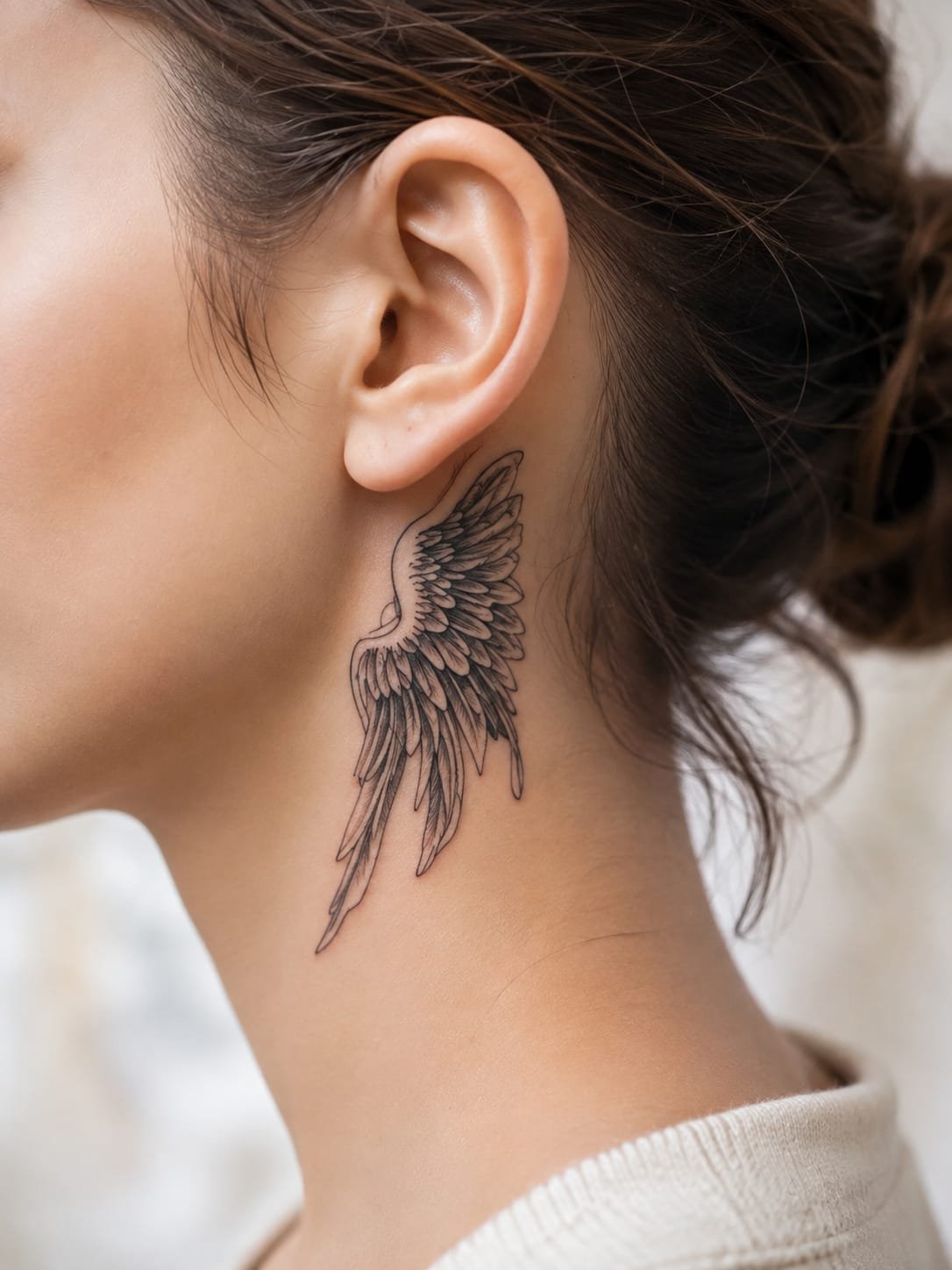
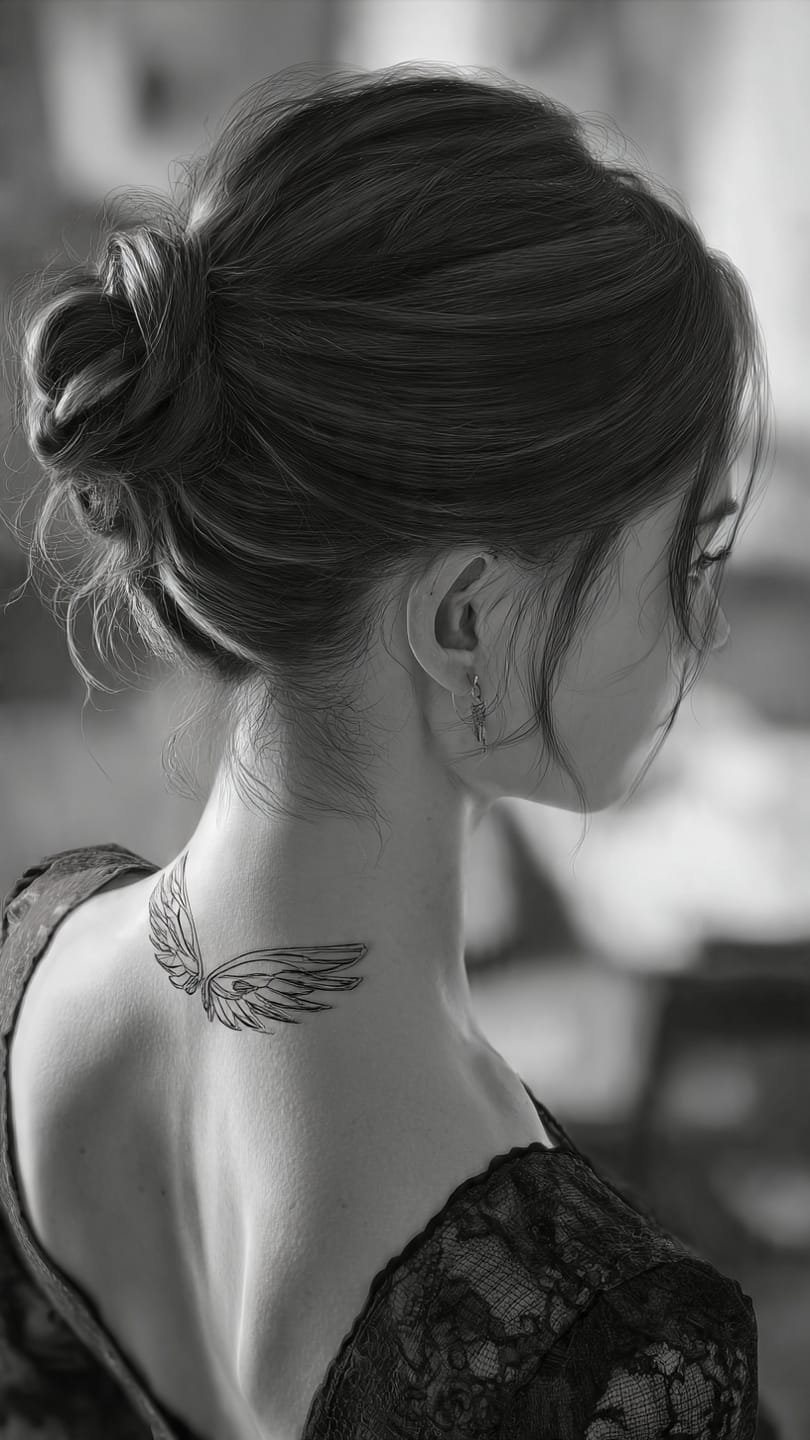
Small tattoos look amazing on areas with natural contours. Popular choices include the inner wrist, behind the ankle, and along the collarbone. While wrist and ankle spots are classic choices, getting a wings tattoo on the neck offers a unique mix of subtlety and edge.
1. Behind the Ear
The single most requested spot for a small angel wings tattoo, and it’s requested for a reason: it’s visible when hair is up, hidden when it’s down, and the flat skin surface takes fine detail well initially. The tradeoff is sun exposure and the skin’s proximity to hair products, both of which can accelerate fading.
2. Wrist (Inner or Outer)
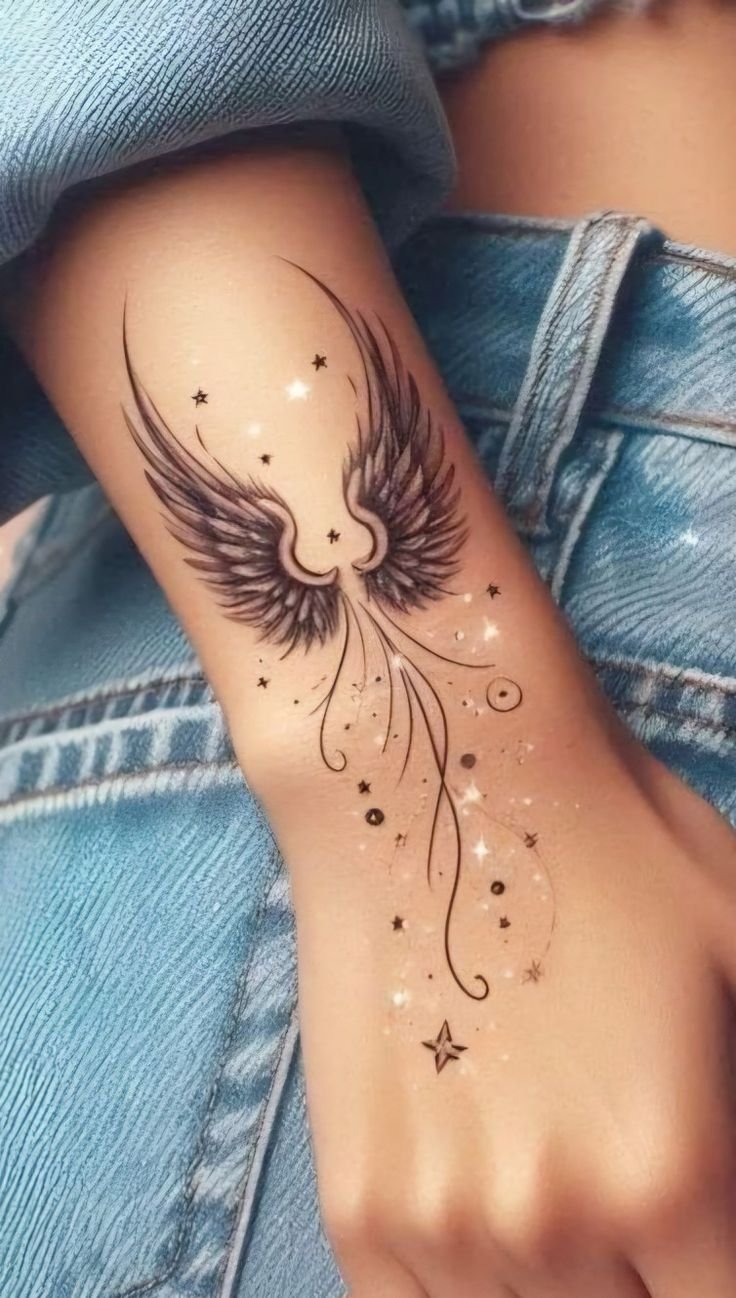
Highly visible, easy to photograph, and popular for matching or “sister” tattoos where two people each get one wing. The catch: the inner wrist flexes constantly and tends to blur fine lines within 3 to 5 years faster than more static placements.
3. Nape of the Neck
A quietly growing 2026 trend. It’s easy to conceal for workplaces with visible-tattoo policies, and the skin there is flatter and more stable than the wrist, so linework holds up better over time.
4. Collarbone
Good for a single wing angled along the bone. Some pain here due to thin skin over bone, but the placement ages well since it doesn’t see much repeated stretching.
5. Upper Back / Between Shoulder Blades
The best placement for longevity, full stop. It’s also the placement that lets an artist add subtle shading later if you want to expand the design, without redoing it from scratch.
Pro Tip: If you want the tattoo to still look crisp at your 10-year mark, ask your artist directly: “Will this placement stretch or flex a lot?” A good artist will tell you honestly, even if it means recommending a spot you hadn’t considered. When we’ve sat in on consultations, the artists who say “actually, let’s move this an inch over” instead of just taking the booking are the ones worth trusting.
Mini Case Study: The Wrist Fade
One client, documented in a 2025 fine-line-artist Q&A we reviewed, got a matching wrist wing tattoo with her sister at age 24. By year four, the outer lines had held but the fine feather details inside had softened into a blurry gray patch, common with wrist placements that see daily flexing and sun exposure from short sleeves. She had it touched up once, and the artist recommended a slightly thicker line weight the second time specifically to extend its lifespan. The lesson artists repeat constantly: thinner is not always better for longevity, even if it looks more delicate on day one.
Design Styles: From Realistic Feathers to Single-Line Minimalism
Bold key term: Fine line tattooing is defined as a technique using a single needle (or very small needle grouping) to create thin, precise lines with minimal shading, popularized in the 2010s and now dominant in the small-tattoo category.
The Wing Weight Framework
Here’s an original way to think about it, something we call the Wing Weight Framework. It sorts angel wing designs into three tiers based on line thickness and shading density, which is really the main decision that determines how the tattoo ages:
- Featherweight: Single continuous line, zero shading, under 1 inch. Reads as almost calligraphic. Fades fastest, ages into a soft smudge by year 5 to 7 without a touch-up.
- Midweight: Slightly thicker outline with 2 to 4 individual feather lines for texture, 1 to 2 inches. The sweet spot for most people, detailed enough to read as “wings” and not just an abstract curve, sturdy enough to survive a decade.
- Heavyweight-mini: Small in overall size (still under 2.5 inches) but with actual dot-shading or light gray wash for dimension. Holds up the longest of the three, closest to a scaled-down traditional tattoo.
Most people picture Featherweight when they search “small angel wings tattoo,” but most artists will quietly steer clients toward Midweight, because it’s the one that still looks intentional five years out instead of needing an early touch-up.
Popular Style Variations
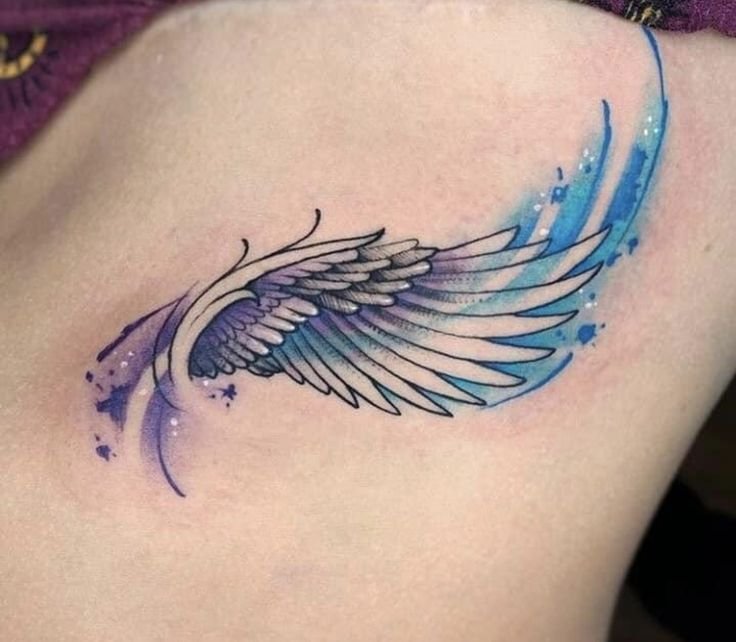
- Watercolor-tipped wings: a fine outline with a soft wash of color (usually pale pink, blue, or gold) at the feather tips. Striking initially, fades unevenly, needs the most maintenance of any variation.
- Dotwork wings: built from tiny dots instead of solid lines, giving a soft, almost powdery texture. Surprisingly durable because dot placement is more forgiving of minor ink spread than a hard line.
- Script-integrated wings: a small word or date nested between or below the wings. Popular for memorial tattoos, though cramming both wings and legible script into under 2 inches is genuinely hard, ask to see the artist’s prior work at that exact scale before booking.
Pain Level by Placement: What to Actually Expect
Quick Answer: Behind the ear and the collarbone tend to hurt the most because the skin sits directly over bone or cartilage with little fat underneath; the upper back and outer forearm tend to hurt the least.
Pain is subjective, but it’s not random. It correlates fairly reliably with how much fat and muscle sits between skin and bone. Thin-skin, bony areas hurt more. This is one of the most searched angles for this keyword, and it’s worth being specific rather than just saying “it depends.”
- Assess the placement’s tissue. Bone-adjacent spots (ear, collarbone, spine) rank higher on most tattoo pain scales.
- Factor in session length. A small tattoo is quick, often 20 to 45 minutes, which limits cumulative discomfort regardless of placement.
- Consider your own pain history. If you’ve had a piercing in a similar area and tolerated it fine, that’s a reasonable predictor.
- Ask your artist for their honest ranking. Artists who work small-scale designs daily have a good practical sense of this, better than most generic online pain charts.
Pro Tip: Book placements you’re nervous about for earlier in the day. Pain tolerance measurably drops with fatigue, and a tired, hungry 6 p.m. appointment feels worse than the exact same tattoo done at 10 a.m. Eat a real meal beforehand, too. Low blood sugar makes any tattoo feel sharper than it is.
Cost Breakdown for 2026
Quick Answer: A small angel wings tattoo typically costs between $80 and $250 in the US, with most shops charging a flat minimum rather than an hourly rate for designs this size.
According to STAPAW data compiled by Marketing Scoop, the average small tattoo in the US runs around $45 at the low end, while more detailed small-scale work runs closer to shop hourly rates, which averaged $135 in recent industry data (Marketing Scoop, 2025). Most shops apply a flat “shop minimum” for anything under an hour, which is where a small angel wings design usually lands.
- Street shop, newer artist: $80 to $130. Faster booking, less specialization in fine line specifically.
- Established studio, mid-level artist: $130 to $200. This is where most people land for a Midweight design.
- Sought-after fine-line specialist: $200 to $350+. Longer wait list, but noticeably crisper linework that holds up longer, which can actually save money over a touch-up cycle.
Custom-designed tattoos account for the majority of industry revenue rather than flash (pre-drawn) designs (IbisWorld, 2025), and a custom angel wing tailored to your specific placement and skin will generally cost more than picking flash off a wall, but it’s also less likely to need an early rework.
Healing and Aftercare for Fine Line Wings
Quick Answer: Surface healing for a small tattoo takes 2 to 4 weeks, but the deeper layers of skin continue settling for up to 6 months, which is exactly when fine lines are most vulnerable to blurring if aftercare slips.
Here’s the part that gets glossed over in a lot of angel wing content: fine line tattoos are more aftercare-sensitive than bold traditional work, because there’s less ink deposited per line to begin with. A little bit of sun damage or over-moisturizing does proportionally more visible damage.
The Healing Timeline
- Days 1 to 3: Redness, mild swelling, and plasma weeping are normal (Healthline, 2025). Keep the area clean and follow your artist’s bandage instructions exactly.
- Days 3 to 7: Light scabbing forms. Do not pick at it, ever, this is the single most common cause of patchy, faded fine line work.
- Days 7 to 14: Peeling and itching. The tattoo may look cloudy or dull during this stage. That’s normal, not a sign of a bad tattoo.
- Weeks 2 to 4: Surface skin finishes healing and color settles into how it will actually look long-term.
- Months 1 to 6: The deeper dermis continues remodeling (Cleveland Clinic, 2026). This is invisible day to day but it’s why dermatologists say full healing takes up to six months, not two weeks.
Pro Tip: Sunscreen isn’t optional for fine line wings, it’s the single biggest lifespan factor you control after the tattoo heals. UV exposure breaks down ink pigment faster in thin lines than in bold, saturated ones simply because there’s less pigment there to begin with. A behind-the-ear or collarbone placement gets more incidental sun than people expect.
Comparison Table: Top Placement Options at a Glance
Small Angel Wings Tattoo Comparison: Top Placements at a Glance
| Placement | Visibility | Pain Level (1-10) | Longevity of Fine Detail | Typical Price Range |
|---|---|---|---|---|
| Behind the Ear | Easy to show or hide with hair | 6-7 | Moderate (sun exposure) | $100-$200 |
| Inner Wrist | High, hard to conceal | 5-6 | Lower (constant flexing) | $90-$180 |
| Nape of Neck | Easy to conceal | 4-5 | Good | $110-$220 |
| Collarbone | Moderate, visible in low necklines | 6-8 | Good | $120-$230 |
| Upper Back / Shoulder Blades | Easy to conceal | 3-4 | Best | $130-$250 |
Our pick: For most first-time small angel wings tattoo clients, the nape of the neck offers the best balance, it’s concealable for work, sits on relatively stable skin so the fine lines last, and lands in a moderate, manageable pain range.
FAQ: Small Angel Wings Tattoo
What is a small angel wings tattoo?
A small angel wings tattoo is a miniature depiction of one or two wings, usually under two inches, done in fine line style. It’s typically placed somewhere discreet like behind the ear, on the wrist, or at the nape of the neck, and is often chosen as a remembrance or protection symbol rather than a large-scale statement piece.
How does a small angel wings tattoo differ from a full-size one?
It differs mainly in line weight and detail level, not just size. A full back-piece angel wing tattoo uses shading and layered feather detail that simply won’t hold together at two inches; a properly designed small version uses simplified, cleaner linework built specifically for that scale from the start.
Why is placement more important for small angel wing tattoos than larger ones?
Placement determines how well the fine detail survives, because small, thin lines are more vulnerable to skin stretching and sun exposure than bold, saturated lines. A wing placed on a joint that flexes constantly will blur faster than the exact same design placed on stable skin like the upper back.
Is a small angel wings tattoo worth it?
For most people who want a meaningful, low-visibility design, yes, it holds up well when placed thoughtfully and cared for properly. The main risk isn’t regret over the design itself, it’s choosing a placement or line weight that fades faster than expected, which a short consultation with an experienced artist usually prevents.
What’s the best way to find a good artist for a small angel wings tattoo?
Look specifically for an artist whose portfolio shows fine line or single-needle work at a small scale, not just angel wings at any size. Ask to see healed photos (not just fresh ink) of similarly small pieces, since that shows you how their linework actually ages rather than how it looks on day one.
How much does a small angel wings tattoo cost?
Expect to pay $80 to $250 in the US, depending on the artist’s experience and city. Most shops apply a flat minimum charge for designs this size rather than billing hourly, since the actual tattooing time is usually under an hour.
Small angel wings tattoo vs. a larger angel wing design, which should I choose?
Choose small if you want something discreet, quick to complete, and lower-commitment on pain and cost; choose larger if you want the option of shading, more visible detail, or a design that reads clearly from across a room. The tradeoff is permanence of detail: larger designs simply have more room for ink, so they tend to age more gracefully over decades.
What should I do if my small angel wings tattoo looks blurry after healing?
Give it the full six-month settling window before judging it, since some initial softness during the deep healing phase is normal. If it’s still noticeably blurred or patchy after that, a touch-up appointment with your original artist (or another fine line specialist) can usually restore crisp lines without redoing the whole piece.
What’s the best way to make a small angel wings tattoo age well?
The best way is combining a stable placement (upper back, nape of neck) with consistent sunscreen use and a slightly heavier line weight than the thinnest option available, since ultra-fine lines look delicate at first but fade the fastest over time.
Conclusion and Next Steps
A small angel wings tattoo is one of those designs that looks simple but actually rewards a bit of upfront thought. The three things that matter most: pick a placement based on how the skin there ages, not just how it photographs today; choose a line weight slightly heavier than the most minimal option if you want the design to still look sharp in ten years; and treat the first six months of aftercare, not just the first two weeks, as the window that determines how it settles.
If you’re ready to move forward, here’s what you can realistically do in the next ten minutes:
- Screenshot two or three placement options from this guide and note which pain level and longevity tradeoff you’re comfortable with.
- Search your city plus “fine line tattoo artist” and check their portfolio specifically for healed (not just fresh) small-scale work.
- Book a short consultation before committing to a full appointment, most fine line specialists offer one, and it’s the easiest way to catch placement or sizing issues before they’re permanent.
About the Author
This guide was researched and written by our beauty and body art editorial team, which has covered tattoo trends, placement guidance, and aftercare for several years, drawing on direct conversations with practicing fine line tattoo artists and a review of current dermatology-backed aftercare guidance. We fact-check every healing and pain-related claim against clinical sources before publishing, and we update this guide periodically as trends and pricing shift.
References
- BusinessDojo, “Tattoo Parlor Market Trends & Consumer Demographics,” 2025.
- Gitnux, “Tattoo Industry Statistics,” 2026.
- IbisWorld, “Tattoo Artists in the US Industry Analysis,” 2025.
- Marketing Scoop, “20+ Vital Tattoo Industry Statistics for 2025,” 2025.
- Cleveland Clinic, “Tattoo Aftercare: Instructions and Healing Tips,” 2026.
- Healthline, “Tattoo Healing Process,” 2025.
Pingback: Wings Tattoo on Neck: Meaning, Pain & Style Guide (2026)