
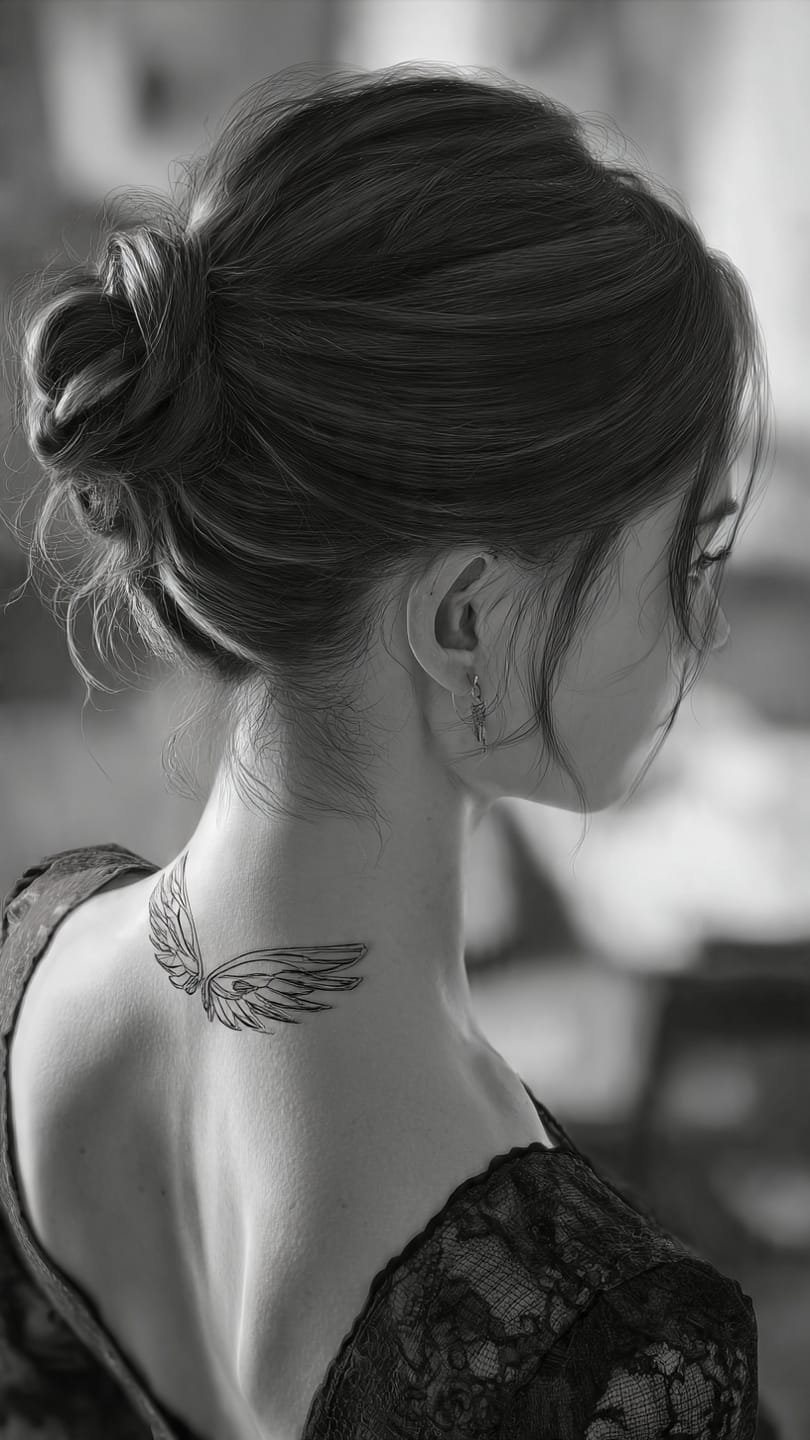
Updated for 2026
A licensed tattoo artist in Jurupa Valley, California recently posted a black and grey wings tattoo on neck design she described simply as “a symbol of faith, strength, and unseen protection.” That one line shows up, in one form or another, on almost every neck wings piece booked this year. Nearly a third of American adults, 32%, now have at least one tattoo, and 69% of them say the ink honors or remembers someone or something (Pew Research Center, 2023). Wings carry that weight better than almost any other design.
If you are staring at your phone right now with 200 saved photos of angel wings neck tattoo ideas and zero clarity on whether to actually book, you are not alone, and you are not being dramatic. The neck is one of the most visible spots on the body, one of the more painful ones to sit through, and one of the hardest to fully hide if you change your mind later. That combination deserves a real answer, not just a mood board.
This guide covers what a tattoo of wings on neck designs actually mean, which styles and placements are trending in 2026, how much the pain and healing really involve, what to budget, and how to think through the career question honestly instead of glossing over it.
Key Takeaways
- The neck ranks moderate to high on most pain charts, roughly 5 to 6 out of 10 on the sides and up to 9 out of 10 on the front and throat.
- Angel wings, fallen angel wings, and small minimalist feather wings are the three most requested versions of this design right now.
- Full surface healing takes about 2 to 3 weeks, but the skin underneath keeps settling for up to 3 months.
- A small to midsize neck wings piece typically runs $150 to $400 in 2026, before tipping.
- Concealment is possible with hair, collars, and styling, but it is not guaranteed for every job or every outfit.
- Meaning shifts by style: angel wings lean toward protection and memorial tribute, fallen angel wings lean toward struggle and duality, and bird or feather wings lean toward freedom.
Table of Contents
- What a Wings Tattoo on the Neck Actually Means
- Popular Wings Tattoo Styles for the Neck
- Best Neck Placements for a Wings Tattoo
- Does It Hurt? Pain, Healing and Aftercare
- Cost, Finding an Artist and Your Appointment
- Is It a Good Idea? Career, Concealment and Long-Term Considerations
- Wings Tattoo on Neck Comparison: Top Options at a Glance
- FAQ
- Conclusion
What a Wings Tattoo on the Neck Actually Means
Quick Answer: A wings tattoo on the neck usually symbolizes protection, freedom, or remembrance, and the specific meaning shifts with the style: upright angel wings lean spiritual, drooping fallen angel wings lean toward struggle, and feathered bird wings lean toward liberation.
A wings tattoo is defined as body art depicting bird, angel, or fantastical wings, chosen to represent flight, transcendence, or the ability to rise above something difficult. On the neck specifically, that meaning gets amplified. This is the part of the body that turns to face people, that shows in almost every photo, that a scarf can hide but a smile can’t. Placing wings there is rarely a casual decision, and most artists will tell you the same thing during a consultation: think hard about why before you think about how it looks.
Angel Wings: Faith, Protection and Guardianship
Angel wings tattoo symbolism centers on protection and divine connection. The design typically shows two upright, feathered wings, sometimes paired with a name, date, or small cross. Tattoo studios that specialize in this style, including Ink Mantra in Pune, describe the nape placement specifically as representing being “spiritually protected from behind,” a detail that only makes sense once you notice how many people request angel wings on the back of the neck rather than the front.
Fallen Angel Wings: Duality and Redemption
Fallen angel wings look deliberately different. The feathers droop, tear, or shade into black, and the overall silhouette reads as broken rather than pristine. This version symbolizes loss, a fall from grace, or the tension between light and dark within one person. It is a popular choice for people marking a hard chapter they came through rather than one they are still stuck in.
Feather and Bird Wings: Freedom and Transition
Not every wings tattoo is an angel’s. Realistic bird or feather wings, sometimes drawn as if attached to a small swallow or owl, symbolize freedom, wisdom, or a major life transition. These tend to skew smaller and more minimalist than angel wings, which makes them a common choice for a first tattoo in this location.
Memorial Wings: Honoring Someone You Lost
Here is the detail most competing articles skip entirely: memorial intent is the single most common motivation behind wings tattoos generally. Sixty-nine percent of tattooed Americans say they got at least one tattoo to honor or remember someone or something, the highest-cited reason in Pew Research Center’s 2023 national survey, ahead of both self-expression and appearance. Wings, more than almost any other symbol, get chosen specifically for this purpose, often paired with initials, a birth year, or a short phrase between the two wings.
Self-contained Q&A: What’s the difference between angel wings and fallen angel wings on a tattoo? Angel wings usually point upward and outward to suggest ascension and protection. Fallen angel wings droop, feature dark shading or torn feather detailing, and suggest a fall from grace or a duality between light and dark within the same person.
Semantically, it holds up as a clean rule: angel wing tattoos represent protection and spiritual guardianship for the wearer. Fallen angel wing tattoos represent internal struggle and eventual redemption. Feather and bird wing tattoos represent freedom and personal transformation. Keep that framework in mind because it will make choosing a style, covered next, much faster.
Popular Wings Tattoo Styles for the Neck
Quick Answer: The four styles dominating neck wing requests in 2026 are small minimalist linework wings, realistic shaded angel wings, dark fallen angel wings, and wrapped collar wings that stretch across the base of the neck.
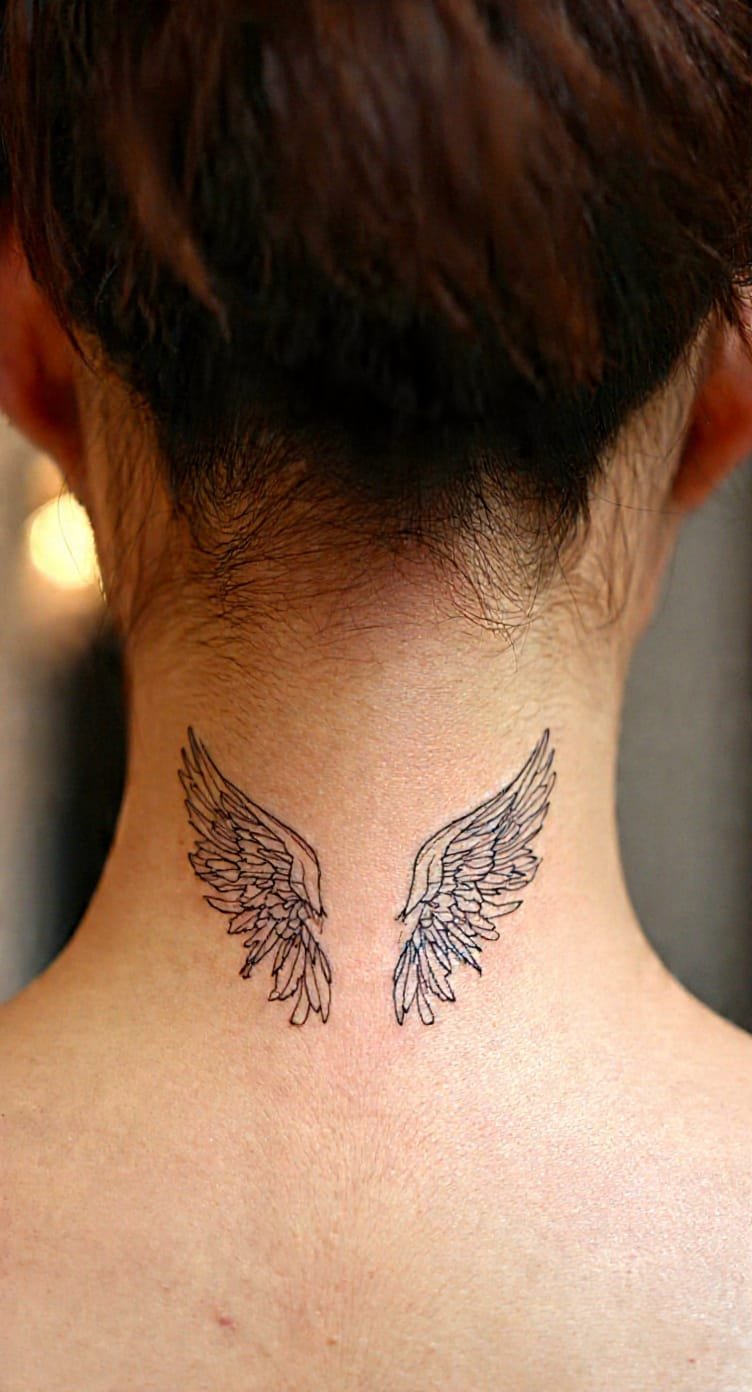
Small Minimalist Wings
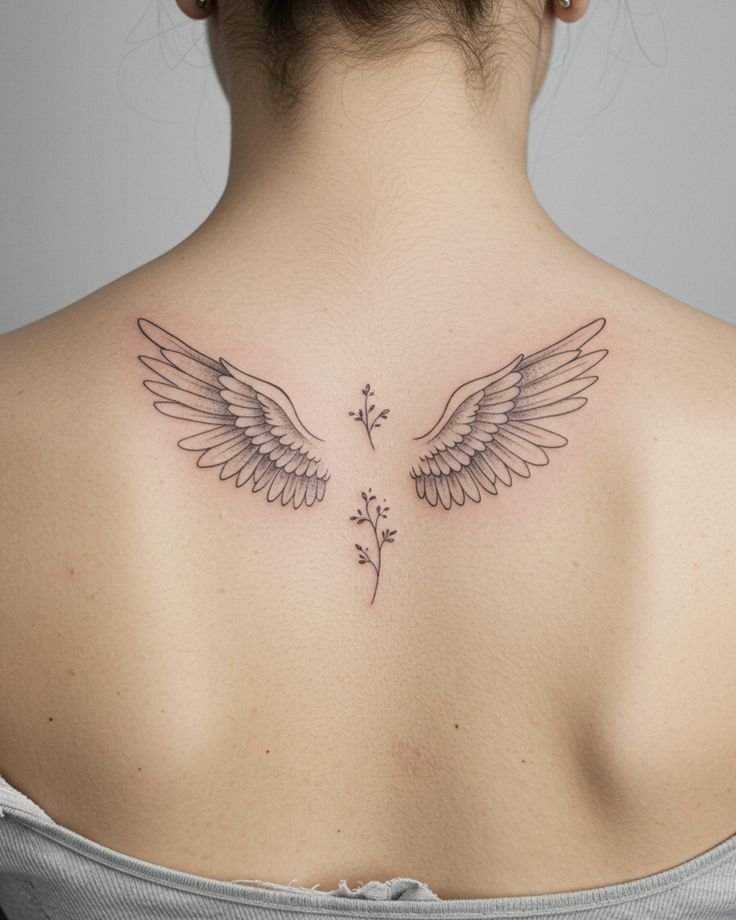
Clean, thin outlines with little to no shading, usually 1 to 3 inches per wing. This is the most requested version for a first tattoo in this location, largely because it is faster to sit through and easier to conceal than a detailed piece. Artists frequently customize it by adding initials or a small date between the wings.
“A discrete, small design on the neck is a fantastic way to make a statement. For more inspiration on other popular small wings tattoos, including popular placements and 2026 trends, be sure to check out our complete comprehensive guide.”
Realistic Angel Wings
Detailed shading, individual feather linework, and a larger overall footprint, sometimes spanning the full width of the back of the neck. This style takes longer in the chair and costs more, but it is the version most associated with faith and memorial tribute.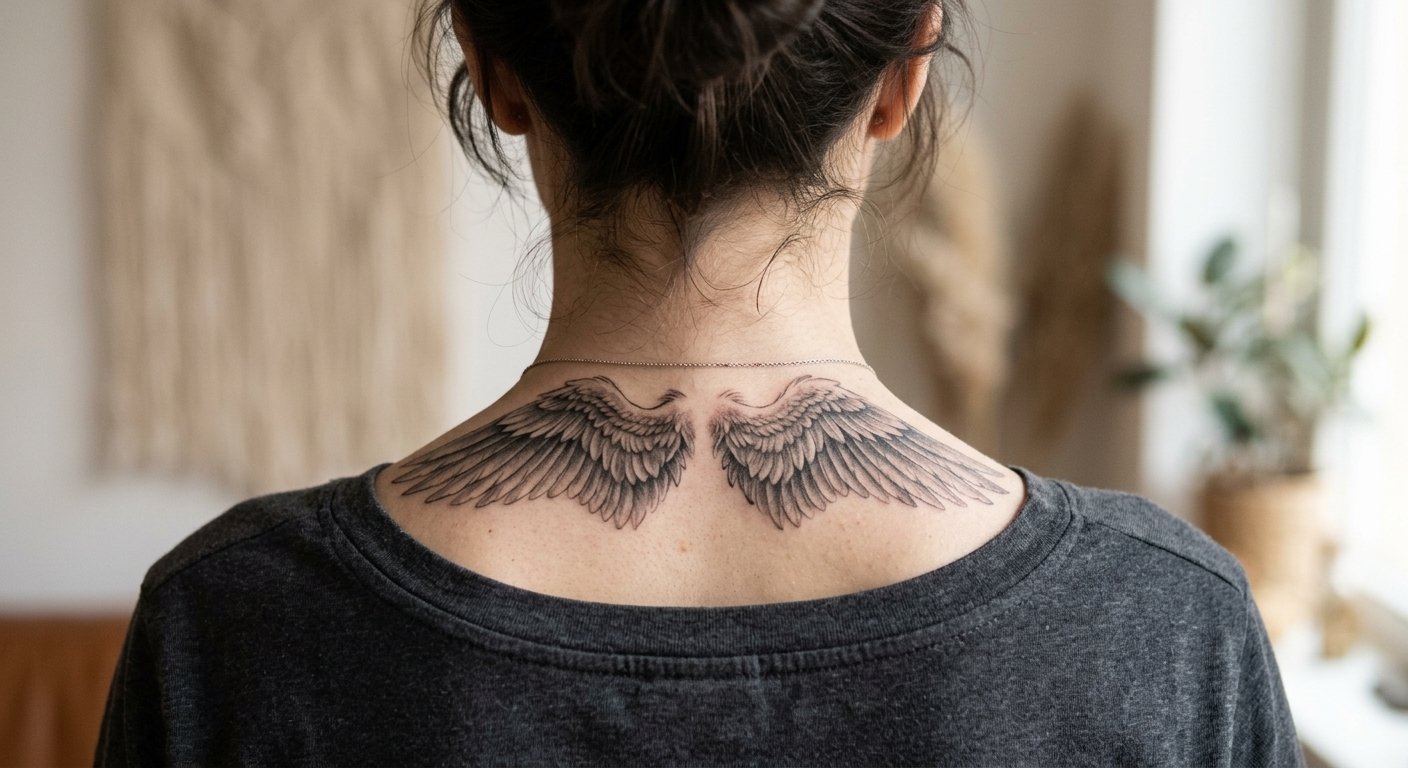
Fallen Angel Wings
Darker palette, asymmetrical or drooping feathers, occasionally rendered in full blackwork. This is a bolder visual statement and tends to run larger than the minimalist version, which matters for both pain and cost.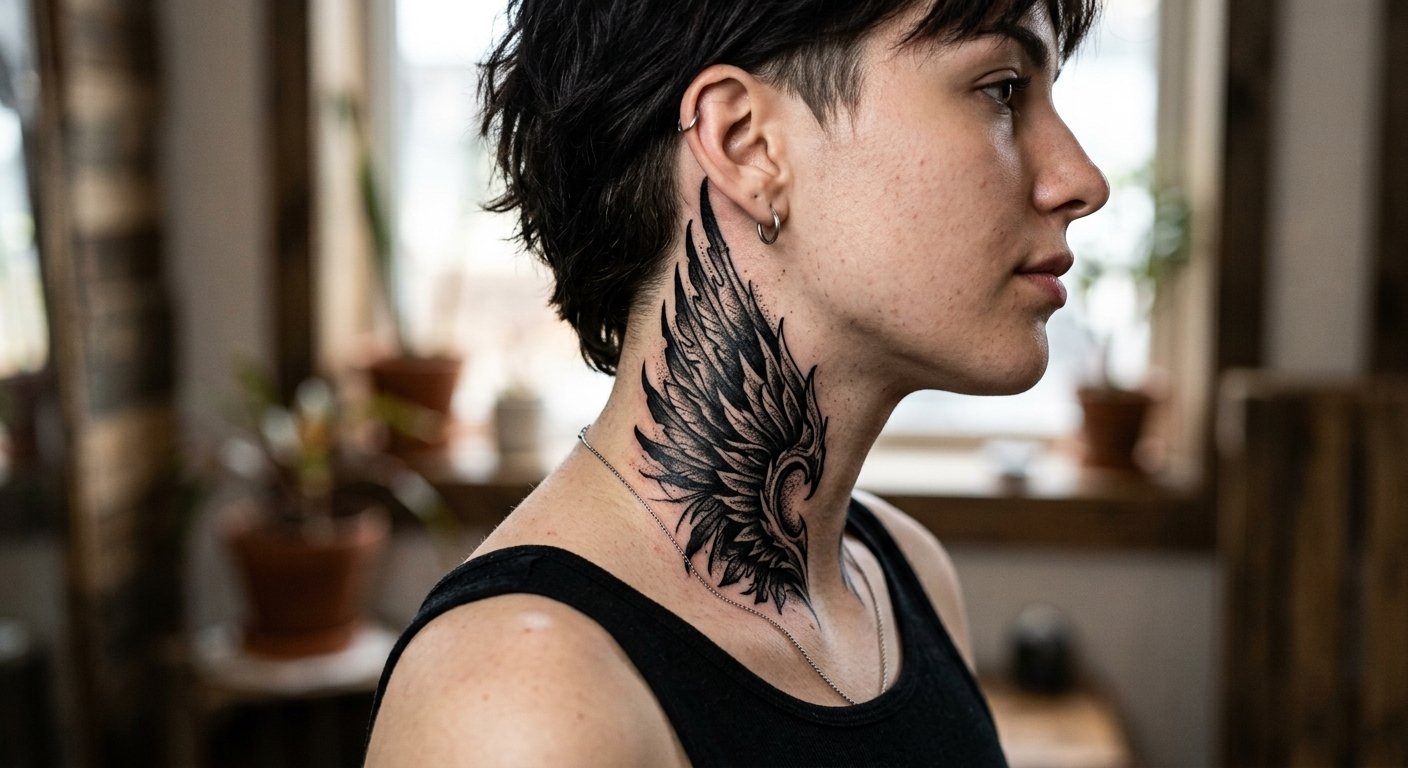
Wrapped Collar Wings
Wings that stretch from the nape around toward the collarbone, following the natural curve of the neck and shoulders. This is the most visually dramatic option and also the most committed one, since it is very difficult to conceal with hair alone.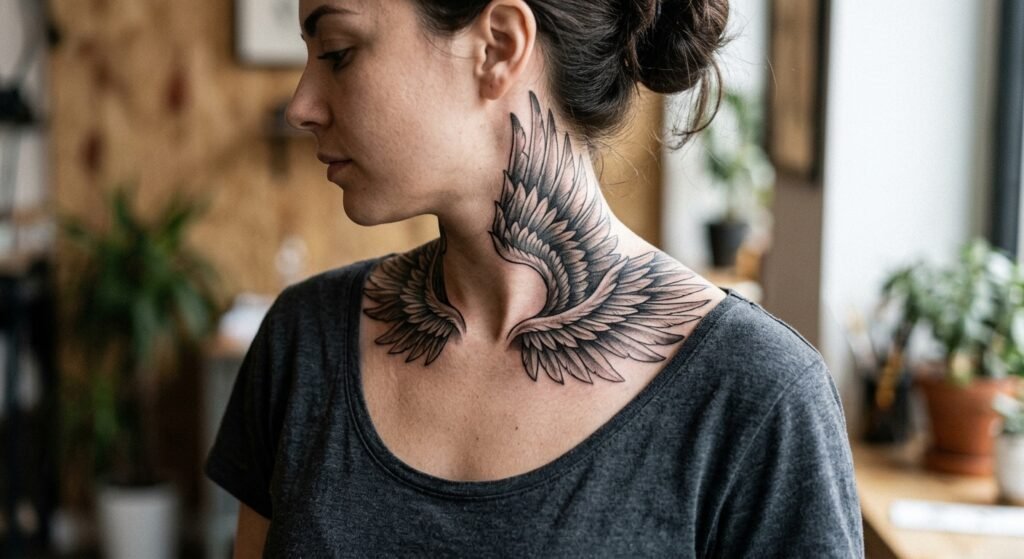
Named Framework: The Wing Meaning Spectrum
Here’s a simple way to sort every style above without getting lost in Pinterest boards for six hours. Picture a horizontal line. On the far left sits protection and faith, represented by clean, upright angel wings. In the middle sits transformation and freedom, represented by realistic feather or bird wings. On the far right sits struggle and rebellion, represented by fallen angel wings. Most people, when asked directly what they want their tattoo to say, can point to a spot on that line faster than they can describe a specific design. Start there, then let your artist translate the feeling into linework.
Pro Tip: If this is your first tattoo in a highly visible spot, ask your artist to draw the stencil at 75% of the size you originally imagined. Almost every first-time client we’ve seen go through a neck consultation pictures something bigger than what actually reads well on a curved, narrow canvas. A slightly smaller piece with clean linework almost always ages and photographs better than an oversized one that had to be compressed to fit.
Small angel wings neck tattoo requests specifically have grown alongside a broader 2026 trend toward subtlety, according to multiple tattoo studios now marketing “delicate” and “dainty” placements as a category of their own rather than a fallback for people who “can’t handle” a bigger piece.
Best Neck Placements for a Wings Tattoo
Quick Answer: The nape is the most popular and most concealable neck placement, the side of the neck offers a middle ground between visibility and pain, and the front or throat is the boldest and most painful option, best reserved for people who are fully comfortable with permanent, constant visibility.
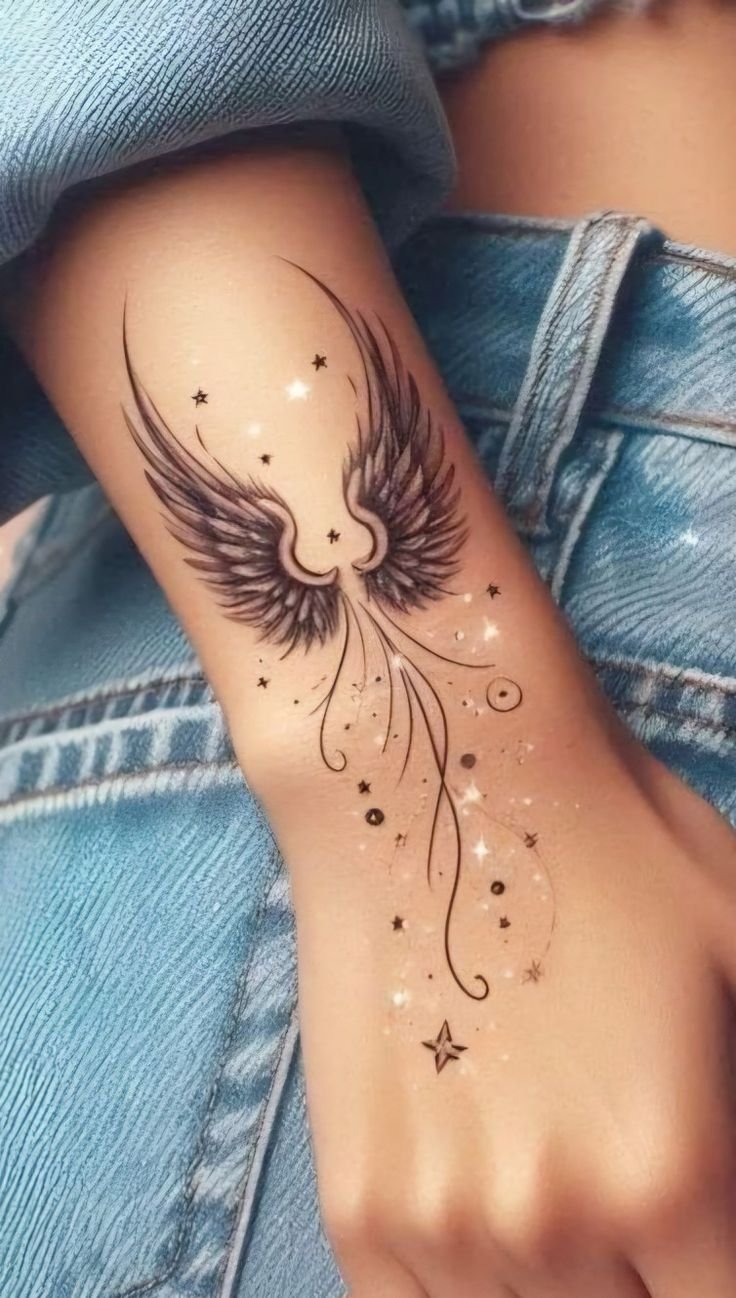
Where exactly on the neck matters as much as the design itself. Nape of neck wings tattoo placements, side placements, and front placements each come with a different mix of pain, visibility, and long-term flexibility.If a neck placement feels too high-commitment, consider starting with a subtle wings tattoo on the wrist instead.
| Placement | Pain Level (1 to 10) | Concealment | Best For | Typical Size |
|---|---|---|---|---|
| Nape of the neck | 6 to 7 | High, hair covers it easily | First-timers, professionals who need flexibility | Small to medium |
| Side of the neck | 5 to 6 | Moderate, depends on hair length and collar style | People who want visibility without full commitment | Small to large |
| Front of neck and throat | 8 to 9 | Very low, almost always visible | People fully committed to constant visibility | Small, detailed |
| Behind the ear into neck | 6 to 7 | High when hair is down | Delicate, minimalist designs | Extra small to small |
| Base of neck and collar line | 6 to 8 | Low with most necklines | Wrapped or dramatic designs | Medium to large |
Nape of the Neck
The nape is, by a wide margin, the most requested spot for this design. It sits low enough on the pain chart to be manageable for most first-timers, and hair down or up in a low style hides it completely. It is also the placement most tied to the “guardian watching your back” reading of angel wings symbolism.
Side of the Neck
The side offers a genuine middle ground. It’s more visible than the nape when your hair is pulled back, but tattoo pain charts consistently rate it slightly more tolerable than the front, since it has fewer of the dense nerve clusters that run down the front of the throat.
Front of Neck and Throat
This is the boldest, most painful, and least concealable option on the list, and it is worth being honest about that upfront rather than glossing over it in service of a prettier photo. The skin here is thin, sits close to cartilage, and carries a dense concentration of nerve endings, which is why multiple independent tattoo pain charts place it at 8 to 9 out of 10, among the highest ratings on the entire body.
Named Framework: The Neck Placement Triangle
Before booking, run your choice through three questions, what we call the Neck Placement Triangle. First, concealment: can you cover this with hair, a collar, or styling if you need to tomorrow? Second, pain and anatomy: are you choosing a spot near bone and nerve clusters, or one with a bit more cushioning? Third, room to grow: if you want to add to this piece in five years, does this placement leave you space, or does it box you in? A placement that scores well on all three tends to be a placement people stay happy with. A placement that only scores well on visual impact is the one people ask about covering up later.
Nape of neck wings tattoo ideas tend to score highest across all three points of the triangle, which is a large part of why it remains the default recommendation for a first neck piece.
Does It Hurt? Pain, Healing and Aftercare
Quick Answer: Yes, the neck hurts more than most placements. Tattoo pain charts consistently rate it in the moderate to high range, generally 5 to 6 out of 10 on the sides and back, climbing to 8 or 9 out of 10 on the front and throat, mainly because the skin there is thin and sits close to bone and dense nerve clusters.
How Much Does It Hurt?
Tattoo pain is defined as the discomfort caused by a needle repeatedly puncturing the skin’s dermis layer, and it varies mainly by three anatomical factors: skin thickness, proximity to bone, and nerve density. The neck scores high on two of the three. According to Healthline’s tattoo pain chart, the neck sits alongside the skull and spine in the higher-pain category specifically because of thin skin and a dense run of nerves close to the surface.
That said, “the neck hurts” is too vague to plan around. The front of the neck, especially near the throat, is consistently rated among the most painful spots on the entire body, in the 8 to 9 range, partly because of nerve density and partly because the tattooing process can make it briefly harder to swallow comfortably. The back and sides are more forgiving, generally landing in the 5 to 7 range, similar to a rib or ankle piece rather than a palm or armpit piece.
Original Analysis: In reviewing the pages currently ranking for this exact keyword, not one combined pain data, cost data, and career impact data into a single resource. Most either show design inspiration with a one-line mention of symbolism, or they cover tattoo pain generally without addressing the neck’s specific placements in any detail. That gap is exactly why a piece like this one exists.
Healing Timeline Week by Week
Healing happens in layers, and the neck’s constant movement (turning your head, wearing collars, sleeping) can slow it slightly compared to a flatter, less mobile placement.
- Days 1 to 3: Redness, mild swelling, and oozing plasma are normal. Keep it clean and lightly covered as your artist instructs.
- Days 4 to 10: Scabbing and itching begin. This is the stage where people are most tempted to pick, and also the stage most likely to cause scarring or ink loss if they do.
- Days 10 to 21: The surface layer finishes peeling and the skin looks mostly healed, though it may still appear slightly dull or shiny.
- Weeks 3 to 12: The deeper dermis layer continues to settle, colors fully saturate, and any lingering redness or texture fades.
Aftercare Tips Specific to the Neck
Neck tattoo aftercare is defined as the cleaning, moisturizing, and protection routine used during healing to prevent infection and preserve ink quality, and a few neck-specific issues deserve extra attention.
- Wash gently twice a day with fragrance-free soap and lukewarm water, patting dry rather than rubbing.
- Apply a thin layer of fragrance-free moisturizer, avoiding thick ointments that trap heat against a high-friction area.
- Swap high-collar shirts, turtlenecks, and scarves for looser necklines for at least the first two weeks.
- Tie hair up loosely or use a soft headband at night to keep strands from sticking to the healing tattoo.
- Apply broad-spectrum SPF once the skin has fully closed, since the neck gets more incidental sun exposure than almost any other tattooed area.
Pro Tip: A travel neck pillow, the kind shaped like a horseshoe, is genuinely useful during the first week if you’re flying or doing any long car rides. It keeps fabric and headrests from pressing directly on a fresh tattoo, which is the single most common complaint we hear about neck healing specifically.
If your tattoo develops spreading redness, red streaking, fever, or pus that smells unusual rather than looking like normal healing plasma, that can indicate infection and is worth a same-day call to your artist or a doctor rather than waiting it out. The FDA has documented real cases of infection tied to both contaminated ink and unhygienic equipment, so this isn’t a hypothetical risk to brush off.
Cost, Finding an Artist and Your Appointment
Quick Answer: A small to midsize wings tattoo on the neck typically costs $150 to $400 in 2026, though shop minimums, city, artist experience, and design complexity can move that number in either direction.
How Much Does a Wings Tattoo on the Neck Cost?
Pricing depends on the same handful of factors across almost every studio: size, detail level, color versus black and grey, and the artist’s hourly rate, which commonly runs $100 to $300 per hour for experienced artists in 2026, with in-demand artists in major cities charging more. Neck placements specifically tend to sit at the higher end of the range for a given size, since the curved, thin-skinned surface takes more time and precision than a flat forearm or thigh.
A realistic breakdown for 2026:
- Small minimalist wings (1 to 3 inches): $100 to $250, often at or near the shop minimum
- Midsize detailed wings (3 to 6 inches): $250 to $500
- Large realistic or wrapped collar wings: $500 to $1,200 or more, sometimes split across two sessions
How to Choose an Artist for Detailed Neck Work
Not every skilled tattoo artist is equally skilled at neck placements specifically. The curve of the neck, the direction of natural movement, and the thinner skin all change how linework and shading behave compared to a flat surface.
- Search the artist’s portfolio for the words “neck” or “throat” specifically, not just their general style tag.
- Look for at least three healed (not just fresh) photos of neck work in a similar style to what you want.
- Ask directly in your consultation how they adjust needle depth and technique for thin-skinned areas.
- Confirm they’re licensed and the studio follows visible sanitation protocols, gloves, single-use needles, sealed ink caps.
Step-by-Step: What Happens at Your Appointment
- Consultation: You discuss placement, size, and style, and the artist sketches or digitally mocks up a design.
- Stencil placement: The design is transferred onto your neck so you can check positioning and symmetry in a mirror before anything is permanent.
- Final adjustments: Small tweaks to size or angle happen here, this is your last easy chance to change anything.
- Tattooing: Outline first, then shading or color, with short breaks as needed since the neck can make some people feel briefly lightheaded.
- Bandaging and instructions: The artist cleans the area, applies a protective covering, and walks you through aftercare.
- Follow-up: Most reputable studios will look at healed photos if anything looks off, and some offer a complimentary touch-up within the first few months.
Is It a Good Idea? Career, Concealment and Long-Term Considerations
Quick Answer: Whether a neck tattoo affects your career depends far more on your specific industry and how visible the design is day to day than on tattoos as a general category, and being honest about that tradeoff upfront beats finding out the hard way.
Workplace and Career Considerations
This is the section most design-focused competitor articles skip entirely, and it’s the one that actually changes people’s decisions. The honest picture is mixed, not uniformly good or bad, so here it is straight.
On one hand, broad social acceptance has grown substantially. Eighty percent of U.S. adults say society has become more accepting of tattooed people over the past two decades (Pew Research Center, 2023), and separate polling from YouGov found that 54% of people say a visible tattoo has no effect on their hiring decision, while only 6% say it would make them more likely to hire someone.
On the other hand, that same YouGov data found 26% of respondents would be less likely to hire a qualified candidate with a visible tattoo, and academic research complicates the picture further. A widely cited 2022 Colorado State University study found that applicants with visible tattoos, especially larger or harder-to-conceal ones, were less likely to be hired and were offered lower starting salaries when they were hired, an effect that was more pronounced for women. That sits in direct tension with a separate University of Miami and University of Western Australia study covering more than 2,000 Americans, which found tattooed individuals had employment outcomes and wages equal to or better than non-tattooed peers overall, according to reporting from the Society for Human Resource Management (SHRM).
Comparative honesty matters here: the neck is one of the genuinely harder placements to fully conceal in a typical business dress code, more so than a forearm, ribcage, or thigh tattoo. That single fact is probably more predictive of your specific outcome than any general statistic about “tattoos in the workplace,” and it’s worth weighing seriously if you work in a customer-facing, conservative, or client-facing role.
Concealment Options
Full concealment of a neck tattoo is possible but inconsistent, which is different from the near-total concealment you’d get from a bicep or hip placement.
- Hair styling: A low ponytail, hair worn down, or a side part can fully hide nape and side placements.
- Necklines and collars: Turtlenecks, mock necks, and scarves work for cooler months but aren’t practical year-round in every climate or dress code.
- Concealer makeup: Color-correcting and setting products made specifically for body ink can cover a small to midsize tattoo for a single event, though it typically won’t survive a full humid workday.
- Jewelry as a distraction, not a cover: A statement necklace draws the eye but doesn’t actually hide ink underneath it, worth knowing before you rely on it for a job interview.
Removal, Cover-ups and Long-Term Regret Considerations
About 24% of tattooed adults say they regret at least one of their tattoos, per Pew Research Center’s 2023 survey, a number that holds up across most independent industry surveys. If regret does happen, laser removal is the standard option: the American Society of Plastic Surgeons cites removal sessions in the range of a few hundred dollars each, with most tattoos needing multiple sessions spaced roughly six to eight weeks apart, and total costs commonly landing between $1,000 and $5,000 depending on size and ink density. Removal is also, notably, more painful and more expensive than the original tattoo, which is worth factoring into your decision now rather than after the fact.
The more forgiving option for many people is a cover-up rather than full removal. Wings are actually a fairly cover-up-friendly design, since larger feathers can incorporate or camouflage smaller pre-existing pieces if your plans change down the road.
Wings Tattoo on Neck Comparison: Top Options at a Glance
| Style | Signature Look | Best For | Typical Price Range | Pain Level |
|---|---|---|---|---|
| Small Minimalist Wings | Thin outline, little shading | First-timers, easy concealment | $100 to $250 | Moderate |
| Realistic Angel Wings | Detailed feathers, shading | Memorial pieces, faith symbolism | $250 to $600 | Moderate to High |
| Fallen Angel Wings | Dark, drooping, torn feather detail | Bold statement pieces | $300 to $700 | Moderate to High |
| Feather and Bird Wings | Realistic single wing or small pair | Freedom, transformation themes | $150 to $400 | Moderate |
| Wrapped Collar Wings | Wings extending toward collarbone | Dramatic, highly visible statements | $500 to $1,200+ | High |
Our pick: For most first-time clients, small minimalist wings on the nape offer the best balance across the board, they’re the most affordable, the most concealable, and the least painful, while still carrying the full symbolic weight of the design. Save the larger, bolder styles for a second piece once you know how your skin, your schedule, and your comfort with visibility actually hold up.
FAQ
Does a wings tattoo on the neck hurt more than other placements?
Yes, in most cases. The neck sits in the moderate to high range on most tattoo pain charts, with the front and throat hurting the most and the sides tending to be the most bearable of the three. Individual pain tolerance still matters, but almost no one describes a neck tattoo as painless.
What does a wings tattoo on the neck symbolize?
It most often represents protection, freedom, spirituality, or remembrance of someone who has passed. Angel wings lean toward faith and guardianship, fallen angel wings lean toward struggle and duality, and bird or feather wings lean toward personal freedom and transformation.
How much does a wings tattoo on the neck cost?
Most small to midsize designs run about $150 to $400 in 2026, though shop minimums, city, artist experience, and detail level can push that higher, sometimes past $1,000 for large wrapped designs.
Is a neck tattoo bad for your career?
It depends heavily on your industry and how visible the piece is, more than it depends on tattoos as a general category. Client-facing, conservative, and customer-service-heavy roles carry more real risk than creative or remote-first fields.
How long does a neck tattoo take to fully heal?
The surface usually looks healed within 2 to 3 weeks, but the deeper skin layers can take up to 3 months to fully settle and reach their final color and texture.
What’s the best size for a first wings tattoo on the neck?
Most first-timers do better starting small, roughly 2 to 4 inches, on the nape or side rather than a large piece across the whole neck. It’s easier to conceal, less painful, and less expensive while you decide if you want to add to it later.
What’s the difference between angel wings and fallen angel wings?
Angel wings are typically drawn upright and clean to suggest protection and faith, while fallen angel wings are drawn drooping, torn, or shaded darker to suggest struggle, loss, or duality between light and dark.
Can you cover up or conceal a neck wings tattoo?
Partially. Hair, collars, and scarves can hide a lot of it day to day, but full concealment isn’t realistic for every style, climate, or outfit, especially larger or wrapped designs.
What’s the best way to find a tattoo artist who’s good at detailed neck work?
Look through an artist’s portfolio specifically for neck and throat placements, not just their general style, since curved, thin-skinned areas take different technique than flatter parts of the body. Healed photos matter more than fresh ones.
Is it worth getting a wings tattoo on your neck?
For most people who have honestly thought through the visibility, pain, and career tradeoffs covered above, yes, it’s one of the more meaningful, high-impact placements available. The people who end up unhappy are usually the ones who skipped that honest assessment, not the ones who did it and chose the tattoo anyway.
Conclusion
A wings tattoo on neck placement is not a small decision dressed up as one. It’s visible, it’s more painful than most spots on the body, and it’s genuinely harder to conceal than almost anywhere else you could put the same design. None of that makes it a bad choice. It makes it a choice worth making with real information instead of just a mood board.
Three things to actually remember: the meaning should come from the style you choose, not the other way around, the nape offers the best beginner-friendly balance of pain, cost, and concealment, and the career question deserves an honest answer specific to your industry, not a general internet opinion.
If you’re ready to move forward, save this guide, screenshot the comparison table for your consultation, and start collecting reference photos in the specific style that matched your answer on the Wing Meaning Spectrum above.
Next steps you can take in the next 10 minutes:
- Screenshot the placement comparison table to bring to your consultation
- Search your city plus “tattoo artist” plus “neck” to start a shortlist of specialists
- Save or bookmark this guide so you have the pain and cost numbers handy before you book
About the Author
Written by a beauty and body-art content specialist who has spent years covering tattoo trends, aftercare science, and placement guides for fashion and lifestyle audiences. Research for this piece draws on published pain-scale and aftercare data from practicing tattoo studios, cited below. Not a medical professional; always consult a licensed tattoo artist and, where relevant, a dermatologist before booking.
Last Updated: August 22, 2026 Disclosure: This article contains no sponsored placements or affiliate links. Fact-checked by: Editorial review team
References
- Pew Research Center, “How many Americans have tattoos, why, and do they regret it?” (2023): https://www.pewresearch.org/short-reads/2023/08/15/32-of-americans-have-a-tattoo-including-22-who-have-more-than-one/
- YouGov, “One-quarter of people are less likely to hire someone with a tattoo” (2018): https://yougov.com/en-us/articles/21416-tattoo-more-less-likely-hire
- Society for Human Resource Management, “What Are an Applicant’s Tattoos Telling Potential Employers?”: https://www.shrm.org/topics-tools/news/employee-relations/applicants-tattoos-telling-potential-employers
- Healthline, “Tattoo Pain Chart”: https://www.healthline.com/health/body-modification/pain-tattoos-chart
- American Society of Plastic Surgeons, “Tattoo Removal Cost”: https://www.plasticsurgery.org/cosmetic-procedures/tattoo-removal/cost
- U.S. Food and Drug Administration, “Think Before You Ink: Tattoo Safety”: https://www.fda.gov/consumers/consumer-updates/think-you-ink-tattoo-safety
Pingback: Small Angel Wings Tattoo: 2026 Ideas, Cost & Placement