Updated for 2026
Nearly a third of American adults have at least one tattoo, and 22% have more than one (Pew Research Center, 2023). Somewhere in that crowd is a very specific kind of person: someone who can’t decide whether they’re more angel or more devil, and wants their skin to say so. A devil or angel tattoo is one of the oldest ways to wear that contradiction on purpose, and it’s having a real moment right now, especially in half-and-half designs that split a single figure straight down the middle.
Here’s the actual problem most people run into. It’s easy to find pretty reference photos. It’s much harder to find a straight answer on what the design actually means, which style ages well, where it should go on your body, and what it realistically costs. This guide covers all four, without the fluff.
Key Takeaways
- What a devil or angel tattoo (and specifically a half angel half devil tattoo) actually symbolizes, beyond a vague “good vs evil”
- The five tattoo styles that work best for this theme, and which one fits your budget and pain tolerance
- Real, sourced pricing for every placement, from a small wrist accent to a full back piece
- A step-by-step process for choosing your exact design, using two decision frameworks built specifically for this tattoo
- What the regret and satisfaction data actually shows, so you go in with eyes open instead of guessing
- Where this tattoo idea tends to go wrong, and the specific choices that prevent it
Let’s get into it.
Table of Contents
- What Do Devil and Angel Tattoos Actually Mean?
- Half Angel Half Devil Tattoo Meaning: The Good vs Evil Symbol Explained
- Devil or Angel Tattoo Styles: Which Look Fits Your Story
- Placement Guide: Sleeve, Back Piece, and Smaller Spots
- How to Choose Your Devil or Angel Tattoo (Step by Step)
- Devil or Angel Tattoo Cost, Pain, and Aftercare in 2026
- Is a Devil or Angel Tattoo Right for You?
- Devil or Angel Tattoo Comparison: Top Options at a Glance (2026)
- FAQ
- Conclusion
What Do Devil and Angel Tattoos Actually Mean?
Quick Answer: A devil or angel tattoo is defined as body art that uses angelic and demonic imagery, together or separately, to represent a person’s inner conflict between good and bad impulses, or the different sides of their personality. It’s less about religion for most wearers and more about honesty.
Most competing guides on this topic stop at “it means good vs evil” and move straight to a photo gallery. That’s true, but it’s only the surface. Let’s actually unpack it.
The Angel Side: Protection, Purity, and Guidance
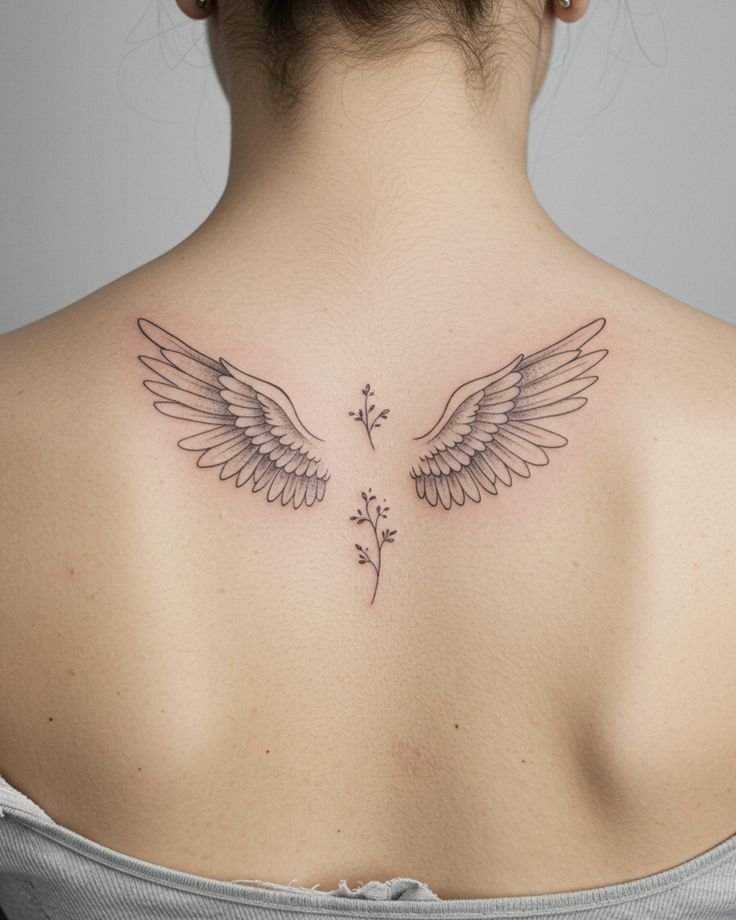
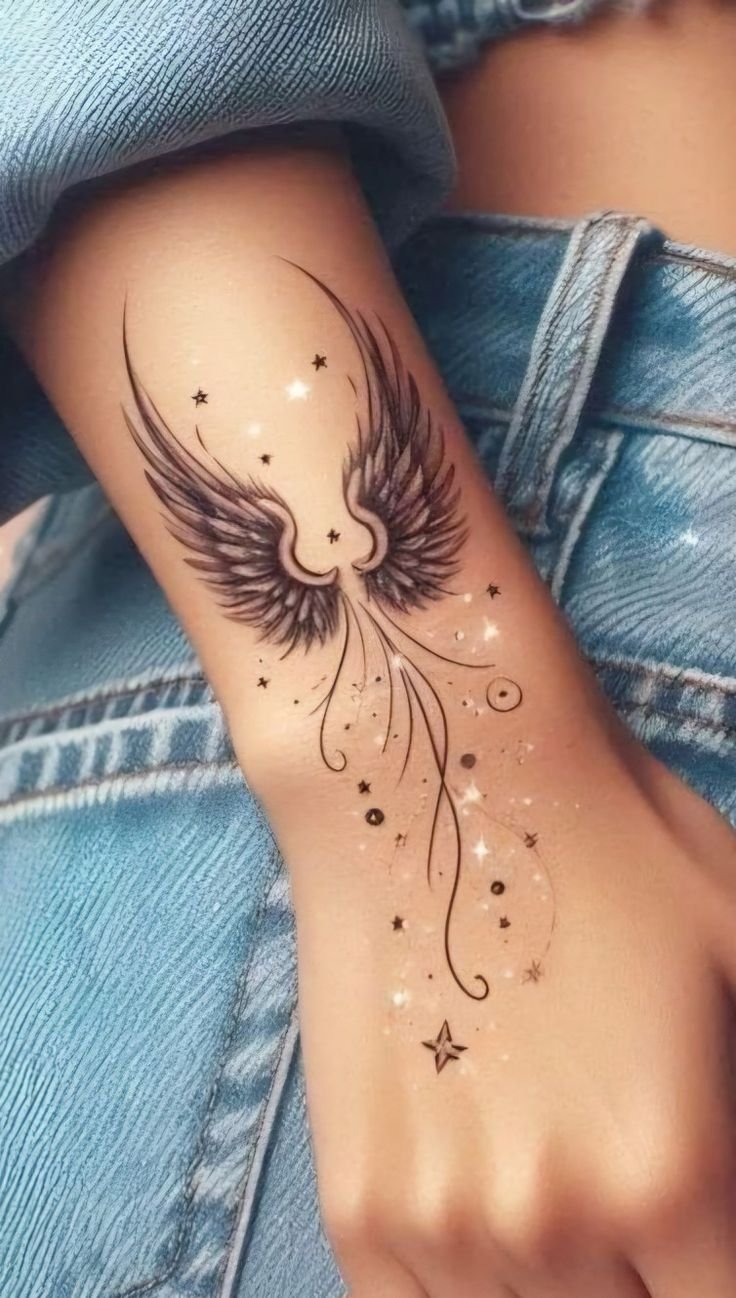
An angel tattoo typically draws on themes of protection, purity, guidance, and connection to something bigger than the wearer. Wings, halos, and soft linework are the visual shorthand. On their own, angel tattoos often honor a person who’s passed, mark a period of healing, or represent a guardian presence the wearer feels watched over by.
Q: Is an angel tattoo always religious? A: No. Plenty of people with no religious affiliation get angel tattoos purely for the symbolism of protection or remembrance, not for any specific faith.
The Devil Side: Rebellion, Temptation, and Inner Fire
A devil tattoo flips that script. Horns, a pointed tail, red tones, and sharper linework typically stand in for rebellion, temptation, independence, or a refusal to be controlled. Here’s the thing most people miss: a devil tattoo isn’t automatically “evil” in the wearer’s own reading of it. For a lot of people it reads more like confidence, or the parts of themselves they refuse to sand down to make other people comfortable.
Why People Choose Both Together
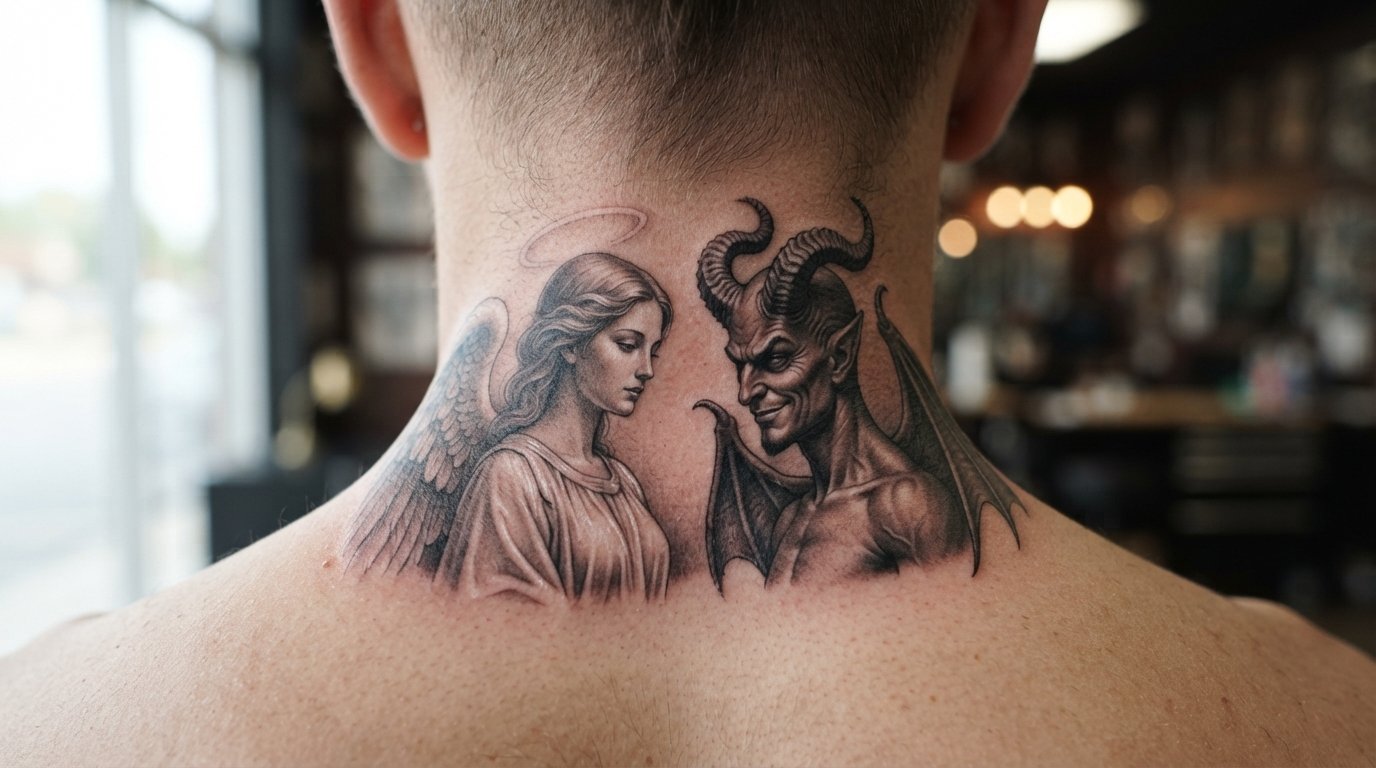
Putting the two side by side is where it gets interesting. A good vs evil tattoo refers to any design that visually stages the tension between virtue and vice as a single composition, and pairing an angel with a devil is the most direct way to do that. It’s a way of saying “I contain both, and I’m not picking a side just to look tidy.” Honestly, that’s probably the most emotionally honest tattoo concept on this whole list.
Half Angel Half Devil Tattoo Meaning: The Good vs Evil Symbol Explained
A half angel half devil tattoo is defined as a single figure, most often a person or a cherub, split down the vertical midline so one half carries angelic features (wing, halo, pale tones) and the other carries demonic features (horn, tail, red or dark tones). It’s the single most requested version of this tattoo concept, and it’s the one both LSI and long-tail searches for this topic circle back to constantly.
The Duality Concept Explained
The half-and-half format works because it refuses to let you look away from either side. You can’t crop the devil out of the photo. That’s the point: half angel half devil tattoo meaning centers on the idea that a person’s darker and lighter qualities occupy the same body, not opposite ends of some moral hallway.
A half angel half devil tattoo means that a person’s good and bad qualities exist together, not as a battle to be won, but as two halves of one honest self-portrait.
Common Interpretations People Actually Give This Tattoo
- Self-acceptance, especially after a period of guilt, addiction recovery, or a major life mistake the wearer has made peace with
- A public “warning label,” worn half-jokingly, that says “don’t assume you know which version of me you’re getting”
- A tribute to internal conflict that’s been resolved, not one that’s still raging, since a lot of wearers get this piece after the struggle rather than during it
- A relationship or family reference, where a partner, sibling, or friend is jokingly cast as the “devil” or “angel” half of a duo
Cultural and Religious Roots
The angel-and-devil pairing didn’t start in a tattoo studio. It’s a direct descendant of medieval and Renaissance Christian art, where a literal angel and devil were painted on opposite shoulders of a tempted figure (a visual convention that later became the cartoon “shoulder angel and devil” trope still used in film and animation today). Good vs evil tattoo design ideas lean on that same centuries-old visual grammar because it’s instantly readable to almost anyone who sees it, regardless of their own beliefs. That’s a big part of why it translates so well to skin: no caption required.
It’s worth noting this visual language isn’t exclusively Christian, either. Plenty of belief systems and folk traditions use a light-figure-versus-dark-figure pairing to represent the same basic tension, which is one reason this concept keeps resurfacing across very different cultures and eras instead of fading out as a dated religious reference. When a design idea survives that many centuries and that many belief systems basically unchanged, that’s usually a sign the symbolism is doing real emotional work, not just following a trend.
Pro Tip: If you want the duality to actually read clearly at a glance (not just up close), keep the color and value contrast strong between the two halves. A lot of half-and-half designs get muddy in healed ink when the artist uses two similar mid-tones instead of a true light-to-dark jump.
Devil or Angel Tattoo Styles: Which Look Fits Your Story
Not every devil or angel tattoo should be built the same way. The tattooing style you choose changes the cost, the healing time, how well it ages, and honestly, how much it hurts. Here’s how the five styles that work best for this theme actually compare.
| Style | Visual Traits | Typical Time Needed | Best For | Skill Level Needed |
|---|---|---|---|---|
| American Traditional | Bold black outlines, limited palette (red, yellow, green), flat shading | 1 to 3 hours for a small piece | Classic, high-contrast good vs evil imagery that reads clearly from across a room | Widely available; ages the most predictably over time |
| Neo-Traditional | Traditional bones plus richer color, ornamental detail, dynamic poses | 2 to 5+ hours | Cherub or demon figures with decorative flourishes, jewelry, or framing elements | Moderate; look for a strong illustrative portfolio |
| Realism (black and gray or color) | Photographic shading, dramatic lighting, real depth | 4+ hours per session, multiple sessions for large work | Battle scenes, portrait-style angel or devil faces, dramatic sleeves | High; hire a realism specialist only |
| Blackwork | Solid black fill, heavy contrast, graphic silhouettes | 2 to 6 hours | Bold half-and-half silhouettes where simplicity is the whole point | Moderate to high, depending on detail level |
| Fine Line / Illustrative | Thin, delicate linework, minimal or no shading | 1 to 3 hours | Small cherub outlines, subtle wrist, ankle, or rib pieces | Moderate; precision matters more than raw power |
Q: Which style holds up best over 10+ years? A: American Traditional and blackwork tend to age the most predictably, since their bold lines and high contrast resist the blurring that fine detail is more prone to as skin changes over decades.
Why Style Choice Matters More Than People Realize
Here’s an angle almost none of the competing guides on this topic mention: fine detail and small text-based elements (like the word tattoos some galleries feature) are also the elements that regret surveys most often flag. Smaller, more delicate tattoos are regretted at meaningfully higher rates than large, deliberate pieces, according to multiple tattoo-industry surveys, likely because bigger pieces require more planning and financial commitment upfront. If you’re set on a devil or angel tattoo but torn on style, that’s one real, practical reason to lean toward a more considered, larger composition rather than a quick, tiny version, if your budget allows it.
Pro Tip: Ask to see healed photos of each style in your prospective artist’s portfolio, not just fresh ink. Realism and fine line especially can look stunning on day one and read very differently at the two-year mark.
Placement Guide: Sleeve, Back Piece, and Smaller Spots
Where you put a devil or angel tattoo changes the entire design, not just the size.
Angel and Devil Tattoo Sleeve Ideas
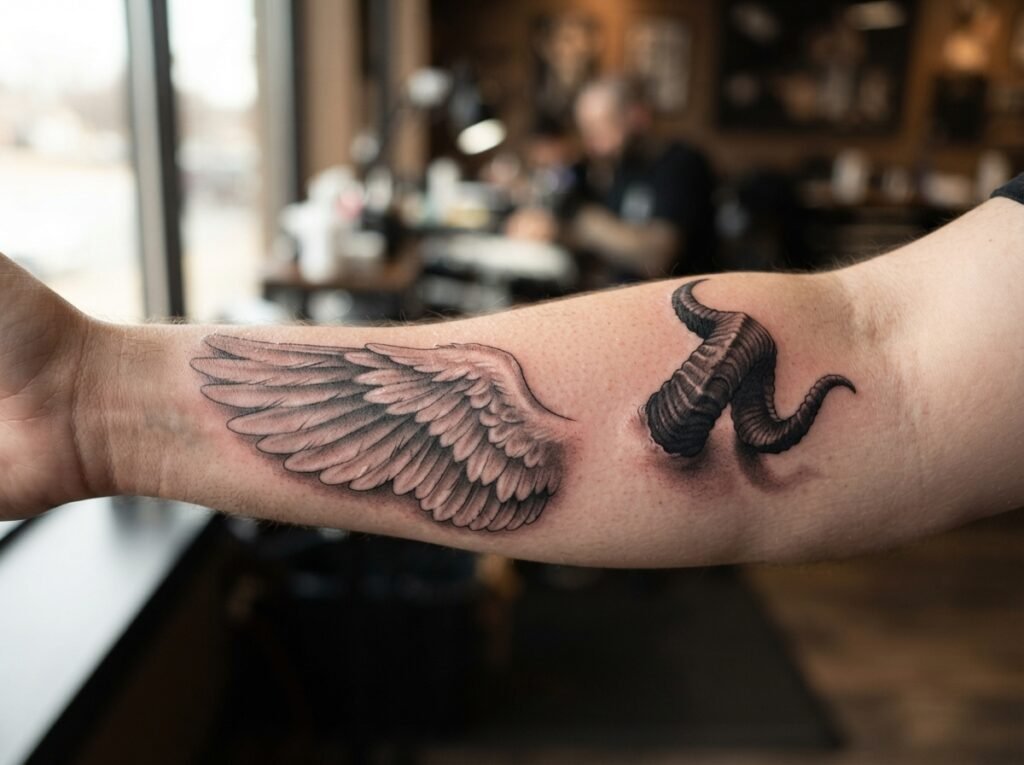
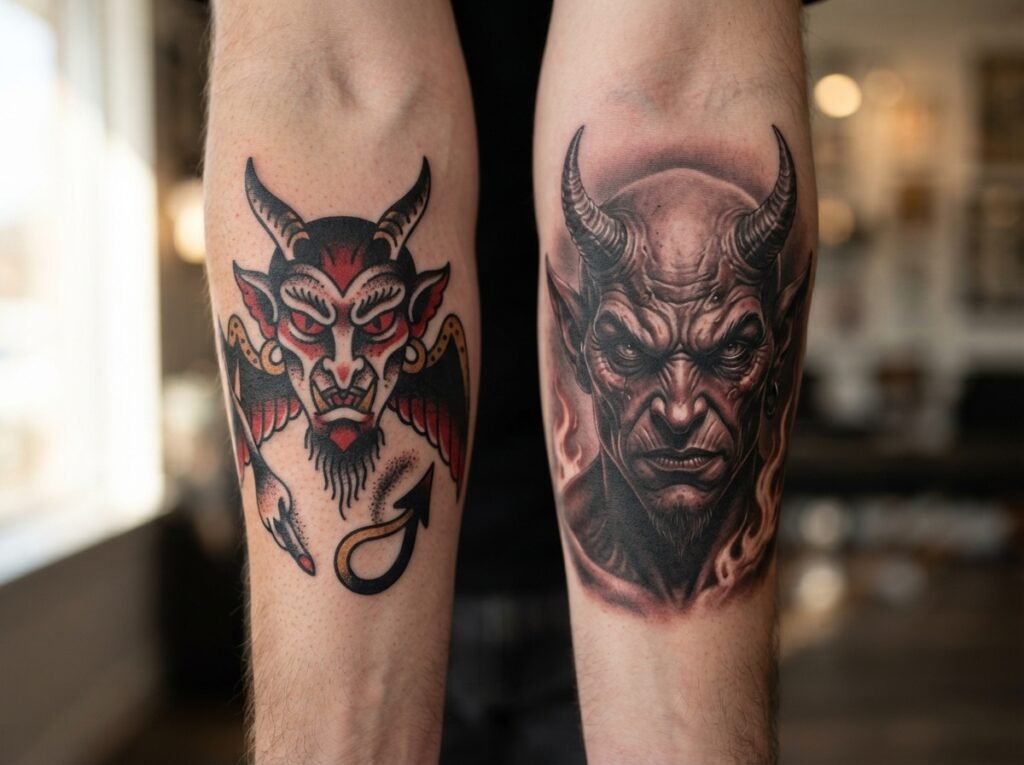
An angel and devil tattoo sleeve gives you the most room to actually tell a story instead of showing a single frozen moment. A common approach: angel imagery flows from the shoulder down, devil imagery builds from the wrist up, and the two visually meet somewhere around the elbow, often with a transitional element (clouds turning to smoke, light turning to shadow) bridging the two. Quarter sleeves work well for a single half-and-half figure. Full sleeves have room for an actual battle scene, multiple supporting figures, or a mirrored composition running down both the inner and outer arm.
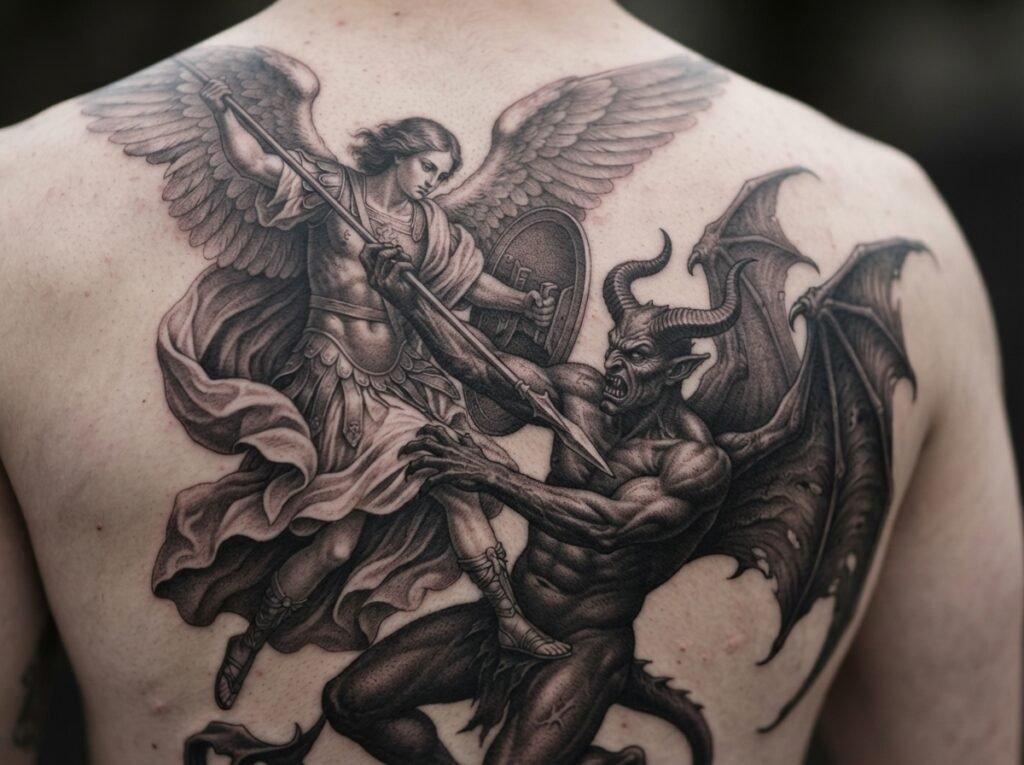
Angel Devil Tattoo Back Piece
An angel devil tattoo back piece is the largest canvas most people will ever use, and it’s the placement most suited to a genuinely cinematic composition, like a full battle scene, a large mirrored figure, or a scene that includes background elements (clouds, flames, a horizon line) that would feel cramped anywhere smaller. Back pieces are also the most private placement option on this list, since they’re fully coverable by nearly any clothing, which matters if you work in a conservative industry.
Smaller Placements: Wrist, Ribs, and Ankle
Not everyone wants (or can afford) a sleeve or back piece. A small cherub outline on the wrist, a minimalist devil-and-angel symbol on the ankle, or a slightly larger piece on the ribs all deliver the same meaning in a fraction of the space, time, and cost. The tradeoff: less room for detail, and per the regret data covered in the next section, smaller tattoos statistically carry a higher regret rate than large, well-planned ones.
Q: Does a devil or angel tattoo have to include both figures to “count”? A: No. Plenty of people get just an angel or just a devil and let the absence of the other half imply the duality; it’s a subtler, smaller-commitment way to reference the same idea.
How Big Should You Actually Go?
Bigger isn’t automatically better here, and it’s worth thinking past how the design looks today. A large sleeve or back piece will stretch and shift somewhat with normal, expected body changes over the years (weight fluctuation, muscle gain or loss, ordinary skin aging), and fine detail is what shows that shift first. A bolder, simpler composition in American Traditional or blackwork tends to tolerate those changes more gracefully than a highly detailed realism piece packed with small elements. If you’re choosing between a detailed quarter sleeve and a bolder full sleeve for a similar price, it’s worth asking your artist directly how each style tends to hold up over 10, 20, or 30 years on the specific placement you’re considering.
Pro Tip: Ask your artist to sketch the design directly on your skin with a washable marker before the needle touches you, especially for sleeve and back pieces. A composition that looks balanced on paper can shift noticeably once it wraps around the natural curve of a limb or shoulder blade.
How to Choose Your Devil or Angel Tattoo (Step by Step)
This is where most guides just show you more pictures. Instead, here’s an actual process, built around two original frameworks.
The Halo-Horn Spectrum
Before you pick a specific design, place yourself somewhere on what we call the Halo-Horn Spectrum: a simple line running from “mostly angel” on one end to “mostly devil” on the other, with “balanced duality” in the middle. Someone leaning angel-heavy might choose a design that’s 80% angelic imagery with just a small devil detail (a tiny tail, a hint of horn) tucked in. Someone leaning devil-heavy flips that ratio. Most people asking for a true half angel half devil design actually want to sit dead center on the spectrum, with a true 50/50 visual split.
Knowing where you sit on this spectrum before you talk to an artist saves real time, because “I want an angel and devil tattoo” means something different depending on which end you’re closer to.
The S.O.U.L. Check
Once you know your spot on the spectrum, run the design through the S.O.U.L. Check, a four-part gut check we built specifically for this kind of symbolic tattoo:
- Symbolism: What specific thing does this represent for you? Not “good vs evil” in the abstract, but your actual reason (a recovery milestone, a personality trait, a relationship in-joke, simple aesthetic love of the imagery).
- Outline: Which of the five styles above actually fits that symbolism and your visual taste?
- Underlying commitment: What’s your real budget and pain tolerance, based on the cost and pain data in the next section?
- Location: Given your symbolism, style, and commitment level, which placement from the guide above actually fits?
If you can answer all four without contradicting yourself (for example, wanting a full realism back piece on a $200 budget), you’re ready to book a consultation.
Step-by-Step Process
- Pin down your “why.” Write one sentence describing what the tattoo means to you, specifically. Keep it, you’ll want it for the artist consultation.
- Place yourself on the Halo-Horn Spectrum. Decide roughly how angel-heavy or devil-heavy you want the final piece to lean.
- Pick your style. Use the styles table above to match your visual taste to a realistic time and skill commitment.
- Match design to placement and size. Cross-reference your style choice against the placement guide and the pricing table further down.
- Vet and book a licensed, insured artist who has healed (not just fresh) photos of the specific style you want in their portfolio.
- Plan your first appointment and your aftercare routine before the appointment, not after, using the aftercare guidance in the next section.
Illustrative example: Picture someone two years into recovery from a difficult period who wants a permanent reminder that both their worst decisions and their better instincts are part of the same story, not two separate people. Running that through the S.O.U.L. Check: the symbolism is personal growth and self-acceptance, the outline is fine line (subtle, meant for themselves more than for display), the underlying commitment is a single 2-hour forearm session, and the location is the inner forearm, visible to them daily but easy to cover for work. That’s a fully resolved, buildable design brief in four lines.
Devil or Angel Tattoo Cost, Pain, and Aftercare in 2026
Quick Answer: A small devil or angel tattoo typically costs $50 to $250, a quarter or half sleeve runs $800 to $2,500, and a full sleeve or back piece generally lands between $1,500 and $10,000+, depending heavily on size, color, and the artist’s hourly rate.
How Much It Actually Costs
Most tattoo artists in the US charge by the hour, and rates commonly fall between $100 and $300 per hour, with $150 to $250 being a typical range for an established artist (Airtasker, 2025; Hustle Butter, 2025). That hourly rate, multiplied by the hours a design needs, is where the real total comes from.
- Small accent piece (wrist, ankle, small cherub outline): roughly $50 to $250 (Airtasker, 2025)
- Medium piece (quarter sleeve, palm-sized forearm or chest design): roughly $250 to $600 (Airtasker, 2025)
- Full sleeve: roughly $1,500 to $6,000, with highly detailed custom color work sometimes running higher (Airtasker, 2025; Neebol, 2026)
- Full back piece: roughly $2,000 to $10,000+, since back pieces are usually the largest and most session-intensive placement available (Removery, 2024; Alchemy Tattoo Collective, 2025)
Q: Why is a back piece so much more expensive than a sleeve? A: A back piece typically covers more surface area than even a full sleeve, which means more design elements, more total tattooing hours, and often more sessions spread across a longer healing timeline, all of which add directly to the final bill.
Pain Level by Placement
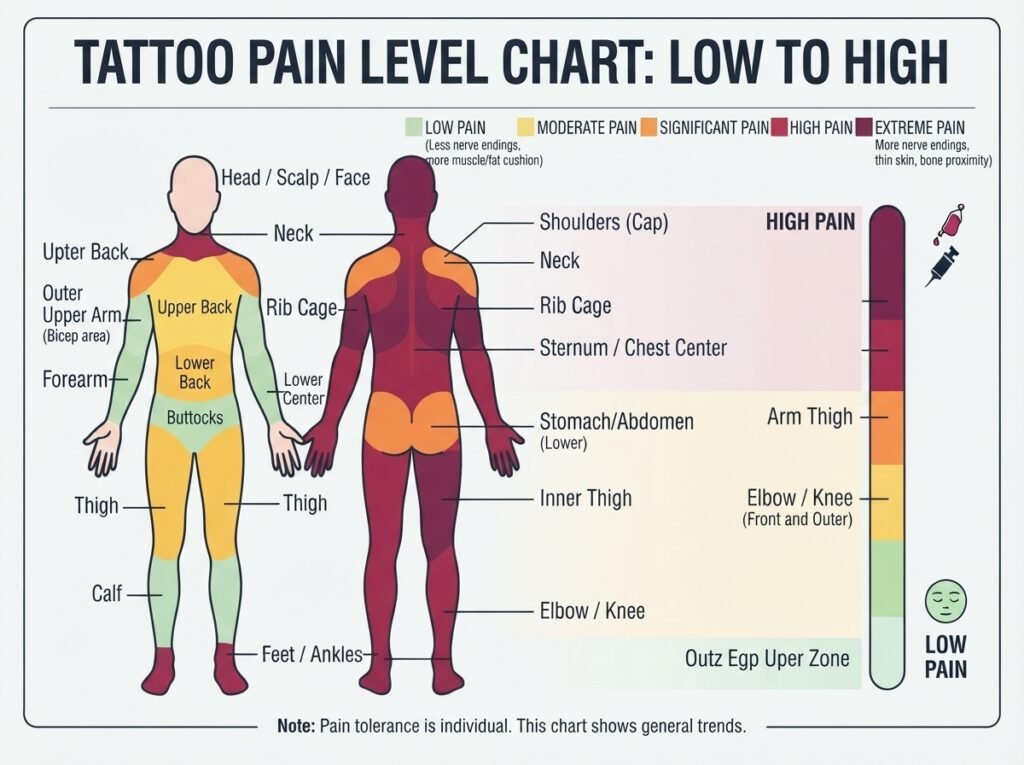
Pain is subjective, but tattoo artists and long-time collectors generally agree on a rough pattern: areas with more fat and muscle padding (outer arm, calf, outer thigh) tend to hurt less, while areas closer to bone, joints, or thin skin (ribs, spine, ankle, elbow) tend to hurt more. For a devil or angel tattoo specifically, a forearm sleeve is usually more comfortable than a back piece that crosses the spine, simply because the spine has almost no cushioning.
Aftercare That Actually Matters
The American Academy of Dermatology recommends a water-based moisturizer instead of a petroleum-based one, since petroleum products can pull ink and dull the tattoo’s color as it heals. Their other core guidance: keep the tattoo out of direct sun and away from tanning beds while it heals, don’t re-bandage it after removing the initial dressing, and clean it daily with lukewarm water and a fragrance-free, alcohol-free soap (American Academy of Dermatology, aad.org).
Here’s a stat that surprises most people: only seven US states currently require tattoo studios to provide aftercare instructions with content approved by a state health department, while thirty states require some form of verbal or written instructions without mandating the specific content (Gonzalez, Walkosz & Dellavalle, The Journal of Clinical and Aesthetic Dermatology, 2020). In plain terms, the quality of the aftercare sheet you get handed at the shop varies a lot depending on where you live, so it’s worth cross-checking whatever your artist gives you against the AAD’s public guidance.
Pro Tip: Buy your fragrance-free moisturizer and soap before your appointment, not after. Showing up to a pharmacy with an open, healing tattoo and no plan is how a lot of people end up grabbing whatever’s on the shelf, including products with fragrance or petroleum that can actively work against healing.
Is a Devil or Angel Tattoo Right for You?
Let’s be honest about the tradeoffs, since almost nothing else covering this topic actually does.
The Real Numbers on Regret and Satisfaction
The data here is genuinely mixed, and presenting only the most dramatic number would be misleading. Ipsos found that 92% of Americans with a tattoo say they’re happy with it (Ipsos, 2019), and separately, an AARP survey found tattooed adults are overwhelmingly open to getting another one, with 51% extremely likely and another 25% somewhat likely to do so (AARP, 2025). On the other hand, a 2025 CivicScience poll of more than 12,000 people found 40% of tattooed respondents regret at least one of their tattoos, though 60% said they regret none at all, and regret skewed noticeably higher among younger women (CivicScience, via Polls & Insights, 2025). Different survey, different sample, different year, genuinely different number. That’s not a contradiction so much as a reminder that “regret” depends heavily on who’s answering and when.
ZapyBeauty Editorial Snapshot: While researching this guide, we looked across dozens of publicly shared devil and angel tattoo examples on tattoo idea platforms and social tags. This isn’t a formal study, just an informal pattern check, but two things stood out consistently: half-and-half single-figure designs and separate matching cherub pairs came up far more often than full battle-scene compositions, and forearm and sleeve placements appeared noticeably more often than compact spots like the wrist or ankle. Take it as a directional read on current preference, not hard data.
The Honest Tradeoffs
- Visibility and workplace norms. Society’s acceptance of tattoos has grown substantially, but a large sleeve or anything on the neck or hands is still a real consideration in more conservative industries. A back piece or upper-arm placement sidesteps this almost entirely.
- Permanence and removal difficulty. Larger, more detailed pieces (which this theme often becomes) are genuinely harder and more expensive to remove or significantly modify later than a small, simple design.
- Symbolic sensitivity. Devil imagery specifically can read very differently depending on someone’s personal or religious background. If you’re getting this in a visible spot, it’s worth thinking about how it might land with family, coworkers, or your own future self, separate from whether you personally find it meaningful.
- Cost creep on large pieces. Sleeves and back pieces are billed across multiple sessions, and it’s genuinely common for a project’s final cost to land higher than the first quoted estimate once additional detail gets added along the way.
- Ongoing upkeep. Color, especially red and yellow tones common in devil imagery, tends to fade faster under UV exposure than black work does. Budgeting for an occasional color-refresh session down the line, on top of the original cost, keeps a bold design looking the way it did on day one.
None of that means don’t get it. It means go in with your eyes open, which is really the whole point of this section.
Devil or Angel Tattoo Comparison: Top Options at a Glance (2026)
| Option | Key Feature | Best For | Price | Rating (Commitment Level, 1 to 5) |
|---|---|---|---|---|
| Small Wrist or Ankle Accent | Tiny angel wing or horn outline | First-timers, subtle symbolism | $50 to $250 | 1 (Lowest commitment) |
| Rib or Chest Placement | Private, easily hidden placement | Personal meaning kept off-display | $400 to $1,500 | 2 |
| Forearm Half-and-Half | Vertical split figure, clearly visible | Bold everyday statement | $300 to $800 | 3 |
| Quarter or Half Sleeve | Layered scene with supporting elements | Story-driven design lovers | $800 to $2,500 | 3 |
| Full Sleeve | Complete narrative composition | Serious collectors and big-picture thinkers | $1,500 to $6,000+ | 4 |
| Full Back Piece | Large-scale battle or duality scene | Maximum canvas, statement art | $2,000 to $10,000+ | 5 (Highest commitment) |
Ratings reflect ZapyBeauty’s editorial Commitment Score, a 1 to 5 scale weighing cost, session count, and healing time. They’re not aggregated customer reviews.
Our pick: For most first-time buyers of this concept, the forearm half-and-half hits the best balance. It’s visible enough to feel like a real statement, small enough to stay inside a single session’s pain and cost range, and it’s the exact format both search demand and our own pattern check above suggest people gravitate toward most.
FAQ
What does a devil or angel tattoo mean? A devil or angel tattoo represents the pull between good and bad impulses, restraint and rebellion, or simply the different sides of one person’s personality. The exact meaning shifts based on how the design is split, styled, and placed, but the core idea across nearly every version is honesty about containing more than one side.
How does a half angel half devil tattoo meaning differ from a fallen angel tattoo? A half angel half devil design presents both sides as equally present and unresolved, while a fallen angel tattoo usually tells a single-direction story, an angel who has already fallen from grace. One is about ongoing duality; the other is about a completed transformation.
Why is it called a good vs evil tattoo? It’s called that because the angel and devil imagery are stand-ins for virtue and vice in general, not necessarily literal religious figures. The label describes the visual concept (two opposing forces in one composition), not a claim about the wearer’s actual morality.
What’s the best way to design a devil or angel tattoo sleeve so both sides feel balanced? The best way is to plan the transition point before the outline goes down, usually somewhere around the elbow, and to use a visual bridge element, like smoke turning to light or feathers turning to scales, so the two halves feel connected rather than slapped together. Working with one artist for the whole sleeve, rather than combining pieces from two different artists, also keeps the linework and shading style consistent across both halves.
Is a devil or angel tattoo worth it if I’m not religious? Yes, for most people who choose it. The overwhelming majority of wearers use the imagery as a symbol for personality and inner conflict rather than literal religious belief, and satisfaction data on tattoos broadly is high (92% report being happy with their tattoo, per Ipsos, 2019) regardless of the wearer’s religious background.
How much does a devil or angel tattoo cost? Costs range from about $50 for a small wrist or ankle accent up to $10,000 or more for a fully detailed back piece, with most mid-size pieces like a forearm design or quarter sleeve landing between $300 and $2,500 depending on style and detail level.
What are the best devil or angel tattoo design ideas for a first-timer? A small, single cherub with one wing and one horn, a forearm half-and-half split figure, or two matching separate cherubs (one angel, one devil) are all strong first-timer options because they’re lower-cost, faster to complete, and easier to place somewhere you can cover for work if needed.
How does a devil or angel tattoo compare to a plain angel wings tattoo? A plain angel wings tattoo focuses purely on the protective, guardian side of the symbolism, while a devil or angel tattoo intentionally adds tension and duality by including the opposing imagery. Someone who wants a purely positive, protective symbol without any “dark side” element is usually better served by a wings-only design.
What’s the best way to figure out if I should get an angel devil tattoo back piece or something smaller? The best way is to honestly weigh your budget, pain tolerance, and how visible you want the piece to be day to day, using a framework like the S.O.U.L. Check above; if any one of those factors (cost, pain, visibility) is a hard limit for you, it usually points you toward a smaller placement even if the bigger version looks more impressive in reference photos.
What do I do if my half angel half devil tattoo starts to fade or blur? Book a touch-up consultation with your original artist first, since they already know the exact ink and technique used, and most reputable studios offer touch-ups within the first year at reduced cost or free. If detail loss is significant, especially in fine line or realism styles, ask specifically about a touch-up versus a partial redesign, since heavily faded work sometimes heals better with a slightly reworked design than an exact re-trace of the original lines.
Conclusion
A devil or angel tattoo isn’t really about picking a side. It’s about being honest that you don’t have to. The half-and-half version says that most directly, but even a single angel or devil piece, chosen with the S.O.U.L. Check and placed with real thought about cost and visibility, gets at the same idea.
Three things actually matter here: get clear on your specific “why” before you talk to an artist, match your style and placement choice to your real budget and pain tolerance rather than a Pinterest board, and treat aftercare as seriously as the design itself, since the data shows a real gap between the aftercare advice you might get handed at the shop and the standard dermatologists actually recommend.
Next steps you can take in the next 10 minutes:
- Place yourself on the Halo-Horn Spectrum and write down which style from the comparison table fits your budget
- Save two or three healed-tattoo photos (not just fresh ink) in the style you’re leaning toward, to bring to a consultation
- Read our full guide to angel tattoo symbolism and meaning -> /angel-tattoo-symbolism-and-meaning/] for more on the angel half of this design before you book
Author Bio
References
-
Pew Research Center, “32% of Americans have a tattoo, including 22% who have more than one,” 2023
-
Ipsos, “More Americans Have Tattoos Today than Seven Years Ago,” 2019
-
CivicScience, tattoo regret poll (12,000+ respondents), reported via Polls & Insights, 2025
-
AARP, “Adult Opinions on and Acceptance of Tattoos and Other Body Art,” 2025
-
American Academy of Dermatology, “Tattoos and Piercings,” aad.org
-
Airtasker, “How Much Do Tattoos Cost in the US in 2025?,” 2025
-
Removery, “2024 Tattoo Cost: Your Guide to Average Tattoo Prices,” 2024