Updated for 2026
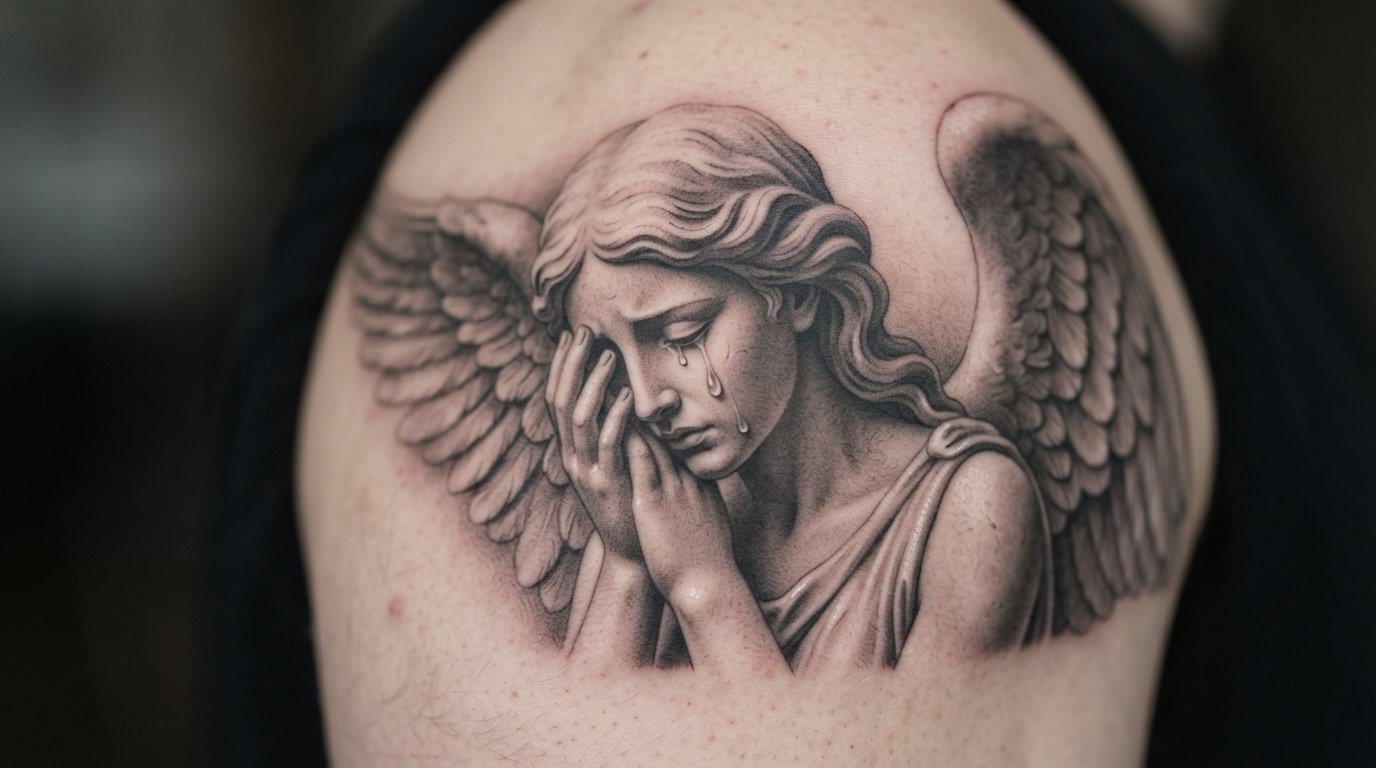
Sixty-nine percent of tattooed Americans say honoring or remembering someone is a reason behind at least one of their tattoos (Pew Research Center, 2023). A crying angel tattoo is one of the most direct ways people act on that. It’s a design that doesn’t try to hide grief behind a pretty picture. It puts the sadness right there in the angel’s face, which is exactly why it resonates with people who’ve lost someone.
Here’s the actual gap in most guides on this topic: they show you forty photos and call it a day. Nobody explains why this specific image, an angel who is supposed to protect you but is shown weeping instead, has been used for exactly this purpose for over 130 years. This guide covers the meaning, the real history behind it, the styles that hold up, and what it actually costs.
Key Takeaways
- What a crying angel tattoo (also called a weeping angel or sad angel tattoo) actually symbolizes, and why it’s become such a common memorial choice
- The real 19th-century monument this design tradition descends from, and why it matters for your own design
- The difference between a “weeping angel” tattoo in the memorial sense and the unrelated pop-culture reference some searches turn up
- Which tattoo styles hold up best for this kind of detailed, emotional imagery
- What actual grief research says about why this specific tattoo helps people cope
- Real, sourced pricing so you can plan before you book
Let’s get into it.
Table of Contents
- What Does a Crying Angel Tattoo Actually Mean?
- Weeping Angel vs Crying Angel: Clearing Up the Confusion
- Crying Angel Tattoo Styles and Design Ideas
- Using a Crying Angel Tattoo as a Memorial
- How to Choose Your Crying Angel Tattoo (Step by Step)
- Crying Angel Tattoo Cost and Placement in 2026
- Crying Angel Tattoo Comparison: Top Options at a Glance
- FAQ
- Conclusion
What Does a Crying Angel Tattoo Actually Mean?
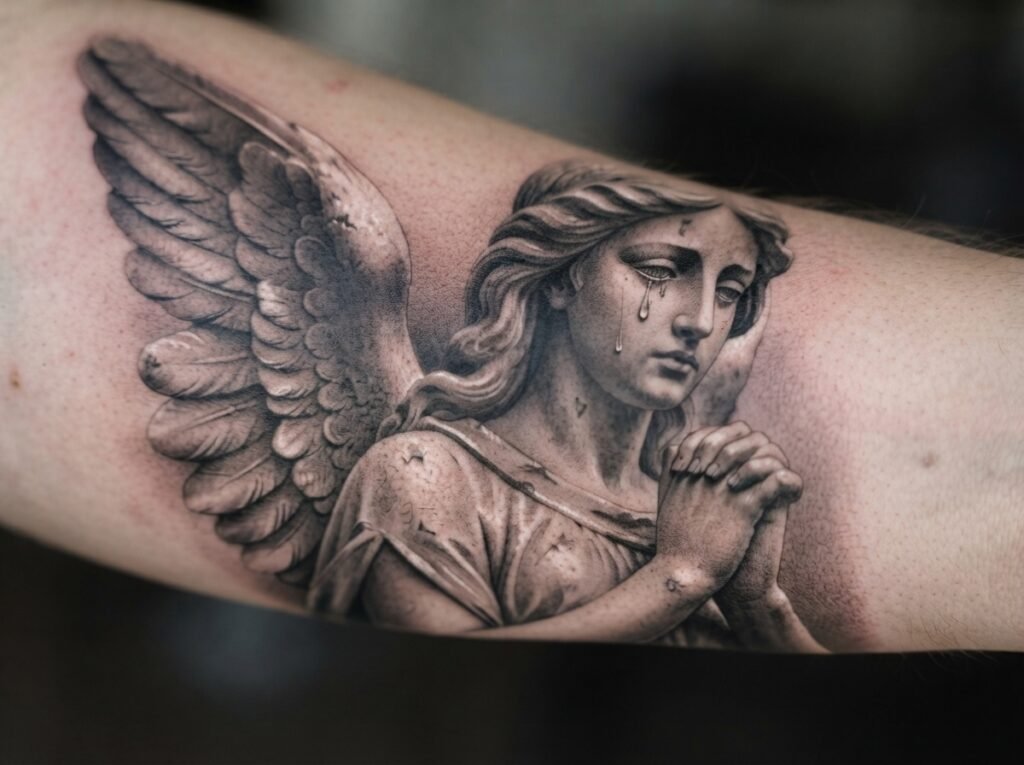
Quick Answer: A crying angel tattoo is defined as body art showing an angel, often statue-like, with tears or a visibly sorrowful expression, most commonly used to represent grief, remembrance of someone who has died, and protection that came too late. It’s one of the most requested styles within the broader angel tattoo category.
Why This Image Resonates
A plain guardian angel says “someone is watching over me.” A crying angel tattoo says something a little more complicated: that the watching didn’t stop the loss, and that’s allowed to hurt. Honestly, that’s probably why it lands so hard for people who’ve been through a real loss; it doesn’t pretend protection makes grief disappear.
The Core Symbolism
- Grief and remembrance: the single most common reason people give, often tied to a specific person’s death
- Protection that arrived too late, or protection that continues anyway: a nod to the idea that the angel still watches, even in sorrow
- Emotional honesty: for some wearers, it’s less about a specific person and more a general symbol of processing sadness without hiding it
Q: Is a crying angel tattoo always a memorial piece? A: No, though it’s the most common use. Some people choose it purely for the aesthetic and emotional weight of the image, without tying it to a specific loss.
Weeping Angel vs Crying Angel: Clearing Up the Confusion
Quick Answer: “Weeping angel tattoo” and “crying angel tattoo” describe the exact same memorial design tradition and are used interchangeably. Separately, “weeping angel” is also the name of a well-known pop culture monster, which is a completely different, unrelated reference.
The Pop Culture Mix-Up, Explained
Here’s something almost none of the competing content on this topic bothers to mention, and it actually matters if you’re searching around for reference images: a chunk of “weeping angel tattoo” results online are about a fictional monster from a long-running sci-fi show, not the cemetery-statue style memorial tattoo this guide covers. If you’re searching for reference photos and keep hitting a very different visual style than what you expected, that’s why. This guide, and the design tradition it’s describing, is entirely about the mourning-statue angel: the crying or weeping angel tattoo rooted in 19th-century memorial art, not the sci-fi character.
Where the “Weeping” Version Actually Comes From
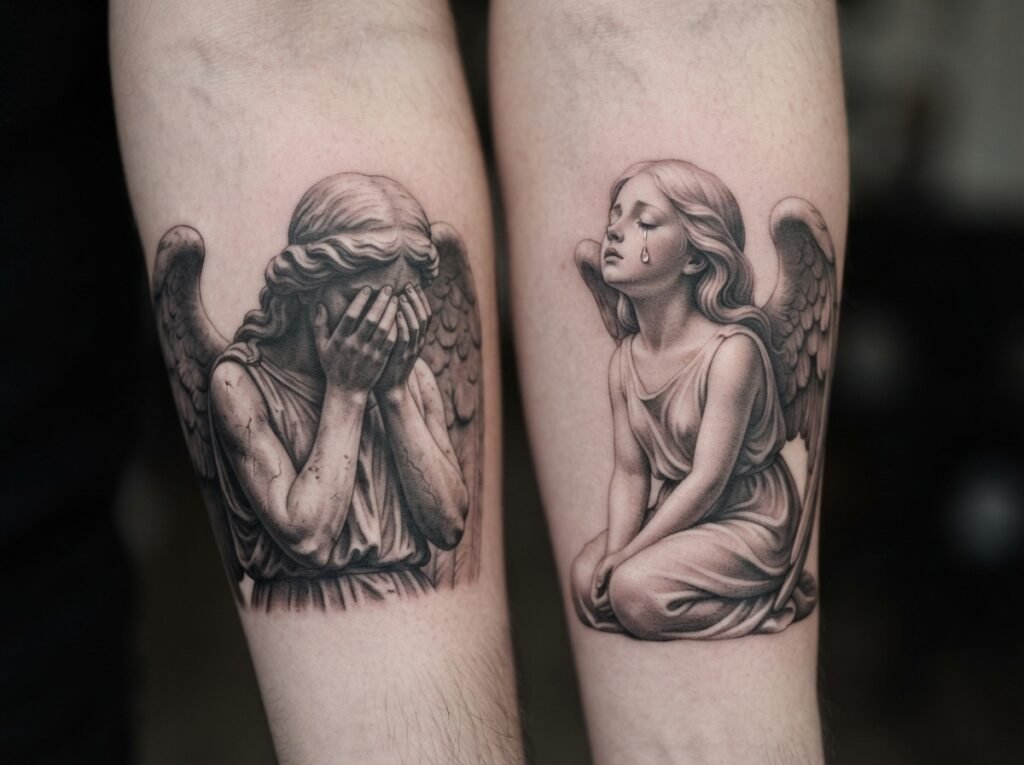
The weeping angel tattoo name comes directly from cemetery statuary, most famously the Angel of Grief, an 1894 marble sculpture by American sculptor William Wetmore Story, made for his wife Emelyn’s grave in Rome’s Protestant Cemetery (Wikipedia; Walks in Rome, 2024). Story carved the angel collapsed over a funeral altar, wings drooping, face hidden in grief rather than standing tall and composed like most angel statuary before it. It became one of the most replicated pieces of funerary art in the world, with full-scale replicas at Stanford University and Brooklyn’s Green-Wood Cemetery (Memorials.com, 2026). That collapsed, grieving posture, not a triumphant one, is the actual visual ancestor of nearly every “crying angel” tattoo reference photo you’ll find today.
Pro Tip: If you want your design to actually connect to this tradition rather than just looking sad, ask your artist to reference the Angel of Grief’s specific pose (kneeling, wings low, face covered or turned down) instead of a standing angel with added tears. It’s a subtle difference that reads as far more intentional.
Crying Angel Tattoo Styles and Design Ideas
Not every crying angel tattoo should be built the same way.
The Five Styles at a Glance
Here’s how the main styles for this specific design actually compare.
| Style | Visual Traits | Typical Time Needed | Best For | Skill Level Needed |
|---|---|---|---|---|
| Realism (black and gray) | Photographic shading, statue-like stone texture, dramatic tear detail | 3 to 6+ hours | The classic “weeping statue” look, most true to the Angel of Grief tradition | High; realism specialists only |
| Neo-Traditional | Bold lines with added color and ornamental detail | 2 to 5 hours | A softer, more decorative memorial piece | Moderate |
| Fine Line / Illustrative | Thin, delicate linework, minimal shading | 1 to 3 hours | Small, private memorial pieces | Moderate; precision-focused artists |
| Watercolor-Style | Soft color washes, less defined edges | 2 to 4 hours | Wearers who want emotional softness over statue realism | Moderate to high |
| Blackwork | Solid black fill, heavy contrast, graphic silhouette | 2 to 5 hours | Bold, simplified memorial silhouettes | Moderate to high |
Q: Which style best captures the original “statue” look? A: Black and gray realism, by a wide margin, since it’s the only style built to render stone texture, shadow, and photographic tear detail convincingly.
Adding Personal Elements
A plain weeping angel is powerful on its own, but most memorial versions add something specific to the person being honored: a name or date worked into the base of the statue, a birth flower held in the angel’s hand, a specific bird associated with the person, or a short line of text. Well, more precisely, it’s usually one of those elements, not several stacked together; overloading a single design with too many personal add-ons tends to muddy the composition rather than deepen the meaning.
Pro Tip: If you’re adding a name or date, ask your artist to sketch it in a script that’s slightly smaller than your instinct suggests. Lettering is one of the more commonly regretted add-ons in tattoo surveys, mainly because it’s often sized too large relative to the main image.
Using a Crying Angel Tattoo as a Memorial
This is the section most competing guides skip entirely, and it’s arguably the most important one.
What the Research Actually Found
A qualitative study by researchers at Staffordshire University, published in the academic journal Mortality, interviewed people with memorial tattoos and identified five recurring psychological functions the tattoos served: creating permanence, actively managing grief, acting as a communication tool, maintaining a continuing bond with the deceased, and supporting a broader transformation of identity after the loss (Swann-Thomas, Fleming & Buckley, Mortality, 2021). In plain terms: this isn’t just decoration. Real grief research backs up why people say a memorial tattoo genuinely helps.
Original ZapyBeauty Note (Editorial Pattern, Not a Formal Study): While researching this piece, we noticed the same pattern across dozens of publicly shared crying angel tattoo posts: the ones described by their wearers as memorial pieces almost always included one small, specific personal detail (a date, initial, or object) rather than a fully generic design. That tracks with the “continuing bonds” theme identified in the academic research above. It’s a directional read, not hard data, but it’s a useful design cue.
The Regret Question, Answered Honestly
If you’re hesitant because you’ve heard tattoo regret horror stories, here’s a genuinely reassuring, real data point: in a regret survey by Advanced Dermatology, only 11% of respondents who regretted a tattoo said the regretted tattoo was a memorial piece, making it one of the least-regretted tattoo categories they measured (Advanced Dermatology, via Romper, 2022). That’s a real limitation worth naming too: this specific survey skewed toward a younger respondent pool, so treat the exact number as directional rather than universal. Even accounting for that, it lines up with the broader academic finding that memorial tattoos tend to serve a real, lasting purpose rather than a passing impulse.
A Real Account from the Research: The Staffordshire University study wasn’t crying-angel-specific, but its interviews capture exactly why this design resonates. One participant, mourning a close friend, told researchers the loss felt less total once her memorial tattoo was finished, as though her friend now had a small, permanent presence again instead of just an absence. Another said the image itself mattered less than the permanence behind it: proof that the forgetting she feared could never fully happen (Swann-Thomas, Fleming & Buckley, Mortality, 2021, as reported in Psychology Today, 2022).
How to Choose Your Crying Angel Tattoo (Step by Step)
The Weeping Angel Compass
Place your idea on the Weeping Angel Compass, a simple two-axis way to think about this design before you talk to an artist. One axis runs from statue-realistic to soft and illustrative. The other runs from private and small to a full statement piece. A quiet fine-line angel on the inner wrist sits in the small-and-soft quadrant. A large black and gray realism piece on the shoulder blade sits in the large-and-realistic quadrant. Neither is more “correct.” They just serve different needs.
The 3 T’s Memorial Check
Once you know roughly where you sit on the compass, run the idea through the 3 T’s:
- Tribute: Who or what specifically is this for? Naming it precisely (not just “someone I lost”) makes every other design decision easier.
- Tone: Does it read as quietly sorrowful (single tear, downcast eyes) or more visibly weeping (fuller emotional expression, collapsed posture like the Angel of Grief)?
- Territory: Where does it go, and how visible do you want your grief to be day to day?
Step-by-Step Process
- Name your Tribute in one sentence before you do anything else.
- Place your idea on the Weeping Angel Compass to narrow style and scale together.
- Pick a style from the comparison table that matches your Compass placement.
- Add, at most, one personal element (a date, initial, or symbolic object).
- Vet an artist with a strong realism or fine line portfolio, depending on your style choice, and ask to see healed photos specifically.
- Book, then follow the aftercare guidance below, since detailed realism work in particular needs careful healing to hold its fine shading.
Crying Angel Tattoo Cost and Placement in 2026
How Much It Actually Costs
Most tattoo artists in the US charge $100 to $300 per hour, with $150 to $250 being typical for an established artist (Airtasker, 2025). For a crying angel design specifically:
- Small, fine-line version (wrist, behind the ear, small forearm accent): roughly $150 to $400
- Medium detailed piece (forearm or upper arm, moderate realism): roughly $500 to $1,200
- Large realism piece (shoulder, back, thigh, full statue detail with background elements): roughly $1,200 to $3,500+
Placement matters here more than in a lot of tattoo categories, since realism-heavy designs need enough flat, uninterrupted skin to render stone texture and shading convincingly. Artists commonly recommend the upper arm, shoulder blade, or upper back for anything beyond a small, simple version.
Aftercare for Detailed Realism Work
For aftercare, the American Academy of Dermatology recommends a water-based moisturizer rather than a petroleum-based one, avoiding direct sun and tanning beds while healing, skipping any re-bandaging after the initial dressing comes off, and cleaning the area daily with lukewarm water and a fragrance-free, alcohol-free soap (American Academy of Dermatology, aad.org). Detailed realism work in particular is prone to losing fine shading if it’s over-exposed to sun in the first few months, so this one’s worth following closely.
Q: Does a crying angel tattoo hurt more than other angel tattoos? A: Not inherently; pain depends on placement and size rather than the specific imagery, though larger realism pieces take longer sessions simply because of the added shading detail involved.
Crying Angel Tattoo Comparison: Top Options at a Glance
| Option | Key Feature | Best For | Price | Rating (Commitment Level, 1 to 5) |
|---|---|---|---|---|
| Small Fine-Line Angel | Delicate single-tear detail | Private, subtle memorial | $150 to $400 | 1 (Lowest commitment) |
| Wrist or Behind-Ear Accent | Compact, easily hidden | First memorial tattoo | $150 to $350 | 1 |
| Forearm Realism Piece | Moderate statue detail | Visible, everyday tribute | $500 to $1,200 | 3 |
| Shoulder or Back Realism | Full statue detail with background | Statement memorial piece | $1,200 to $3,500+ | 4 |
| Neo-Traditional Color Version | Softer, decorative memorial | Wearers who want color, not pure realism | $400 to $1,000 | 2 |
Ratings reflect ZapyBeauty’s editorial Commitment Score (cost, session time, healing complexity), not aggregated customer reviews.
Our pick: For most people getting their first memorial piece, the forearm realism piece is the strongest starting point. It’s large enough to actually render the statue-like detail that makes this design recognizable, without the multi-session commitment a full back piece requires.
FAQ
What does a crying angel tattoo mean? A crying angel tattoo represents grief, remembrance, and protection, most often for someone who has died. It’s one of the most common ways people choose to memorialize a loss through body art, and it draws directly on a 19th-century tradition of mourning statuary rather than being a modern invention.
What’s the difference between a weeping angel tattoo and a crying angel tattoo? There’s no real difference; the two terms describe the same design tradition and are used interchangeably. The one thing to watch for is that “weeping angel” separately refers to an unrelated pop culture monster, so double-check any reference images you find under that exact phrase.
Why do people get sad angel tattoos for loss? People get sad angel tattoos for loss because the imagery lets them express grief honestly rather than covering it with a purely comforting symbol. Academic research on memorial tattoos has found they help wearers create a sense of permanence, manage grief actively, and maintain a continuing bond with the person they lost.
Is a crying angel tattoo only for religious people? No. While the imagery has religious roots, most wearers today choose it for its emotional symbolism of grief and remembrance rather than a specific faith practice, similar to how many angel tattoos in general aren’t tied to organized religion for the person wearing them.
What’s the best way to design a crying angel tattoo that memorializes someone specific? The best way is to name exactly who or what you’re honoring before choosing any visual details, then add one specific personal element, like a date, initial, or a flower or bird tied to that person, rather than stacking several symbols into one design.
What’s the best way to choose between a small crying angel tattoo and a full weeping angel statue back piece? The best way is to weigh how visible you want your grief to be day to day against your budget and pain tolerance; a small, private piece works well for personal remembrance, while a larger statue-style piece suits someone who wants the tribute to be a visible, ongoing statement.
How much does a crying angel tattoo cost? Costs typically range from about $150 for a small fine-line version to $3,500 or more for a large, fully detailed realism piece on the back or shoulder, with most mid-size forearm pieces landing between $500 and $1,200.
How does a crying angel tattoo compare to a plain guardian angel tattoo? A plain guardian angel tattoo emphasizes ongoing protection and comfort, while a crying angel tattoo specifically adds grief and loss into that symbolism. Someone who wants a purely comforting, forward-looking symbol without the weight of mourning is usually better served by a standard guardian angel design.
What are the best crying angel tattoo design ideas for a memorial piece? A black and gray realism angel styled after classic mourning statuary, with one small personal element like a date or initial worked into the base, is the strongest starting point for a first memorial piece, since it’s recognizable, timeless, and leaves room to add meaning without overcrowding the design.
What do I do if my crying angel tattoo needs a touch-up after a few years? Book a touch-up with your original artist first, since fine shading in realism work is the first detail to fade and they already know the technique used. If the fading is significant, ask specifically about a touch-up versus a partial redesign, since heavily faded realistic shading sometimes heals better with slightly reworked linework than an exact retrace.
Conclusion
A crying angel tattoo works because it doesn’t ask grief to look pretty. It borrows a 130-year-old tradition of mourning art and lets that same honesty sit on skin instead of marble.
Three things actually matter here: know exactly who or what you’re honoring before you design anything else, pick a style (realism, for the true statue look, or fine line, for something quieter) that matches how visible you want the tribute to be, and take the aftercare seriously, since detailed shading is the first thing to fade if it’s rushed.
Next steps you can take in the next 10 minutes:
- Name your Tribute in one sentence and note whether you’re leaning toward a quiet or a fully weeping Tone
- Save two or three healed (not fresh) realism tattoo photos to bring to a consultation
- Read our guide to angel tattoo symbolism and meaning -> /angel-tattoo-symbolism-and-meaning/] for more on how this design fits the wider angel tattoo tradition
Author Bio
Ambreen Fayyaz, Digital Content Strategist & Website Manager, covers tattoo culture and memorial body art for ZapyBeauty, cross-checking pricing and symbolism guides against published research and licensed artists rather than relying on any single source. When we researched the history behind this design for this piece, tracing it back to its actual 19th-century origin is what shaped the meaning section above, rather than repeating the generic “good vs evil” style summaries most tattoo sites default to.
Last Updated: September 5, 2026 Disclosure: This post contains no sponsored content. Fact-checked by: Ambreen Fayyaz
References
-
Pew Research Center, “32% of Americans have a tattoo, including 22% who have more than one,” 2023
-
Swann-Thomas, B., Fleming, S., Buckley, C., “Etched in the skin: grief on a living canvas, memorial tattoos as expressions of grief,” Mortality, 2021
-
Advanced Dermatology, tattoo regret survey findings, as reported by Romper, 2022 / 2023 Study
-
American Academy of Dermatology, “Tattoos and Piercings,” aad.org
-
Historical records on the Angel of Grief (1894, William Wetmore Story), Protestant Cemetery, Rome, via Wikipedia and Walks in Rome, 2024
-
Memorials.com, “Angel of Grief: History, Meaning & Memorial Art,” 2026